


Search results
Search for "hydroxylation" in Full Text gives 129 result(s) in Beilstein Journal of Organic Chemistry.
Gold-catalyzed heterocyclizations in alkynyl- and allenyl-β-lactams
Beilstein J. Org. Chem. 2011, 7, 622–630, doi:10.3762/bjoc.7.73
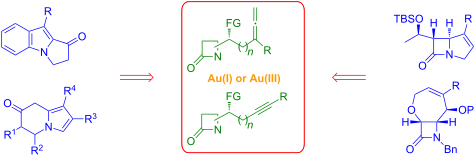
- oxycyclization/hydroxylation of 2-azetidinone-tethered alkynols for the synthesis of non-fused, spiro, and fused oxabicyclic β-lactams has been reported [65]. Attempts at a cyclization reaction of terminal alkynols using gold catalysts failed. However, under the appropriate reaction conditions was found that
- AuCl3 could be a good catalyst for the cycloetherification reaction of non-terminal alkynols 22. Scheme 12 shows that tetrahydrofuryl hemiacetals 23 are accessible as single isomers in fair yields via the gold-catalyzed tandem oxycyclization/hydroxylation reaction of 2-azetidinone-tethered
- scope of these transformations, gold-catalyzed heterocyclization reactions of alkynols to the fused bicyclic systems was also examined. Indeed, treatment of 2-azetidinone-tethered bishomopropargylic alcohol 26 with AuCl3 provided the desired cycloetherification/hydroxylation product 27a in good yield



Synthesis of a new class of aminocyclitol analogues with the conduramine D-2 configuration
Beilstein J. Org. Chem. 2010, 6, No. 15, doi:10.3762/bjoc.6.15
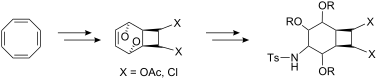
- acetic anhydride/CH3COONa [35] (Scheme 3). Careful examination of the reaction mixture did not reveal the formation of the other isomer. The stereochemical course of the hydroxylation may be syn or anti with respect to the oxazolidinone and cyclobutane rings. NMR spectroscopic studies did not allow the
- assignment of the exact orientation of the hydroxyl groups. X-ray analysis of 18 (Figure 1) revealed the exact configuration of the compound. This also confirms the configurations of endoperoxide 10, oxazolidinone 13 and cis-hydroxylation product 17. The all cis-configuration of the four acetate and amino
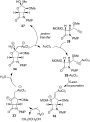
- ionization (Scheme 5). Hydrolysis of oxazolidinone 23 with K2CO3 gave alcohol 26, which was subsequently converted into acetate 27 by treatment with Ac2O/NaOAc [35] (Scheme 6). cis-Hydroxylation of 27 with OsO4 at 0°C gave the corresponding diol 28, which was further converted into triacetate 7 with Ac2O


End game strategies towards the total synthesis of vibsanin E, 3-hydroxyvibsanin E, furanovibsanin A, and 3-O-methylfuranovibsanin A
Beilstein J. Org. Chem. 2008, 4, No. 34, doi:10.3762/bjoc.4.34
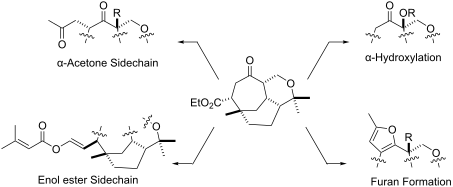
- sidechain and corresponding α-oxo functionality depicted in Scheme 2. Essentially four areas were identified for study; 1) regio- and stereospecific α-hydroxylation (methoxylation) 19, 2) furan formation i.e. 20, 3) installing the acetone sidechain i.e. 21, and 4) building the enol ester function i.e. 22
- (Scheme 2). The results of each area of investigation allow end game strategies to be postulated based on combinations of these results. For example, success with α-hydroxylation (methoxylation) 19 could flow into furan formation (i.e. 20), installing the acetone sidechain i.e. 21, or building the enol
- cleavage. Nevertheless, the acetone sidechain could be introduced in ~20% overall yield allowing end game functionalisation (as discussed below). α-Hydroxylation was next investigated. Considering the observed preference for regiospecific enolate formation in our system we devised a simple two pot


Sordarin, an antifungal agent with a unique mode of action
Beilstein J. Org. Chem. 2008, 4, No. 31, doi:10.3762/bjoc.4.31
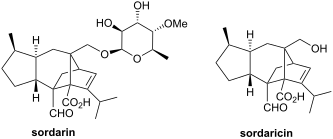
- protection of the alcohol, MoO5-mediated hydroxylation of the enolate of the ester [22] and ensuing dehydration by SOCl2 (Scheme 2). The sequence utilized for the introduction of the dienophilic subunit in 13 is outlined in Scheme 3. The primary alcohol was deprotected (TBAF) and oxidized to an aldehyde


Other Beilstein-Institut Open Science Activities



