


Search results
Search for "microwave-assisted" in Full Text gives 153 result(s) in Beilstein Journal of Organic Chemistry.
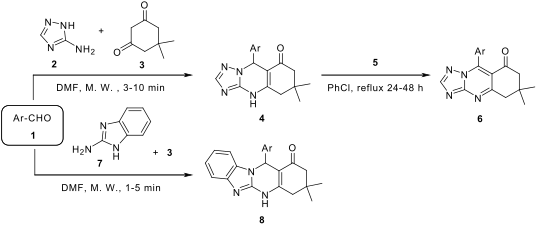
Microwave assisted synthesis of triazoloquinazolinones and benzimidazoquinazolinones
Beilstein J. Org. Chem. 2007, 3, No. 11, doi:10.1186/1860-5397-3-11


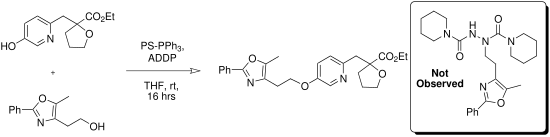
ADDP and PS-PPh3: an efficient Mitsunobu protocol for the preparation of pyridine ether PPAR agonists
Beilstein J. Org. Chem. 2006, 2, No. 21, doi:10.1186/1860-5397-2-21
- esters, we then sought an expedient method for obtaining the final carboxylic acids. We opted for a microwave-assisted procedure for this basic hydrolysis step. As shown in Scheme 3, the carboxylic acids (e.g. 25) could be obtained in a matter of minutes [see Supporting Information File 1 and Supporting


Microwave- assisted ring closure reactions: Synthesis of 8-substituted xanthine derivatives and related pyrimido- and diazepinopurinediones
Beilstein J. Org. Chem. 2006, 2, No. 20, doi:10.1186/1860-5397-2-20
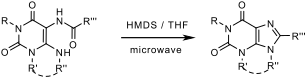
- high yield by microwave-assisted ring closure reaction. Results and Discussion A key step in the classical synthetic route towards xanthines is the ring closure of the imidazole ring [15]. An improved ring closure method leading to 8-unsubstituted xanthines by microwave-assisted ring closure reaction
- poor mixing. Microwave-assisted synthesis has been extensively applied in the field of heterocyclic chemistry, especially when high temperatures are needed for ring formation with conventional heating [24]. Based on these findings the preparation of 8-substituted xanthine derivatives and related
- solution or suspension of the starting compounds in a mixture of HMDS and tetrahydrofuran. The addition of THF as a co-solvent proved to be crucial. Yields were generally improved by the new method. The new microwave-assisted cyclization procedure allowed the preparation of a previously unaccessible 2


Other Beilstein-Institut Open Science Activities



