


Search results
Search for "catalyzed" in Full Text gives 1870 result(s) in Beilstein Journal of Organic Chemistry. Showing first 200.
Transition-metal-free synthesis of arylboronates via thermal generation of aryl radicals from triarylbismuthines in air
Beilstein J. Org. Chem. 2024, 20, 2577–2584, doi:10.3762/bjoc.20.216
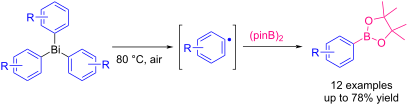
- variety of transition-metal-catalyzed reactions and photoredox reactions using arylboronates as aryl sources have been energetically investigated for the construction of carbon–carbon or carbon–heteroatom bonds [12][13][14][15]. The preparation of arylboronates often requires pre-functionalized substrates
- with halogen or triflate groups. Recently, transition-metal-catalyzed direct borylation of arenes via C–H bond activation has been reported, although the design of the substrate and ligands is somewhat complicated [16][17][18][19][20][21][22]. Since the complete removal of catalyst-derived metal
- diborons can capture the in situ-generated carbon-centered radicals [28][29][30][31][32][33][34][35][36]. Among the aryl sources in organic synthesis, triarylbismuthines are shelf-stable and easy-to-handle reagents with appropriate reactivities in transition-metal-catalyzed reactions and radical reactions



A review of recent advances in electrochemical and photoelectrochemical late-stage functionalization classified by anodic oxidation, cathodic reduction, and paired electrolysis
Beilstein J. Org. Chem. 2024, 20, 2500–2566, doi:10.3762/bjoc.20.214
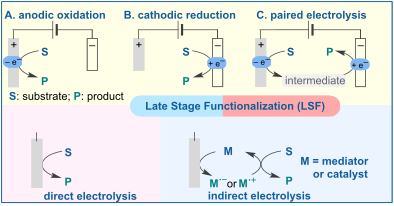
- [3]. Transition-metal-catalyzed LSF strategies have been well-established over the past decades. More recently, with the vigorous development of photochemistry and electrochemistry, numerous innovative reports on LSF using photo-, electro-, and photoelectrochemistry have emerged. These areas have
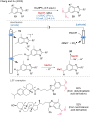
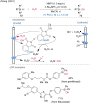
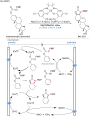
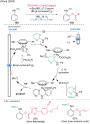
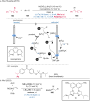
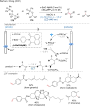
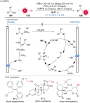
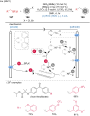
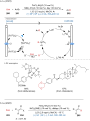
- pharmaceutical drugs and natural products. We classify these advancements into three types: anodic oxidation, cathodic reduction, and paired electrolysis (Figure 1). This review considers direct electrolysis (oxidation or reduction), mediator-induced electrolysis, and metal-catalyzed and photocatalyzed
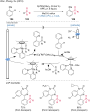
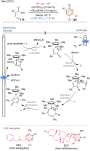
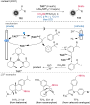
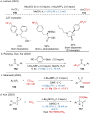
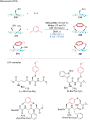
- product (Scheme 15). The synthesis of aziridines can be achieved via the formation of nitrenes in either a metal-catalyzed or metal-free fashion. In this context, Wickens and colleagues presented a remarkable dication pool strategy for accessing N-alkylaziridines via metastable dicationic intermediates


























HFIP as a versatile solvent in resorcin[n]arene synthesis
Beilstein J. Org. Chem. 2024, 20, 2469–2475, doi:10.3762/bjoc.20.211
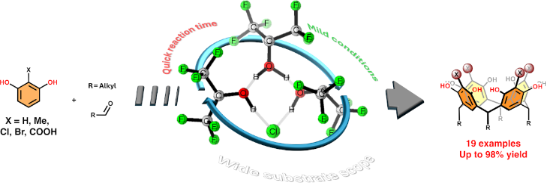
- tolerated. This method leads to a variety of 2-substituted resorcin[n]arenes in a single synthetic step with isolated yields up to 98%. Keywords: cavitand; cyclization; HFIP; hydroxyalkylation; resorcinarenes; Introduction The acid-catalyzed aldehyde-resorcinol condensation has been studied for more than
- molecular recognition [12][46]. Despite extensive research, challenges remain in the acid-catalyzed resorcin[n]arene synthesis, for example: 1) reaction times for simple resorcin[n]arenes starting from aliphatic aldehydes and resorcinol generally require multiple days and up to a week (Scheme 1a) [9][26]; 2


Photoredox-catalyzed intramolecular nucleophilic amidation of alkenes with β-lactams
Beilstein J. Org. Chem. 2024, 20, 2461–2468, doi:10.3762/bjoc.20.210
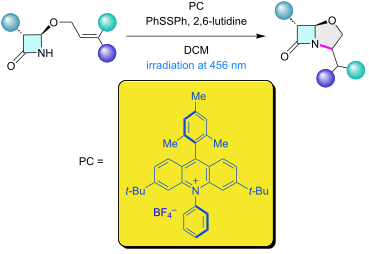
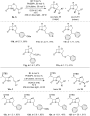
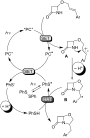
- intramolecular photoredox reaction. Photoredox-catalyzed intramolecular N-alkylation reactions of various β-lactams. The trans/cis dr was determined by 1H NMR analysis of the crude reaction mixture. Synthesis of the model substrate 14 and its photoredox-catalyzed intramolecular N-alkylation reaction. The trans




Hypervalent iodine-mediated cyclization of bishomoallylamides to prolinols
Beilstein J. Org. Chem. 2024, 20, 2455–2460, doi:10.3762/bjoc.20.209
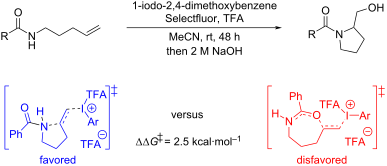
- -catalyzed cyclization of N-allylamides 1 and N-homoallylamides 2 to 2-oxazolines 4 and dihydrooxazines 5, respectively (Scheme 1A) [15]. We also reported that an N-bishomoallylamide 3 (n = 3) was cyclized under the reaction conditions, but in just 30% yield. It turned out that the product of this reaction


Homogeneous continuous flow nitration of O-methylisouronium sulfate and its optimization by kinetic modeling
Beilstein J. Org. Chem. 2024, 20, 2408–2420, doi:10.3762/bjoc.20.205
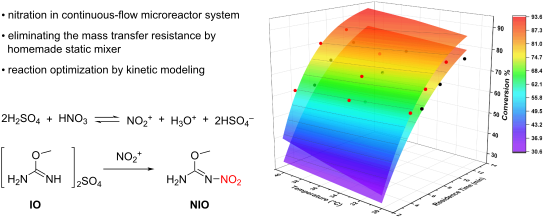
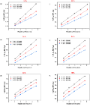
- with increasing H2SO4 mass fraction, which aligns with the findings from previous studies on mixed acid-catalyzed nitration reactions [32][33]. However, the data also reveal a decline in rate constants when the H2SO4 mass fraction exceeds 94%, suggesting a complex interaction at higher acid
- different temperatures are shown in Table 2. The value of k0 increases with increasing temperature and the value of n remains almost constant with temperature, which is consistent with the results reported in previous studies for other mixed acid-catalyzed nitration reactions [17][39]. According to the


![[Graphic 1]](/bjoc/content/inline/1860-5397-20-205-i17.svg?max-width=637&scale=1.18182)


Evaluating the halogen bonding strength of a iodoloisoxazolium(III) salt
Beilstein J. Org. Chem. 2024, 20, 2401–2407, doi:10.3762/bjoc.20.204
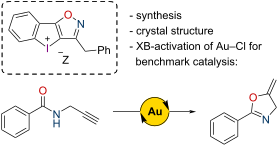
- . Finally, the potential as halogen-bonding activator was benchmarked in solution in the gold-catalyzed cyclization of a propargyl amide. Keywords: diaryliodonium; gold catalysis; halogen bonding; hypervalent iodine; non-covalent interactions; Introduction The compound class of diaryliodonium (DAI) salts
- it with our known iodonium species in the activation of Au(I)–Cl bonds. Results and Discussion As immediate precursor to the target structure 7Z, the literature-known isoxazole 10 was synthesized via a Cu(I)-catalyzed cycloaddition between (2-iodophenyl)acetylene (8) and benzyl nitrile oxide, which
- )AuCl was applied with a catalyst loading of 2 mol %, activated by an equal amount of the DAI salt. Due to solubility issues, the reaction had to be performed in methylene chloride instead of chloroform. The gold-catalyzed cyclization reaction (Scheme 2) was followed via 1H NMR spectroscopy (Figure 3




Synthesis, electrochemical properties, and antioxidant activity of sterically hindered catechols with 1,3,4-oxadiazole, 1,2,4-triazole, thiazole or pyridine fragments
Beilstein J. Org. Chem. 2024, 20, 2378–2391, doi:10.3762/bjoc.20.202
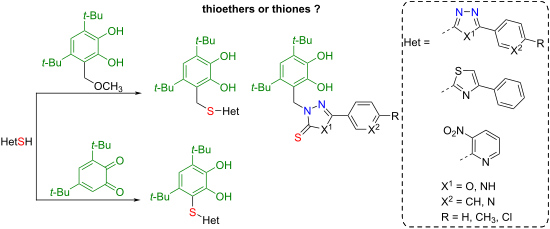
- previously found that the reaction between 3,5-di-tert-butyl-6-methoxymethylcatechol and different functionalized thiols occurs via an acid-catalyzed mechanism and leads to corresponding thioethers with methylene linker [53][54]. Hybrid structures of this type are of particular interest from the point of
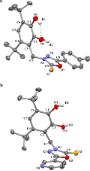
- –80%) (Scheme 1a). The reaction between 3,5-di-tert-butyl-6-methoxymethylcatechol and 2-mercapto-4-phenylthiazole or 3-nitropyridine-2-thiol occurs via an acid-catalyzed mechanism and leads to corresponding thioethers 4, 5 with methylene linker in a good yield (80% and 63%, correspondingly) (Scheme 1b
- with heterocyclic thiols leads to the formation of S-functionalized catechols. In the case of the acid-catalyzed reaction between 3,5-di-tert-butyl-6-methoxymethylcatechol and mercapto-substituted thiazole or pyridine derivatives, catechol−thioethers are formed with an additional methylene bridge




Improved deconvolution of natural products’ protein targets using diagnostic ions from chemical proteomics linkers
Beilstein J. Org. Chem. 2024, 20, 2323–2341, doi:10.3762/bjoc.20.199
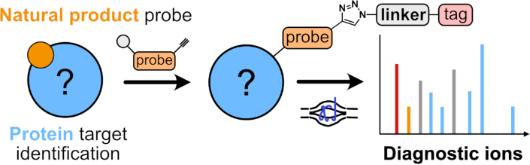
- bearing an affinity or reporter tag. To carry out this bioorthogonal reaction well-known chemistries were developed including traceless Staudinger ligation, Cu-catalyzed azide–alkyne cycloaddition (CuAAC), strain-promoted azide–alkyne cycloaddition (SPAAC), inverse electron-demand Diels–Alder reaction




Stereoselective mechanochemical synthesis of thiomalonate Michael adducts via iminium catalysis by chiral primary amines
Beilstein J. Org. Chem. 2024, 20, 2313–2322, doi:10.3762/bjoc.20.198
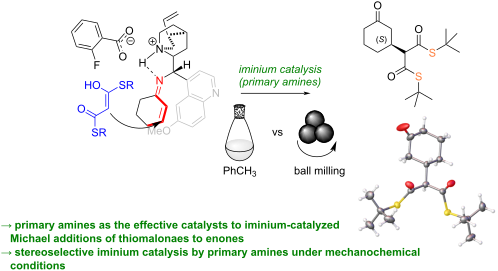
- studies by Bolm [12][13], and Juaristi et al. [14]. have significantly advanced chiral secondary amine-catalyzed stereoselective reactions under ball milling conditions, representing a widely explored activation mode in mechanochemical-mediated transformations. However, reports on chiral primary iminium
- [15][16] or iminium-ion catalysis [17] under ball-mill conditions are scarce, in contrast to the abundance of transformations catalyzed by such covalent catalysis. Among the numerous organocatalytic reactions facilitated by primary amine-based iminium ions, Michael-type additions deserve special
- time of two days under a pressure of 0.8 GPa [23]. Less reactive benzyl malonates, which allow for the cleavage of a free carboxylic group without the need for harsh base- or acid-mediated conditions [24], undergo additions catalyzed by primary amines [19]. However, these transformations are hampered


Deuterated reagents in multicomponent reactions to afford deuterium-labeled products
Beilstein J. Org. Chem. 2024, 20, 2270–2279, doi:10.3762/bjoc.20.195
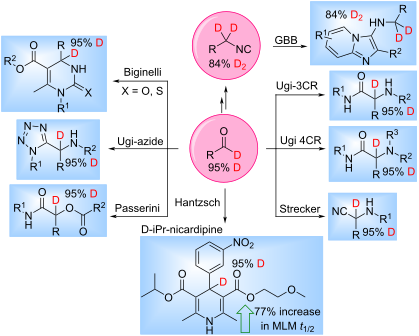
- aldehyde [10]. Latterly, Yamamoto utilized a 90% deuterated [D2]-isocyanide in a copper catalyzed [3 + 2] cycloaddition to afford a 60% deuterated [D2]-pyrrole [11]. The utility of the Leuckart–Wallach reaction towards the generation of isocyanides was first explored by Dömling [12], yet the use of such
- method to prepare [D1]-formamides (D–C=O) is through a Leuckart–Wallach reaction with an amine and [D1]-methyl/ethyl formate or [D1]-dimethylformamide [19][20]. Stockmann and co-workers produced [D2]-formamides (N–D, D–C=O) via acid-catalyzed nitrile hydrolysis with HCl and D2O [21]. Thus, using the


gem-Difluorination of carbon–carbon triple bonds using Brønsted acid/Bu4NBF4 or electrogenerated acid
Beilstein J. Org. Chem. 2024, 20, 2261–2269, doi:10.3762/bjoc.20.194
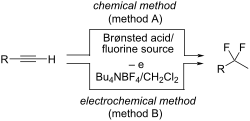
- fluorobenziodoxole, are also utilized as F+ equivalents to introduce fluorine atoms into organic molecules. In addition, various trifluoromethylation reagents have been developed so far [5][6][7][8][9][10][11][12][13][14][15][16][17][18]. Transition-metal-catalyzed fluorination and trifluoromethylation methods have

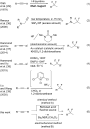


Selective hydrolysis of α-oxo ketene N,S-acetals in water: switchable aqueous synthesis of β-keto thioesters and β-keto amides
Beilstein J. Org. Chem. 2024, 20, 2225–2233, doi:10.3762/bjoc.20.190

- ) [25] or β-keto esters (Scheme 1a, path 4) [26][27], the aldol reaction between aldehydes and S-ethyl acetothioate followed by oxidation with Dess–Martin periodinane (Scheme 1a, path 5) [28], the hydrolysis of α-oxo ketene dithioacetals (Scheme 1a, path 6) [29] and MgBr2·OEt2-catalyzed acylation of



Heterocycle-guided synthesis of m-hetarylanilines via three-component benzannulation
Beilstein J. Org. Chem. 2024, 20, 2208–2216, doi:10.3762/bjoc.20.188
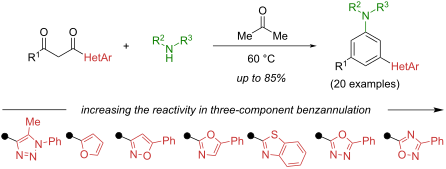
- mainly via metal-catalyzed C–N or C–C bond formation. Despite recent advances in the area of remote C–H functionalization, this strategy still requires some pre-functionalization of the starting material or the use of directing groups [28][29][30][31][32]. An alternative strategy is based on aromatic


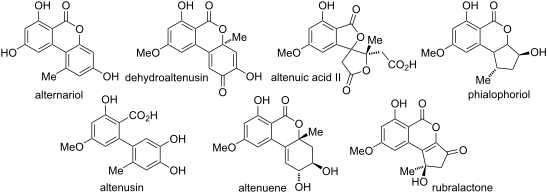
Natural resorcylic lactones derived from alternariol
Beilstein J. Org. Chem. 2024, 20, 2171–2207, doi:10.3762/bjoc.20.187

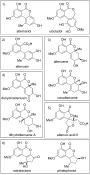
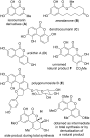


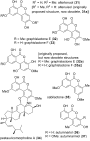

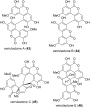


Novel truxene-based dipyrromethanes (DPMs): synthesis, spectroscopic characterization and photophysical properties
Beilstein J. Org. Chem. 2024, 20, 2163–2170, doi:10.3762/bjoc.20.186
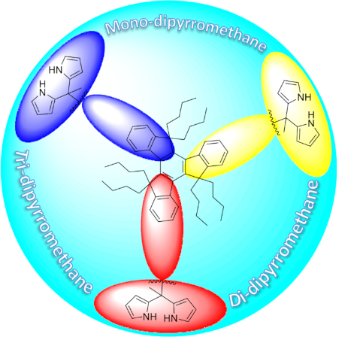
- –80%) along with their preliminary photophysical (absorption, emission and time resolved fluorescence lifetime) properties. The condensation reaction for assembling the required DPMs were catalyzed with trifluoroacetic acid (TFA) at 0 °C to room temperature (rt), and the stable dipyrromethanes were


O,S,Se-containing Biginelli products based on cyclic β-ketosulfone and their postfunctionalization
Beilstein J. Org. Chem. 2024, 20, 2143–2151, doi:10.3762/bjoc.20.184
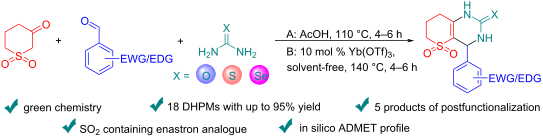
- Biginelli synthesis of dihydropyrimidinones/thiones/selenones via acetic acid or solvent-free Yb(OTf)3-catalyzed tandem reaction of β-ketosulfone (dihydro-2H-thiopyran-3(4H)-one-1,1-dioxide), an appropriate urea, and arylaldehyde has been developed. The reaction proceeds with high chemo- and
- ) are the key methodology to access valuable heterocycles for medicinal chemistry projects. The classical Biginelli reaction (1893) is an acid-catalyzed, three-component reaction between an aldehyde, β-ketoester, and urea that produces 3,4-dihydropyrimidin-2(1H)-ones, also known as DHPMs (Scheme 1A



Efficacy of radical reactions of isocyanides with heteroatom radicals in organic synthesis
Beilstein J. Org. Chem. 2024, 20, 2114–2128, doi:10.3762/bjoc.20.182
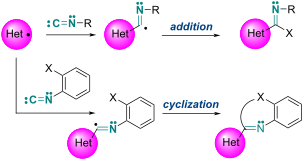
- ), but is also widely used in transition-metal-catalyzed carbonylation reactions [1][2]. However, carbon monoxide is a flammable gas with a wide explosive range, although colorless and odorless, and requires special care in handling due to its high toxicity. In addition, when carbon monoxide is used in a
- phenanthridines via silver-catalyzed radical sulfonylation–cyclization of 2-isocyanobiphenyls (Scheme 25) [98]. Wang et al. reported a radical borylative cyclization of 2-isocyanobiaryls with N-heterocyclic carbene borane (Scheme 26) [99]. The boryl radical generated via hydrogen abstraction in the presence of di


Multicomponent syntheses of pyrazoles via (3 + 2)-cyclocondensation and (3 + 2)-cycloaddition key steps
Beilstein J. Org. Chem. 2024, 20, 2024–2077, doi:10.3762/bjoc.20.178

- is that the reaction with methylhydrazine leads to two different regioisomers. Shen et al. used a concept developed by them for the C-acylation of β-ketoesters for the one-pot synthesis of pyrazoles. SmCl3-catalyzed acylation of these yields the 1,3-diketones 4, and after cyclization with hydrazine
- conducted without solvent. In a similar approach, Khan et al. succeeded in synthesizing pyrazole-4-carbodithioates 67. The products are prepared from phenylhydrazine, aldehydes, and alkyl-3-oxo-3-arylpropane dithioates 66 catalyzed by iron sulfate (Scheme 22) [100]. In this method, aliphatic aldehydes as
- the corresponding pyrazolone derivatives, thereby providing access to both bis(pyrazolyl) and bis(pyrazolonyl)methanes. Enaminones 81 can be generated as intermediates by condensation of 1,3-dicarbonyl compounds and DMF-dimethylacetal (DMFDMA, 79). The reaction is catalyzed by the solvent 2,2,2




Diastereoselective synthesis of highly substituted cyclohexanones and tetrahydrochromene-4-ones via conjugate addition of curcumins to arylidenemalonates
Beilstein J. Org. Chem. 2024, 20, 2016–2023, doi:10.3762/bjoc.20.177
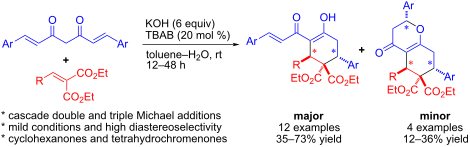
- ]. Other groups have also investigated the Michael donor–acceptor reactivity of curcumins [25]. For instance, a quinine-thiourea catalyzed Michael addition of curcumins to nitroalkenes reported by Ye et al. stopped at the single Michael addition stage [35]. In the subsequent year, Yan et al. demonstrated a


Harnessing the versatility of hydrazones through electrosynthetic oxidative transformations
Beilstein J. Org. Chem. 2024, 20, 1988–2004, doi:10.3762/bjoc.20.175
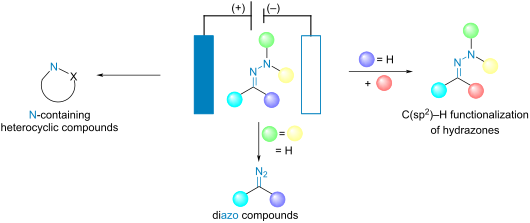
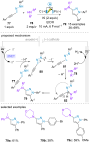
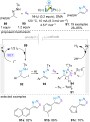
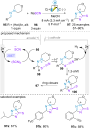
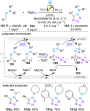
- engaged aromatic aldehyde-derived NH-tosylhydrazones 83 in an iodide-catalyzed electrochemical formal (3 + 2)-cycloaddition with quinolines 84 to build [1,2,4]triazolo[4,3-a]quinoline derivatives 85. Better yields were obtained with hydrazones bearing an electron-rich substituent on the aromatic ring. The



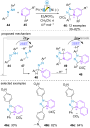
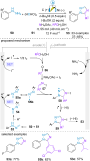
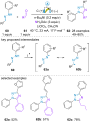


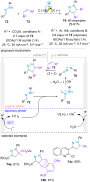




Development of a flow photochemical process for a π-Lewis acidic metal-catalyzed cyclization/radical addition sequence: in situ-generated 2-benzopyrylium as photoredox catalyst and reactive intermediate
Beilstein J. Org. Chem. 2024, 20, 1973–1980, doi:10.3762/bjoc.20.173
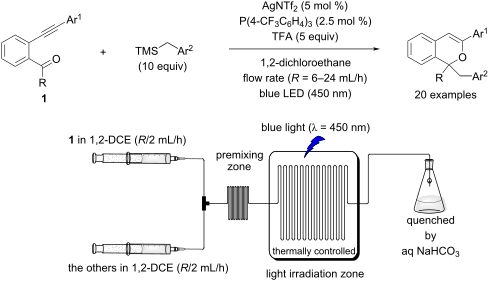
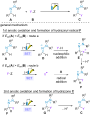
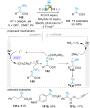
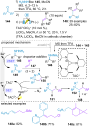
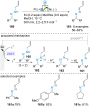
- Abstract A flow photochemical reaction system for a π-Lewis acidic metal-catalyzed cyclization/radical addition sequence was developed, which utilizes in situ-generated 2-benzopyrylium intermediates as the photoredox catalyst and electrophilic substrates. The key 2-benzopyrylium intermediates were
- [26][27][28][29] is increased. Thus, the flow photochemical process is crucial and beneficial to product formation. Recently, we reported a sequential transformation consisting of a π-Lewis acidic metal-catalyzed cyclization [30][31][32][33][34][35][36][37][38][39][40][41][42][43][44][45] and
- improved the yield of 3t (78%), presumably because of the retardation of the desilylation process (from B to C in Scheme 1a). Conclusion We have demonstrated a flow reaction system for a π-Lewis acidic metal-catalyzed cyclization/photochemical radical addition sequence, affording, in most cases, the 1H


1,2-Difluoroethylene (HFO-1132): synthesis and chemistry
Beilstein J. Org. Chem. 2024, 20, 1955–1966, doi:10.3762/bjoc.20.171

- ], respectively, while reference [68] provides UV-spectral data of both isomers. 1H, 19F, and 13C NMR data [69][70] are given in Table 2. Chemistry of HFO-1132 Isomerization Iodine-catalyzed cis–trans isomerization of 1,2-difluoroethylene and corresponding equilibrium measurements were described in the 1960s [47


Negishi-coupling-enabled synthesis of α-heteroaryl-α-amino acid building blocks for DNA-encoded chemical library applications
Beilstein J. Org. Chem. 2024, 20, 1922–1932, doi:10.3762/bjoc.20.168
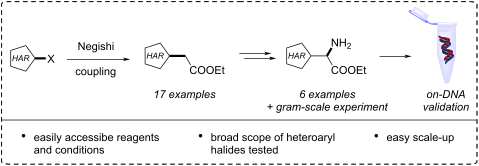
- ][28]. However, the selectivity of these photoredox reactions is driven by the structural properties of the heteroaromatic ring. During the preparation of this article, the Meggers group published an outstanding enantioselective iron-catalyzed α-amination pathway (Scheme 1b) [29]. The method is widely
- the blue region. This complex then accelerates the oxidative addition of the aryl halide to the metal, which is usually the rate-limiting step for palladium-catalyzed cross-couplings. Based on these results we decided to perform all Negishi reactions under blue light irradiation. With the optimized


Access to 2-oxoazetidine-3-carboxylic acid derivatives via thermal microwave-assisted Wolff rearrangement of 3-diazotetramic acids in the presence of nucleophiles
Beilstein J. Org. Chem. 2024, 20, 1894–1899, doi:10.3762/bjoc.20.164

- cyclization [15][16]. Additionally, the manganese(III)-promoted cyclization of N-alkenyl malonamides [17][18] and the Cu(I)-catalyzed reaction of propiolic acid derivatives with nitrones (Kinugasa reaction) [19][20][21] should also be mentioned, as well as intramolecular C–H insertion using





