


Search results
Search for "Apis mellifera" in Full Text gives 2 result(s) in Beilstein Journal of Organic Chemistry.
Synthesis and acaricidal activity against Varroa destructor of α- and γ-costic acid dimers
Beilstein J. Org. Chem. 2026, 22, 1088–1096, doi:10.3762/bjoc.22.87
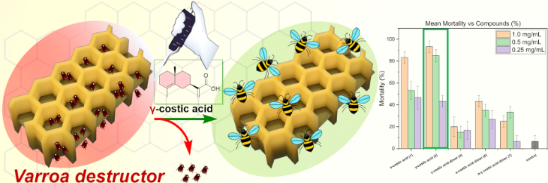
- possessing diverse biological activities. Among these, the most promising property for practical application is its acaricidal activity against Varroa destructor, considered the most important and dangerous parasite of the honeybee (Apis mellifera L.). Infestations of V. destructor can decimate bee
- against Varroa destructor that is considered the most important and dangerous parasite of the honeybee (Apis mellifera L.). V. destructor is able to completely suppress infested honeybee populations within a few years [11][12] with severe economic consequences [13]. A significant acaricidal effect was
- of column chromatography and TLC to afford α-costic acid (1, 455 mg, 1.14 g/kg) as a pale-yellow oil [9]. General procedure for mortality test Adult females of V. destructor were obtained from naturally infested and untreated Italian honeybee (Apis mellifera ligustica) colonies maintained at the


Use of costic acid, a natural extract from Dittrichia viscosa, for the control of Varroa destructor, a parasite of the European honey bee
Beilstein J. Org. Chem. 2017, 13, 952–959, doi:10.3762/bjoc.13.96
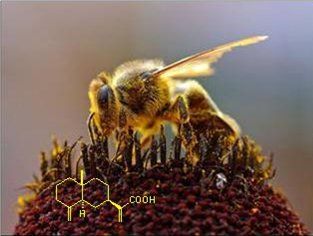
- recent address: Department of Chemistry and Food Chemistry, TU Dresden, 01062, Dresden, Germany 10.3762/bjoc.13.96 Abstract Costic acid has been isolated from the plant Dittrichia viscosa and its efficacy against Varroa destructor, a parasite of Apis mellifera, the European honey bee, has been studied
- efficient agent for controlling varroosis in honey bee colonies. Keywords: Apis mellifera; Dittrichia viscosa; natural products; Varroa destructor; varroosis; Introduction The honey bee ectoparasite Varroa destructor (Anderson & Trueman) was discovered by Oudemans in 1904 [1]. The mite was located on the
- . jacobsoni world-wide, Anderson and Trueman came to the conclusion that the mite belongs to two species: a) Varroa jacobsoni s.s., located in the Malaysia–Indonesia region, infesting Apis cerana F. and b) Varroa destructor, Anderson & Trueman, infesting both, Apis cerana in Asia and Apis mellifera worldwide


Other Beilstein-Institut Open Science Activities



