


Search results
Search for "N-hetarenes" in Full Text gives 1 result(s) in Beilstein Journal of Organic Chemistry.
Synthesis of functionalized, 13-alkyl-substituted coralyne derivatives and investigation of their interactions with duplex and abasic site-containing DNA
Beilstein J. Org. Chem. 2026, 22, 1057–1066, doi:10.3762/bjoc.22.84
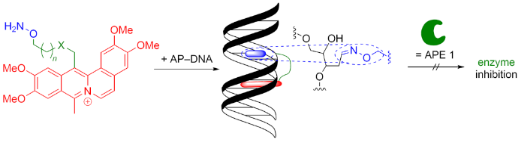
- released from a Boc-protected precursor and that the corresponding coralyne–alkoxyamine conjugate can operate as a ligand for AP-DNA and as inhibitor of enzymatic repair of abasic sites. Keywords: APE1 inhibition; DNA binders; N-hetarenes; papaverine; protoberberines; Introduction DNA is a main target in
- [6][7]. In this context, several classes of polycyclic, nitrogen-containing hetarenes (N-hetarenes) have been shown to bind selectively and with high affinity to DNA [8][9][10][11][12], and, in some cases, to cause photoinduced DNA damage [13][14][15]. As a result, the synthesis and development of
- novel DNA-binding N-hetarenes still constitutes a cornerstone in current drug development and in the search for promising drug candidates. Along these lines, the protoberberines, such as, e.g., berberine (1a), palmatine (1b), or jatrorrhizine (1c) (Figure 1), may be considered as privileged structures


Other Beilstein-Institut Open Science Activities



