


Search results
Search for "Parmotrema tinctorum" in Full Text gives 1 result(s) in Beilstein Journal of Organic Chemistry.
Semisynthesis, characterisation, and antibacterial evaluation of a novel lecanoric acid-derived amide library
Beilstein J. Org. Chem. 2026, 22, 1023–1032, doi:10.3762/bjoc.22.81
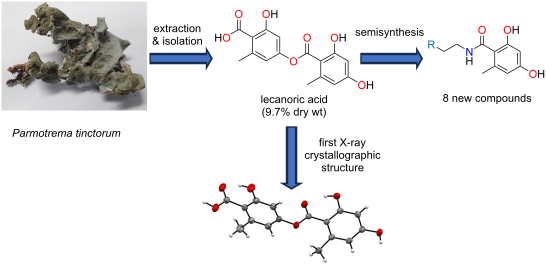
- identified as a scaffold of interest for the generation of a unique semisynthetic biodiscovery screening library. Large-scale extraction and isolation on the Australian-sourced lichen Parmotrema tinctorum resulted in the purification of ≈1 g of the desired scaffold 1, along with other known lichen
- of biofilm (21% at 50 µM). Keywords: amide; biodiscovery; depside; lecanoric acid; natural products; Parmotrema tinctorum; Pseudomonas aeruginosa; semisynthesis; Introduction Lichens are organisms resulting from the symbiotic relationship between a fungus (the mycobiont) and an alga (the photobiont
- products and their semisynthetic derivatives. Owing to the Davis group’s ongoing interest in the semisynthesis of unique and rare biodiscovery screening libraries based on Australian natural products [10][11][12][13][14], a locally collected lichen, Parmotrema tinctorum, was selected for chemical


Other Beilstein-Institut Open Science Activities



