


Search results
Search for "aromatic macrocycle" in Full Text gives 2 result(s) in Beilstein Journal of Organic Chemistry.
Research progress on calixarene/pillararene-based controlled drug release systems
- Liu-Huan Yi,
- Jian Qin,
- Si-Ran Lu,
- Liu-Pan Yang,
- Li-Li Wang and
- Huan Yao
Beilstein J. Org. Chem. 2025, 21, 1757–1785, doi:10.3762/bjoc.21.139
- of controlled-release technologies, with the aim of offering a reference for the utilization of aromatic macrocycles in drug-controlled release applications. Keywords: aromatic macrocycle; controlled-release drug delivery systems; stimulus response; supramolecular chemistry; Introduction Drugs are

Graphical Abstract

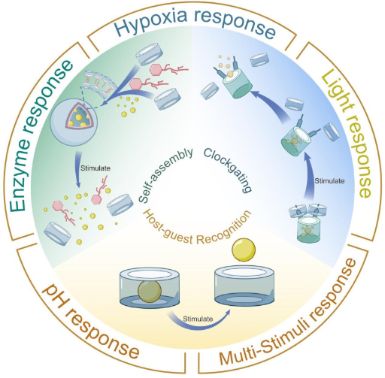
Figure 1: Schematic diagram of drug-controlled release mechanisms based on aromatic macrocycles.

Figure 2: Chemical structure of a) calix[n]arene (m = 1,3,5), and b) pillar[n]arene (m = 1,2,3).

Figure 3: Changes in pH conditions cause the release of drugs from CA8 host–guest complexes [101]. Figure 3 was adapted wi...

Figure 4: The illustration of the pH-mediated 1:1 complex formation between the host and guest molecules in a...

Figure 5: Illustration of the pH-responsive self-assembly of mannose-modified CA4 into micelles and the subse...

Figure 6: Illustration of the assembly of supramolecular prodrug nanoparticles from WP6 and DOX-derived prodr...

Figure 7: Illustration of the formation of supramolecular vesicles and their pH-dependent drug release [93]. Figure 7 was...

Figure 8: Schematic illustration of the application of the multifunctional nanoplatform CyCA@POPD in combined...

Figure 9: Illustration of the photolysis of an amphiphilic assembly via CA-induced aggregation [114]. Figure 9 was reprint...
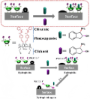
Figure 10: Schematic illustration of drug release controlled by the photo-responsive macroscopic switch based ...

Figure 11: Schematic illustration of the formation process of Azo-SMX and its photoisomerization reaction unde...

Figure 12: Schematic illustration of the enzyme-responsive behavior of supramolecular polymers [95]. Figure 12 was used wit...

Figure 13: Schematic illustration of the amphiphilic assembly of SC4A and its enzyme-responsive applications [119]. ...

Figure 14: Stimuli-responsive nanovalves based on MSNs and choline-SC4A[2]pseudorotaxanes, MSN-C1 with ester-l...

Figure 15: A schematic diagram showing the construction of a supramolecular system by host–guest interaction b...
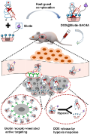
Figure 16: A schematic diagram showing the formation of the host–guest complex DOX@Biotin-SAC4A by biotin modi...

Figure 17: A schematic diagram showing the self-assembly of CA4 into a hypoxia-responsive peptide hydrogel, wh...

Figure 18: Schematic illustration of the formation process of Lip@GluAC4A and the release of Lip under hypoxic...

Figure 19: Schematic illustration of the construction of a supramolecular vesicle based on the host–guest comp...

Figure 20: Schematic illustration of WP6 self-assembly at pH > 7, and the stimulus-responsive drug release beh...

Figure 21: Schematic illustration of the formation of supramolecular vesicles based on the WP5⊃G super-amphiph...

Figure 22: Schematic illustrations of the host–guest recognition of QAP5⊃SXD, the formation of the nanoparticl...

Figure 23: Schematic illustration of the activation of T-SRNs by acid, alkali, or Zn2+ stimuli to regulate the...

Figure 24: Illustration of the triggered release of BH from CP[5]A@MSNs-Q NPs in response to a drop in pH or a...

Figure 25: Illustration of the supramolecular amphiphiles TPENCn@1 (n = 6 and 12) self-assembling with disulfi...
From steroids to aqueous supramolecular chemistry: an autobiographical career review
- Bruce C. Gibb
Beilstein J. Org. Chem. 2016, 12, 684–701, doi:10.3762/bjoc.12.69
- aromatic macrocycle [25]. Interestingly, as these hosts are tetra-acetals we initially tried removing the template under acidic conditions. However, even reflux in 1:1 EtOH/H2SO4 for a week failed to affect the starting material. Evidently, under reversible conditions, a broken acetal can easily reform

Graphical Abstract

Scheme 1: The formation of a 1:1 complex and a 2:1 supramolecular nano-capsule complex from bowl-shaped “cavi...

Scheme 2: Abbreviated synthesis of 7-amino-2-phenyl-6-azaindolizine.

Figure 1: My two favorite compounds for my Ph.D. dissertation, “The Synthesis and Structural Examination of 3...

Scheme 3: An inspiring chlorination from the group of Ronald Breslow.

Scheme 4: The carceplex reaction.
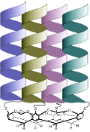
Figure 2: Schematic of a cavitein.

Figure 3: General structure of zinc-TPA complexes.

Scheme 5: Stereoselective bridging of a resorcinarene with benzal halides.

Scheme 6: An eight-fold Ullman ether “weaving” reaction.

Scheme 7: Directed ortho-metallation of the deep-cavity cavitands, showing the mono-endo substituted to tetra-...

Scheme 8: Macrocycle synthesis via resorcinarene covalent templates.

Figure 4: Tris-pyridyl hosts.

Figure 5: (Center) Chemical structure of the octa-acid host. (Left and right) Respective space-filling repres...

Figure 6: Cartoons of the 2:1 host–guest complexes of estradiol (left) and cholesterol (right).

Figure 7: Representative guests for the capsular complexes formed by octa-acid (stoichiometry shown in parent...

Figure 8: A dendrimer-coated cavitand.

Figure 9: Selective oxidation of olefins by singlet oxygen.

Figure 10: a) Preferred packing motifs of methyl, pentyl and octyl guests. b) Product distribution observed fo...

Figure 11: Schematic of the competition of two esters for the capsule formed by octa-acid. The ester that bind...

Figure 12: Schematic of the inter-phase separation of propane and butane; the latter binds more strongly to th...

Figure 13: Structure of tetra-endo-methyl octa-acid (TEMOA).

Figure 14: Assembly properties of TEMOA.

Figure 15: How salts influence the association constant (Ka) for the binding of ClO4– to octa-acid (Figure 4). The ind...



