


Search results
Search for "diffusion mixing" in Full Text gives 2 result(s) in Beilstein Journal of Organic Chemistry.
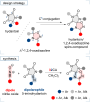
Facile synthesis of hydantoin/1,2,4-oxadiazoline spiro-compounds via 1,3-dipolar cycloaddition of nitrile oxides to 5-iminohydantoins
Beilstein J. Org. Chem. 2025, 21, 1552–1560, doi:10.3762/bjoc.21.118

- -dipoles. These techniques differed in the method of introducing the base necessary for generating the 1,3-dipole into the reaction medium, and included the base addition “drop by drop” or using a diffusion mixing procedure [21]. We found that the formation of spiro-compounds occurs chemo- and
- near or superior to those obtained by diffusion mixing. However, there were three exceptions (5d, 5g and 5h) where we observed a significant difference in the results. The most striking example was compound 5h, which exhibited a yield decrease of more than a third when the diffusion mixing technique
- , was observed for the spiro-compound 5l, which contains a p-nitro group in the aromatic core of the nitrile oxide fragment. This compound was obtained in excellent yield of 93% and 88% using the dropwise and diffusion mixing technique, respectively. This result may be explained by the optimal



Three-component reactions of conjugated dienes, CH acids and formaldehyde under diffusion mixing conditions
Beilstein J. Org. Chem. 2025, 21, 262–269, doi:10.3762/bjoc.21.18
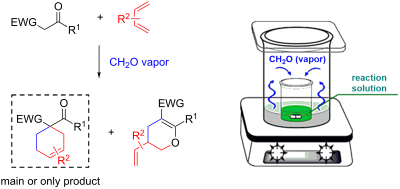
- Dmitry E. Shybanov Maxim E. Kukushkin Eugene V. Babaev Nikolai V. Zyk Elena K. Beloglazkina Department of Chemistry, M. V. Lomonosov Moscow State University, 119991 Moscow, Russian Federation 10.3762/bjoc.21.18 Abstract A diffusion mixing technique with a volatile reagent was successfully used to
- main reaction products. Keywords: aldol condensation; [4 + 2]-cycloaddition; diffusion mixing; formaldehyde; Knoevenagel condensation; three-component reactions; Introduction Formaldehyde is a reactive electrophilic reagent widely used as a C1 building block in multicomponent reactions [1][2][3]. Its
- reactions that proceed through the formation of formaldehyde condensation products (Scheme 1). Previously, we have proposed a convenient diffusion mixing technique for multicomponent reactions based on the absorption of volatile reagent vapors by a mixture containing the remaining reaction components. This


Other Beilstein-Institut Open Science Activities



