


Search results
Search for "indan-2-one" in Full Text gives 4 result(s) in Beilstein Journal of Organic Chemistry.
Symmetrical D–π–A–π–D indanone dyes: a new design for nonlinear optics and cyanide detection
Beilstein J. Org. Chem. 2026, 22, 131–142, doi:10.3762/bjoc.22.6
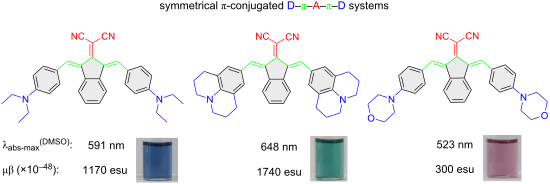
- 10.3762/bjoc.22.6 Abstract Three indan-2-one-based donor–π–acceptor–π–donor type dyes with symmetric donor groups were synthesized and characterized to study their nonlinear optical (NLO) properties and their potential use in the rapid and selective determination of cyanide. The designed structures
- cyanide and the chemosensor is determined by a 1H NMR study and explained by DFT calculations. Keywords: chemosensor; DFT calculations; donor–π–acceptor–π–donor based organic dyes; indan-2-one; NLO; Introduction Over the past decades, the functional heterocyclic push–pull dyes have attracted significant
- can be shifted in the deep red/NIR region by changing the donor group with increased conjugated systems [19][20][21][22]. Gupta et al. studied optical properties of D–π–A system-based indan-2-one derivatives, and symmetric derivatives showed a significant bathochromic shift (≈300 nm) compared to


N-Glycosides of indigo, indirubin, and isoindigo: blue, red, and yellow sugars and their cancerostatic activity
Beilstein J. Org. Chem. 2024, 20, 2840–2869, doi:10.3762/bjoc.20.240
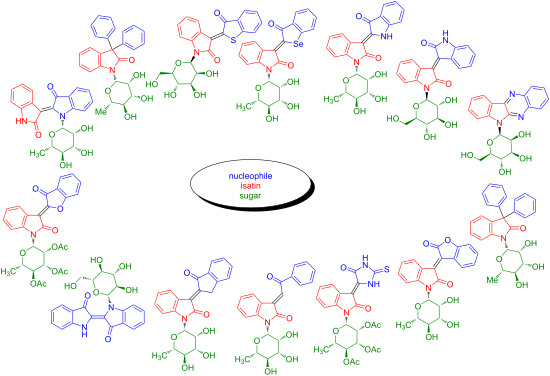
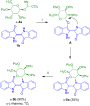
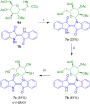
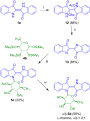
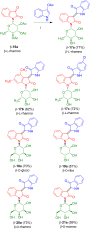
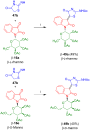
- , due to cleavage of the lactone moiety. Starting from the respective isatin-N-glycosides, N-glucoside β-74b and N-mannoside β-74c were prepared. Carboisoindigo-N-glycosides The condensation of isatin-N-rhamnoside β-16a with indan-2-one (76) afforded carboisoindigo-N-rhamnoside β-77 in 39% yield (Scheme










Attempts to prepare an all-carbon indigoid system
Beilstein J. Org. Chem. 2015, 11, 363–372, doi:10.3762/bjoc.11.42

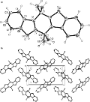
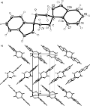
- Braunschweig, Germany, Fax: (+49)531-391-5387 10.3762/bjoc.11.42 Abstract First attempts are described to prepare a precursor for an all-carbon analog of indigo, the tetracyclic triene 4. Starting from indan-2-one (9) the α-methylene ketone 13 was prepared. Upon subjecting this compound to a McMurry coupling







Thermochemistry and photochemistry of spiroketals derived from indan-2-one: Stepwise processes versus coarctate fragmentations
Beilstein J. Org. Chem. 2013, 9, 1668–1676, doi:10.3762/bjoc.9.191
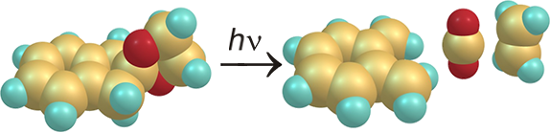
- we investigate the fragmentation reactions of cyclic ketals. Three ketals with different ring sizes derived from indan-2-one were decomposed by photolysis and pyrolysis. Particularly clean is the photolysis of the indan-2-one ketal 1, which gives o-quinodimethane, carbon dioxide and ethylene. The
- ) should be thermochemically activated (Scheme 2) [22]. To test the above hypothesis, we now investigate the thermochemistry and the photochemistry of the ketals 1 and 3, derived from indan-2-one and ethylene glycol, and cis-2-butene-1,4-diol (Scheme 3). The ketal 2, derived from 1,3-propanediol, was
- chosen as a reference system that cannot undergo a coarctate fragmentation. Results Photolysis and pyrolysis of the ketals. Photolysis (λexc = 254 nm, Hg low-pressure lamp) of indan-2-one ethylene ketal (1), matrix-isolated in Ar at 10 K, leads to the formation of CO2 (vs, ν = 2342.1 cm−1), o-xylylene


Other Beilstein-Institut Open Science Activities



