


Search results
Search for "maltose-binding protein (MBP)" in Full Text gives 2 result(s) in Beilstein Journal of Organic Chemistry.
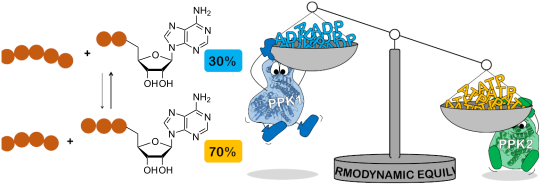
Make or break: the thermodynamic equilibrium of polyphosphate kinase-catalysed reactions
Beilstein J. Org. Chem. 2022, 18, 1278–1288, doi:10.3762/bjoc.18.134
- soluble enzymes and could be easily purified via Ni-NTA affinity chromatography using N-terminal His-tags, the PPK1 enzymes required an N-terminal maltose binding protein (MBP-tag) to improve solubility [46][47]. Trials to cleave the MBP-tag were unsuccessful and resulted in inactive protein aggregates


Synthesis of fluorinated maltose derivatives for monitoring protein interaction by 19F NMR
Beilstein J. Org. Chem. 2012, 8, 448–455, doi:10.3762/bjoc.8.51
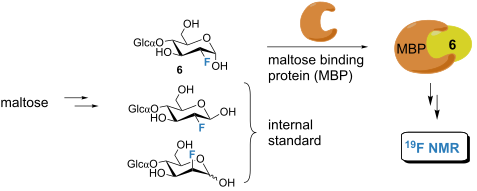
- interactions, is presented. This approach uses 2-F-labeled maltose as a spy ligand to indirectly probe protein–ligand or protein–protein interactions of proteins fused or tagged to the maltose-binding protein (MBP). The key feature is the simultaneous NMR observation of both 19F NMR signals of gluco/manno-type
- studies of protein–ligand interaction interfaces. Keywords: fluorination; 19F NMR; maltose-binding protein (MBP); maltose derivatives; protein interaction; Introduction In recent years, we have witnessed significant improvements in NMR spectroscopy, especially as a powerful tool for studying protein
- rationale for choosing maltose lies in the fact that maltodextrin/maltose-binding protein (MBP) is a generally applicable protein fusion tag with beneficial solution properties and therefore widely used in molecular biology [12][13]. MBP belongs to the family of periplasmic binding proteins, which are


Other Beilstein-Institut Open Science Activities



