


Search results
Search for "pyridine-3,5-dicarbonitrile" in Full Text gives 2 result(s) in Beilstein Journal of Organic Chemistry.
Aromatic systems with two and three pyridine-2,6-dicarbazolyl-3,5-dicarbonitrile fragments as electron-transporting organic semiconductors exhibiting long-lived emissions
Beilstein J. Org. Chem. 2023, 19, 1867–1880, doi:10.3762/bjoc.19.139
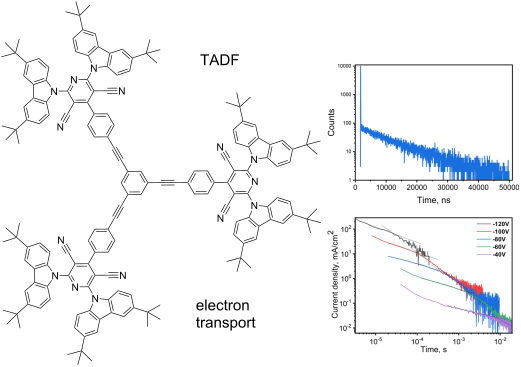
- Organic Synthesis, Aizkraukles 21, LV-1006, Riga, Latvia 10.3762/bjoc.19.139 Abstract The pyridine-3,5-dicarbonitrile moiety has gained significant attention in the field of materials chemistry, particularly in the development of heavy-metal-free pure organic light-emitting diodes (OLEDs). Extensive
- compounds. In general, polyaromatic π-systems with pyridine-3,5-dicarbonitrile fragments demonstrate promising potential for use in organic electronic devices, such as OLEDs. Keywords: charge transport; intramolecular charge transfer; photophysical properties; pyridine-3,5-dicarbonitrile; Introduction The
- pyridine-3,5-dicarbonitrile moiety attracted a great deal of attention in the last decade in the field of materials chemistry, precisely in the development of novel heavy-metal-free pure organic light-emitting diodes (OLEDs). Inexpensive and environmentally friendly emitters are vital for organic


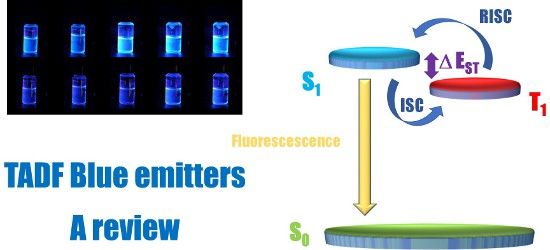
Recent advances on organic blue thermally activated delayed fluorescence (TADF) emitters for organic light-emitting diodes (OLEDs)
Beilstein J. Org. Chem. 2018, 14, 282–308, doi:10.3762/bjoc.14.18
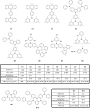
- and an EQE as high as 13% could be maintained at the luminance of 1000 cd·m−2. 6. CN-Substituted pyridine and pyrimidine derivatives In 2015, Liu et al. constructed a novel blue TADF emitter CN-P1 comprising a carbazole donating moiety connected to a pyridine-3,5-dicarbonitrile accepting group (see
- Figure 11) [69]. The choice of pyridine-3,5-dicarbonitrile as acceptor was notably motivated by the outstanding charge-transport ability and the remarkable electrochemical stability of this group [70][71]. Thus, CN-P1 had a small singlet−triplet splitting (ΔEST = 0.04 eV), fairish PLQY in doped films




Other Beilstein-Institut Open Science Activities



