


Search results
Search for "triphenylphosphine monolith" in Full Text gives 2 result(s) in Beilstein Journal of Organic Chemistry.
The application of a monolithic triphenylphosphine reagent for conducting Ramirez gem-dibromoolefination reactions in flow
Beilstein J. Org. Chem. 2013, 9, 1781–1790, doi:10.3762/bjoc.9.207
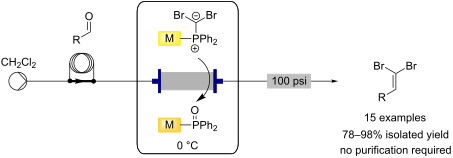
- possible to perform the Appel reaction using the same monolith and the relationship between the mechanisms of the two reactions is discussed. Keywords: bromination; flow chemistry; Ramirez gem-dibromoolefination reaction; solid-supported reagent; triphenylphosphine monolith; Introduction The advantages
- be potential intermediates in the Appel reaction [58][59] and consequently we also wished to investigate the interplay between the two reaction mechanisms. Results and Discussion Formation of the triphenylphosphine monolith The triphenylphosphine monoliths for the Ramirez reactions were formed using
- active brominating agent during the reaction. An alternative mechanistic pathway can ensue if the Appel reaction is performed subsequent to the Ramirez reaction. a. An unfunctionalised triphenylphosphine monolith; b. Monolith after functionalisation with carbon tetrabromide at 0 °C; c. Monolith after


The application of a monolithic triphenylphosphine reagent for conducting Appel reactions in flow microreactors
Beilstein J. Org. Chem. 2011, 7, 1648–1655, doi:10.3762/bjoc.7.194
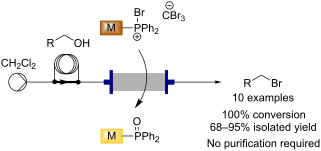
- purification. Keywords: Appel reaction; bromination; flow chemistry; solid-supported reagent; triphenylphosphine monolith; Introduction Flow chemistry is well-established as a useful addition to the toolbox of the modern research chemist, with advantages accrued through increased efficiency, reproducibility
- both the solution or solid-phase reactions (5% with solution-based triphenylphosphine and 18–29% with solid-supported triphenylphosphine), indicating that path B is the major pathway in either case [40][43]. Using a polystyrene-based triphenylphosphine monolith we hoped to benefit from the accelerated
- rate of reaction observed as well as to circumvent problems associated with the use of bead-based immobilised reagents in continuous flow. Results and Discussion Formation of the triphenylphosphine monolith The triphenylphosphine monoliths were formed by precipitation polymerisation of the appropriate


Other Beilstein-Institut Open Science Activities



