


Search results
Search for "ubiquitination" in Full Text gives 5 result(s) in Beilstein Journal of Organic Chemistry.
Site-specific labelling of native peptides and proteins: chemical and enzymatic strategies
Beilstein J. Org. Chem. 2026, 22, 857–881, doi:10.3762/bjoc.22.67
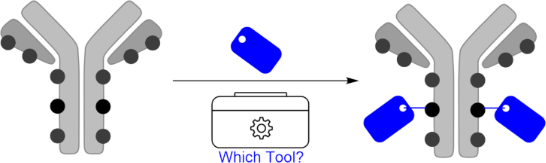
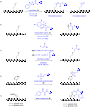
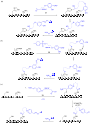
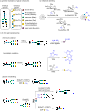
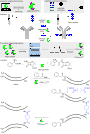
- ) refer to chemical changes to a protein in-cell after it is synthesised by the ribosome, encompassing over 650 types of transformations, including phosphorylation, methylation, acylation, ubiquitination and glycosylation [110]. While numerous naturally occurring PTMs have been repurposed for


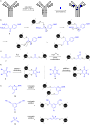
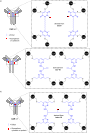


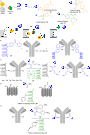




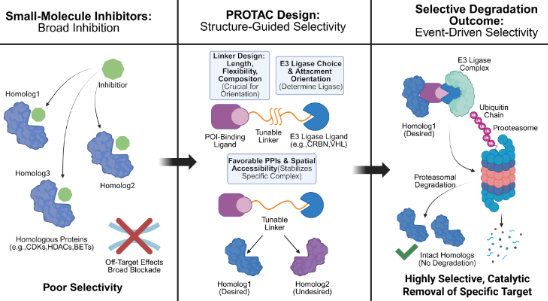
Advantages of PROTACs in achieving selective degradation of homologous protein families
Beilstein J. Org. Chem. 2026, 22, 628–661, doi:10.3762/bjoc.22.49
- ; PROTAC; protein–protein interaction; selectivity; ubiquitination; Introduction The cell is the fundamental unit of structure and function in the human body [1][2]. More than 20,000 proteins act in concert to regulate the entire cellular life process [1]. To date, dysregulated protein function has been
- sufficient to trigger rapid ubiquitination [15][16]. Consequently, a PROTAC operates through an event-driven pharmacological paradigm, distinguishing itself from the traditional occupancy-driven model of small-molecule inhibitors [17]. Furthermore, PROTACs function catalytically, requiring only
- isoform-specific selectivity. Furthermore, we examine the influence of PPIs, a factor increasingly recognized for its critical contribution to the refined selectivity of PROTACs. The review also explores potential selectivity variations arising from the spatial distribution of ubiquitination-accessible


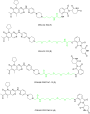

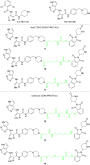






Identification and removal of a cryptic impurity in pomalidomide-PEG based PROTAC
Beilstein J. Org. Chem. 2025, 21, 407–411, doi:10.3762/bjoc.21.28
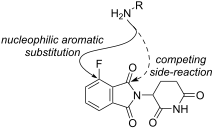
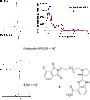
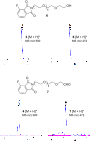
- chimera (PROTAC) has made it a popular starting point to develop selective small-molecule degraders [2]. Currently, leveraging ubiquitination by the von Hippel–Lindau (VHL) protein or cereblon (CRBN) is the most successful method to achieve targeted protein degradation [3][4]. For initial studies, a short




Pyridinoacridine alkaloids of marine origin: NMR and MS spectral data, synthesis, biosynthesis and biological activity
Beilstein J. Org. Chem. 2015, 11, 1667–1699, doi:10.3762/bjoc.11.183
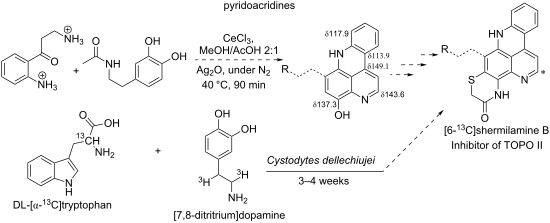
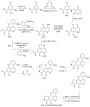
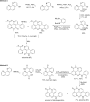
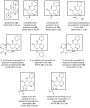
- containing only one of the motifs such as shermilamine B (67) and lissoclinidine B (27) inhibit TOPO II [42][83] or induce apoptosis via other mechanisms like ubiquitination and degradation of p53 by acting on ubiquitin ligase [44]. Conclusion This review compiles up-to-date information on recently










Regulation of integrin and growth factor signaling in biomaterials for osteodifferentiation
Beilstein J. Org. Chem. 2015, 11, 773–783, doi:10.3762/bjoc.11.87
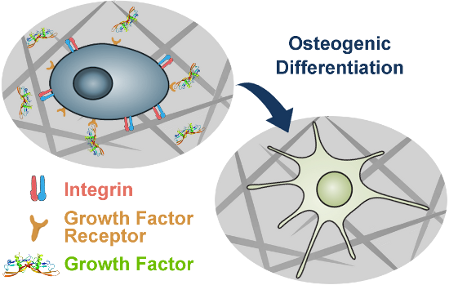
- regulate G-proteins involved in filopodia, lamellipodia, and contraction [7]. Moreover, FAK can directly serve to gene regulation. It can transfer from focal adhesions to the nucleus to target ubiquitination of the cell-cycle mediator p53 and act as a transcription co-regulator with the GATA4 zinc-finger




Other Beilstein-Institut Open Science Activities



