Search results
Search for "carbon materials" in Full Text gives 109 result(s) in Beilstein Journal of Nanotechnology.
Electrochemical determination of ciprofloxacin using a MIL-101/reduced graphene oxide-modified electrode
Beilstein J. Nanotechnol. 2026, 17, 541–554, doi:10.3762/bjnano.17.35
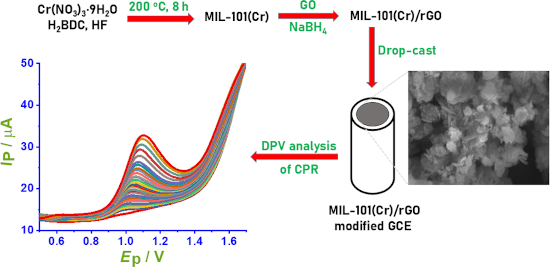
- direct use in electrochemical sensing. To address this limitation, hybridizing MOFs with conductive carbon materials has been extensively studied. Reduced graphene oxide (rGO) is especially appealing due to its high electrical conductivity [12], large specific surface area, mechanical stability [13], and


Upcycling agroindustrial waste into graphene oxide supports for gold nanoparticles: toward sustainable nanomaterials
Beilstein J. Nanotechnol. 2026, 17, 489–504, doi:10.3762/bjnano.17.32
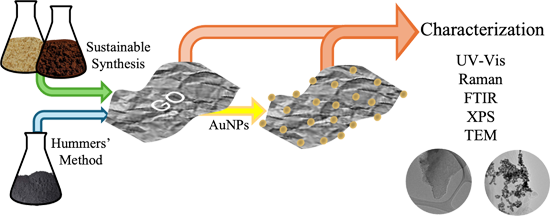
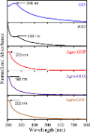
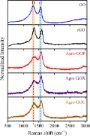
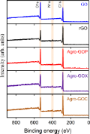
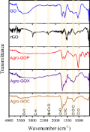
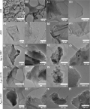
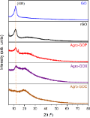
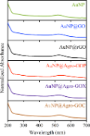
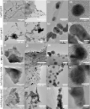
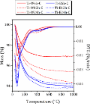
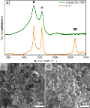
- ) peak, indicating reduced lamellar periodicity and a predominantly disordered structure, matching the results observed in TEM and XPS. TGA curves for the samples are shown in Figure 8, exhibiting a characteristic multistep weight-loss behavior typical of oxygenated carbon materials. An initial mass loss



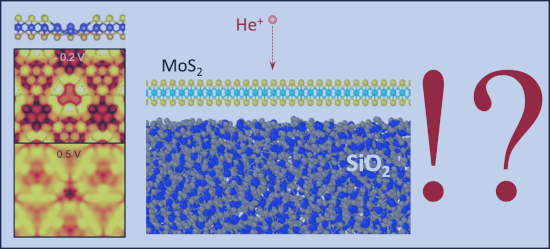
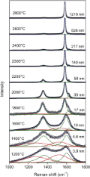
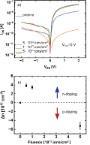
Defects and defect-mediated engineering of two-dimensional materials: challenges and open questions
Beilstein J. Nanotechnol. 2026, 17, 454–488, doi:10.3762/bjnano.17.31





Gold nanoparticle-decorated reduced graphene oxide as a highly effective catalyst for the selective α,β-dehydrogenation of N-alkyl-4-piperidones
Beilstein J. Nanotechnol. 2026, 17, 218–238, doi:10.3762/bjnano.17.15
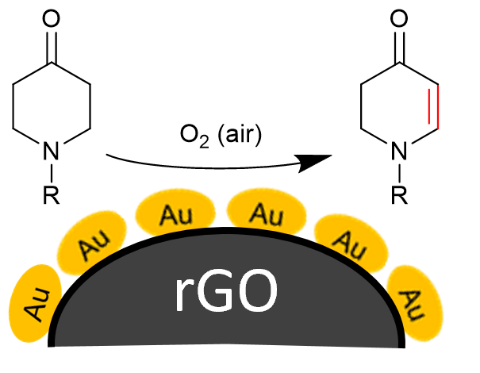
- its reaction product N-methyl-2,3-dihydropyridin-4(1H)-one is highly valuable (>1000 €·g−1) in contrast to the inexpensive starting material (0.15 €·g−1). Various synthesis methods were employed to prepare AuNPs supported on different carbon materials, including reduced graphene oxide (rGO), activated
- size, stabilized by SiW9, and supported on the three-carbon materials AC, rGO, and CB by the RD and DP methods were synthesized as depicted in Figure 1. To assess the influence of the preparation methods and the type of the carbon supports, the catalytic activity was evaluated using the model reaction
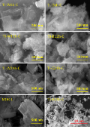
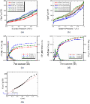
- small particles. The nitrogen sorption isotherms and their hysteresis loops in Figure 3 supplement the SEM analysis of the three carbon materials in terms of specific BET surface area, and pore volume and size. AC features a reversible almost type-I isotherm, given by microporous materials with narrow


Missing links in nanomaterials research impacting productivity and perceptions
Beilstein J. Nanotechnol. 2025, 16, 2168–2176, doi:10.3762/bjnano.16.149
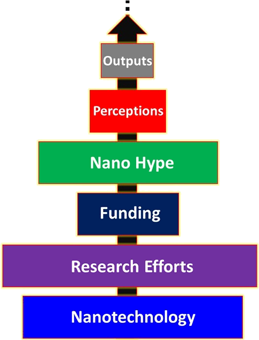
- conventional bulk materials toward advanced nanoscale innovations. Acknowledgements SKT gratefully acknowledges that the conception of this paper was inspired during the Indian Conference on Carbon Materials-2023 (ICCM-2023), held at BARC, Mumbai, where he had the privilege of serving as an invited speaker
Microplastic pollution in Himalayan lakes: assessment, risks, and sustainable remediation strategies
Beilstein J. Nanotechnol. 2025, 16, 2144–2167, doi:10.3762/bjnano.16.148
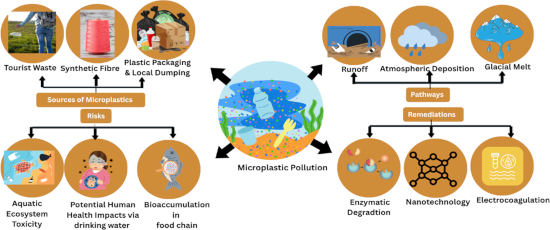
- the most prevalent mechanisms in nanomaterials to eliminate MPs, where metal oxides and carbon materials are particularly effective. Surface modification and environmental factors are crucial in controlling removal. 6.3 Tailoring nanomaterials for low-temperature, high-UV environments The Himalayan


Further insights into the thermodynamics of linear carbon chains for temperatures ranging from 13 to 300 K
Beilstein J. Nanotechnol. 2025, 16, 1818–1825, doi:10.3762/bjnano.16.125
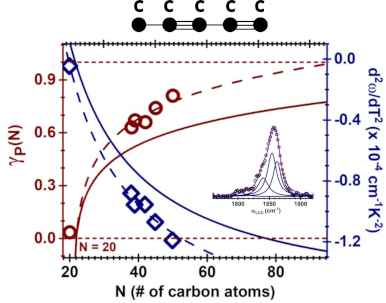
- μm) and lifetimes (≈30–110 ps), which tend to make ph–ph interactions inefficient [31][32]. These mean free paths and lifetimes are considerably larger when compared with other carbon materials [13][31][32][33]. In addition, several other works [29][30][31][32][55][56][57][58][59] have pointed out


![[Graphic 23]](/bjnano/content/inline/2190-4286-16-125-i25.svg?max-width=637&scale=1.18182)
Nanotechnology-based approaches for the removal of microplastics from wastewater: a comprehensive review
Beilstein J. Nanotechnol. 2025, 16, 1607–1632, doi:10.3762/bjnano.16.114
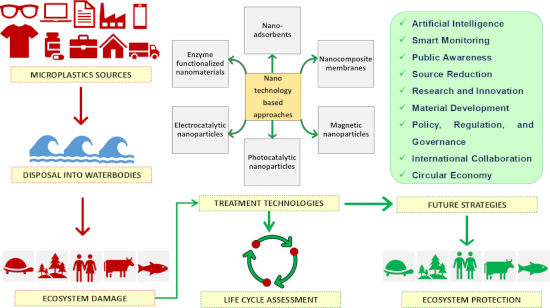
- , adaptability for functionalization and superior sorption capacity. Carbon materials with graphene-like structures, made up of sp2-hybridized carbon atoms, have gained considerable interest for their use in water treatment technologies. Their abundance of functional groups, expansive surface area, and inherent


Dendrimer-modified carbon nanotubes for the removal and recovery of heavy metal ions from water
Beilstein J. Nanotechnol. 2025, 16, 1522–1532, doi:10.3762/bjnano.16.107

- chelation of divalent ions at later stages. In fact, chelation mechanism has been reported in previous studies including PAMAM-functionalized carbon materials [46][47][48]. Moreover, the kinetic study for the adsorption of Pb2+ and Cd2+ metal ions by dendrimerized CNTs-G5 was evaluated using two kinetic


Structural and magnetic properties of microwave-synthesized reduced graphene oxide/VO2/Fe2O3 nanocomposite
Beilstein J. Nanotechnol. 2025, 16, 921–932, doi:10.3762/bjnano.16.70
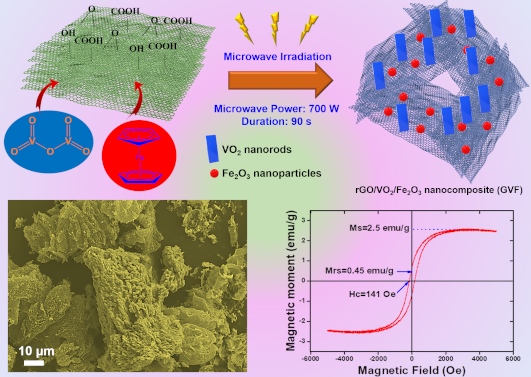
- . Keywords: Fe2O3; magnetism; microwave irradiation; reduced graphene oxide; VO2; Introduction Graphene-based materials have been significantly explored in various fields of materials science due to their unique physical and chemical characteristics [1][2][3][4]. The special arrangement of carbon materials



Recent advances in photothermal nanomaterials for ophthalmic applications
Beilstein J. Nanotechnol. 2025, 16, 195–215, doi:10.3762/bjnano.16.16
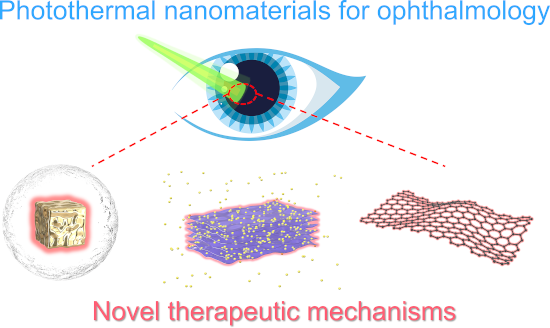
- heat (see below in Figure 2d) [57]. The presence of a high density of loosely bound electrons and the narrow energy level spacing of the π electrons endow carbon materials (such as graphene, carbon nanotubes, carbon quantum dots, and fullerenes) and polymer materials (like polydopamine, polyaniline


TiO2 immobilized on 2D mordenite: effect of hydrolysis conditions on structural, textural, and optical characteristics of the nanocomposites
Beilstein J. Nanotechnol. 2025, 16, 128–140, doi:10.3762/bjnano.16.12
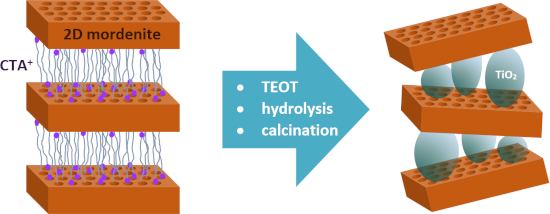
- immobilization of TiO2 nanoparticles is of great importance. Many materials are considered as a possible support for immobilization, including porous ceramics [15], glass [16][17], porous carbon materials [18][19], mesoporous silica [20][21][22][23], and zeolites [24][25][26][27]. Recent studies have confirmed



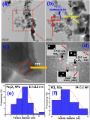
Interface properties of nanostructured carbon-coated biological implants: an overview
Beilstein J. Nanotechnol. 2024, 15, 1041–1053, doi:10.3762/bjnano.15.85
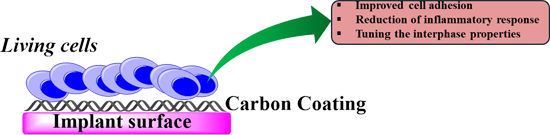
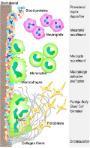
- section, we investigate the effect of carbon-based nanostructured interfaces on the mitigation of adverse effects occurring to biological implants, considering advantages and disadvantages as summarized in Table 1. Nanostructured and nanosized carbon materials: an overview The family of nanostructured
- carbon materials has several members with peculiar properties, namely, (i) graphene-related materials, (ii) CNTs, and (iii) nanodiamonds (NDs) as shown in Figure 2. All nanosized carbon materials show remarkable properties regarding both thermal and electronic conduction, but they should be treated
- carefully to ensure reproducible production protocols. The next section briefly overviews all nanosized carbon materials since a deep understanding of each material is of capital importance for a comprehensive understanding of their applications at biological interfaces. Graphene and graphene-related



Simultaneous electrochemical determination of uric acid and hypoxanthine at a TiO2/graphene quantum dot-modified electrode
Beilstein J. Nanotechnol. 2024, 15, 719–732, doi:10.3762/bjnano.15.60
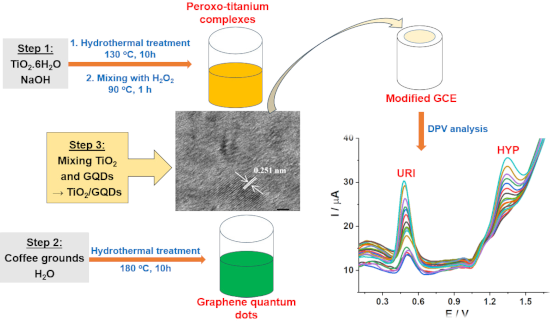
- and food waste) is a renewable resource for the preparation of high-value carbon materials. Among food wastes, coffee grounds are a promising precursor to prepare GQDs with new functionalities regarding a more sustainable materials industry [16]. Considering the fields of catalysis and


Nanoarchitectonics of photothermal materials to enhance the sensitivity of lateral flow assays
Beilstein J. Nanotechnol. 2023, 14, 988–1003, doi:10.3762/bjnano.14.82
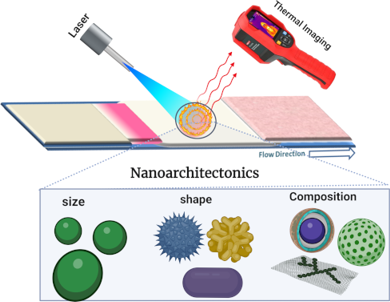
- material [75]. For example, nanocomposite materials have been developed by combining noble metal nanoparticles (Au–Ag, Au–Pt, and Au–Ag–Pt) or hybrids of noble metals, metals, and/or carbon materials (Au–Fe, Au–carbon, and Au–Fe–carbon). The resultant nanocomposites exhibit properties of all constituents


Fragmentation of metal(II) bis(acetylacetonate) complexes induced by slow electrons
Beilstein J. Nanotechnol. 2023, 14, 980–987, doi:10.3762/bjnano.14.81
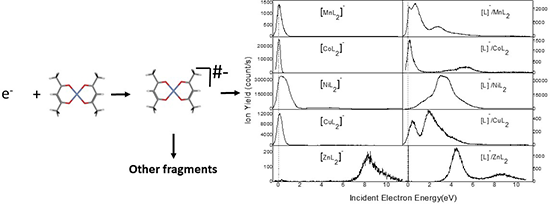
- . Metal bis(acetylacetonate) complexes are of interest for many thin film fabrication techniques (e.g., chemical vapor deposition [9], atomic layer epitaxy [10], or atomic layer etching [11]) and as precursors for carbon materials, such as carbon nanotubes and carbon onion particles [12], or metal oxide


In situ magnesiothermic reduction synthesis of a Ge@C composite for high-performance lithium-ion batterie anodes
Beilstein J. Nanotechnol. 2023, 14, 751–761, doi:10.3762/bjnano.14.62
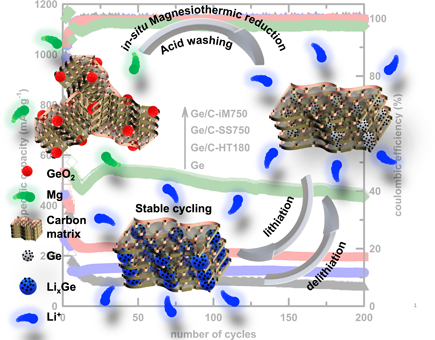
- from Binh Dinh province, Vietnam. Fabrication of activated carbon from banana peel A procedure similar to our previous work [33] has been used to prepare carbon materials from banana peels. An appropriate amount of banana peels was dried at 80 °C overnight in a vacuum oven and ground into small pieces


Metal-organic framework-based nanomaterials as opto-electrochemical sensors for the detection of antibiotics and hormones: A review
Beilstein J. Nanotechnol. 2023, 14, 631–673, doi:10.3762/bjnano.14.52
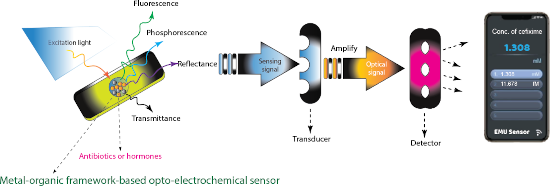
- , which lowers their electrochemical detection performance [64]. Researchers have focused on various research efforts to improve the conductivity and amplify the electrical signals of MOFs by combining them with other highly conductive materials (such as carbon materials, metal nanoparticles, or metal


ZnO-decorated SiC@C hybrids with strong electromagnetic absorption
Beilstein J. Nanotechnol. 2023, 14, 565–573, doi:10.3762/bjnano.14.47
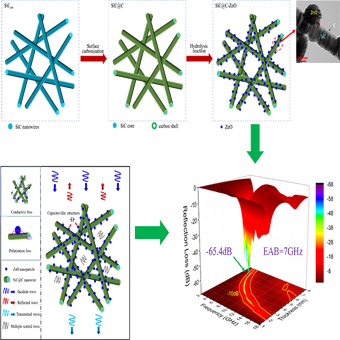
- ]. Nevertheless, the EM absorption of most SiC-based absorbers with heterostructures is far from satisfactory [21][22][23]. In our previous work, SiC@C nanowires have been successfully obtained by surface carbonization of SiC nanowires [24]. Carbon materials are prone to bond with other dielectric or magnetic
- is a good strategy to grow ZnO nanocrystals on the surface of SiC nanowires. The final hybrids (SiC@ZnO) showed enhanced performance, with a higher value of effective absorption bandwidth (EAB = 6.6 GHz) and lower RLmin (−42.11 dB) [16]. Growing ZnO nanocrystals on carbon materials (e.g., MWCNTs or


Conjugated photothermal materials and structure design for solar steam generation
Beilstein J. Nanotechnol. 2023, 14, 454–466, doi:10.3762/bjnano.14.36
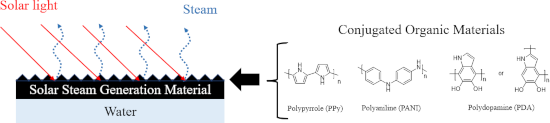
- can be predicted by density functional theory (DFT) calculations of the conjugated structures. This is an advantage over other carbon materials, even if they are of the same chemical composition [18][19][20][21][22]. We review the recent progress in the material development of conjugated solar


Molecular nanoarchitectonics: unification of nanotechnology and molecular/materials science
Beilstein J. Nanotechnol. 2023, 14, 434–453, doi:10.3762/bjnano.14.35
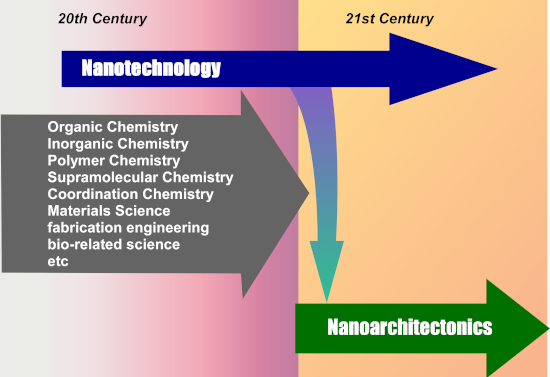
- both metallic and semiconducting properties. These networks have been applied to thermoelectric materials and have been found to exhibit low interplane thermal conductivity, which is not typical of carbon materials, while maintaining the interplane electrical conductivity. Müllen, Fuchs, Chi, and co
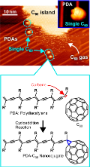
- also be a promising strategy to construct designer nanoscale carbon materials by sequentially linking multiple monomers on a surface. It is expected to contribute to future carbon-based nanoelectronics. Junctions between molecular block units have also been reported with graphene nanoribbons





Evaluation of electrosynthesized reduced graphene oxide–Ni/Fe/Co-based (oxy)hydroxide catalysts towards the oxygen evolution reaction
Beilstein J. Nanotechnol. 2023, 14, 420–433, doi:10.3762/bjnano.14.34
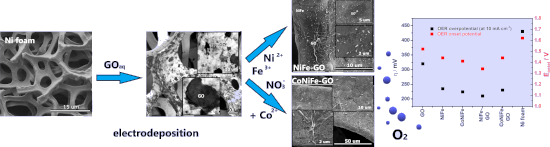
- different kinds of conductive carbon materials [14][15][16][17][18]. Recently, graphene (Gr)/graphene oxide (GO) has attracted the attention of many researchers due to its high surface area, significant chemical stability, high electrical conductivity, and high mechanical strength [12][19]. Combining a




A novel approach to pulsed laser deposition of platinum catalyst on carbon particles for use in polymer electrolyte membrane fuel cells
Beilstein J. Nanotechnol. 2023, 14, 190–204, doi:10.3762/bjnano.14.19
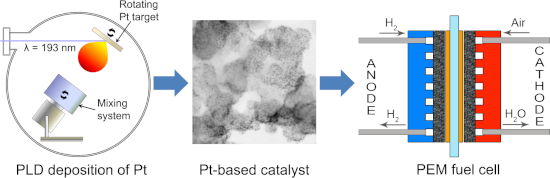
- [12][13][14]. Recently, nanoarchitectonics approaches have been used to fabricate various materials for energy-related applications, including carbon-based composites [15][16], Pt-based nanostructures and composites with carbon materials [17][18][19], and metal alloys deposited on TiO2 [20]. The most
- narrow D and G peaks and an intense 2D band, which proves the highly graphitic structure. The D to G peak height ratio is 1.24 and 1.07, respectively, for the Vulcan XC-72R and C-11 material, which means that both materials have a high content of sp3-hybridized carbon. Both carbon materials were also
- Two carbon materials with similar specific surface area, namely Vulcan XC-72R carbon black powder (purchased from Fuel Cell Store, United States) and a synthesized carbon material (C-11) with a high graphitization degree, were used as carbon support. The carbon material C-11 was synthesized in a



Application of nanoarchitectonics in moist-electric generation
Beilstein J. Nanotechnol. 2022, 13, 1185–1200, doi:10.3762/bjnano.13.99
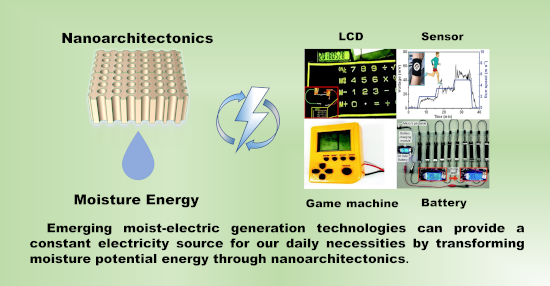
- MEGs. Among them, carbon materials are favored by researchers due to their good electrical conductivity and mature preparation technologies. In addition, surface modification of materials is an important part of research for MEGs. The surface functional groups of inorganic nanomaterials are easy to
- permission from Springer Nature from the journal Nature Nanotechnology (“Water-evaporation-induced electricity with nanostructured carbon materials“ by G. Xue; Y. Xu; T. Ding; J. Li; J. Yin; W. Fei; Y. Cao; J. Yu; L. Yuan; L. Gong; J. Chen; S. Deng; J. Zhou; W. Guo), Copyright 2017 Springer Nature. This


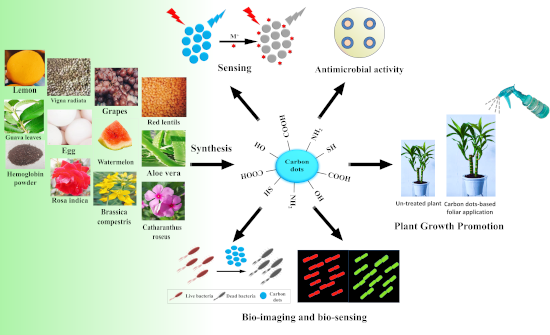
Recent advances in green carbon dots (2015–2022): synthesis, metal ion sensing, and biological applications
Beilstein J. Nanotechnol. 2022, 13, 1068–1107, doi:10.3762/bjnano.13.93