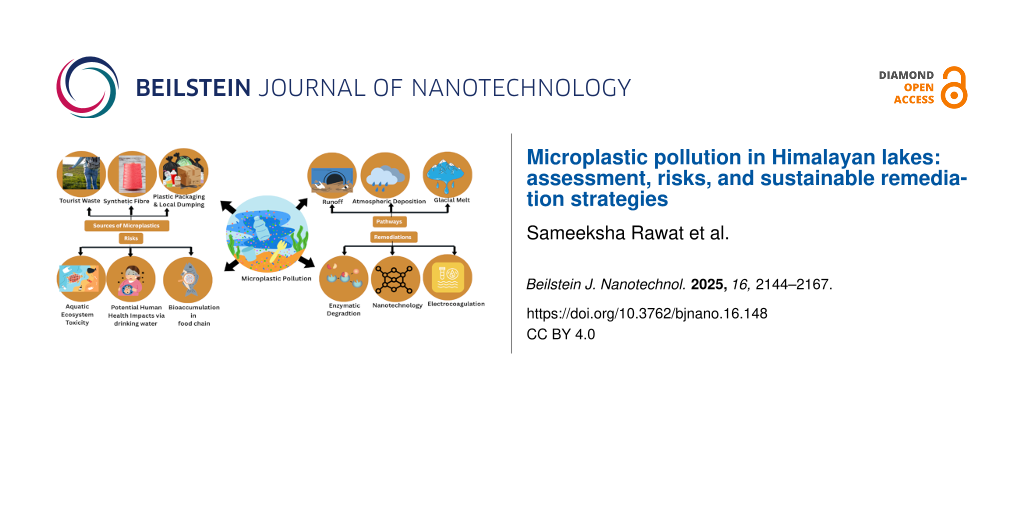
Abstract
Microplastic contamination is a newly emerging environmental problem in the ecologically sensitive Himalayan lakes, posing a threat to biodiversity, water quality, and human habitation. These high-altitude freshwater ecosystems are being increasingly polluted through human use, tourism, glacier melt, and atmospheric deposition. Microplastic quantification in such isolated locations is, however, limited by factors such as harsh climatic conditions, logistical challenges, and the need for expert analytical techniques like microscopy and spectroscopy. The present review considers sources, pathways, and ecological impacts of microplastics in Himalayan lakes compared to other sensitive aquatic ecosystems. The review describes existing remediation technologies, categorizing these into physical, chemical, and biological interventions, and takes into account emerging sustainable approaches, including biofilm-mediated degradation and nanotechnology-based solutions. The application of nanomaterials for microplastic removal is elaborated in detail, and case studies validated their effectiveness, especially in cold environments with strong UV irradiation. In the face of increasing worldwide research into microplastic contamination, there remains a huge knowledge gap concerning its behavior in distant, elevated lake systems such as the Himalayas. The most important areas to focus with regard to the ecotoxicological impact of microplastics are the bioaccumulation of microplastics in the Himalayan food web, plasticizer toxicity, and long-term potential health and ecological threats. This review addresses the imperatives of enhanced governance, monitoring, legislation, and community-based mitigation measures. This research makes a contribution by integrating region-specific data, defining priority research needs, and provoking sustainable, multidisciplinary solutions specific to freshwater cold-climate ecosystems. This contribution serves to address the imperative of adopting multidisciplinary research, region-specific remedial measures, and judicious estimation of microplastic contamination of high-altitude lakes through by describing research gaps. It distills the present scenario and promotes novel, environmentally friendly remedial measures, regulatory policies, cooperative initiatives to combat microplastic pollution, and vulnerabilities in the fragile Himalayan freshwater aquatic ecosystems.
Review
1 Introduction
The Himalayan lakes, often known as the “Water Towers of Asia,” serve an important role in biodiversity conservation, downstream hydraulic management, and supplying freshwater supplies to millions of people. Sau et al. explain that Pangong, Tsomoriri, and Tsokar are typical instances of untouched alpine lakes that support indigenous species and lifestyles [1]. The Nainital lakes, including Naini Lake and Bhimtal Lake, are crucial to the region’s environment and tourism. The unique ecosystem of the lakes and rising anthropogenic pressures have made them a target for environmental research [2]. Similarly, the Ramsar wetland Loktak Lake is renowned for floating vegetation and being a sanctuary for the endangered Sangai deer [3]. These alpine lakes are exposed to increasing environmental stresses due to human population, population increase, and climate change [4]. Himalayan lakes vary widely and include, for example, the Pangong Lake (Ladakh, high-altitude, saline), the Nainital Lake (Uttarakhand, mid-altitude, urban-influenced), and the Dal Lake (Kashmir, low-altitude, densely populated). Their altitudes, catchment characteristics, and anthropogenic pressures result in distinct pathways of contamination with microplastics (MPs).
MP contamination is currently a problem of global proportions impacting freshwater, oceanic, and terrestrial ecosystems. Although initial studies primarily addressed oceanic ecosystems, current studies show the increasing load of MPs in inland water bodies, for example, rivers, lakes, and estuaries [5]. For South Asia, especially, high MP loads in major river systems such as the Ganges and Brahmaputra have all been driven by rapid urbanization, poor plastic waste management, and hydrological connectivity [6]. Yet, although the upland catchments are so crucial to maintaining these rivers, high-altitude regions, above all, the Himalayas, are still inadequately studied. Himalayan lakes are exposed to increased plastic contamination by natural and human-induced processes. The complex process of MP transport and deposition is outlined in Section 3. The harsh environmental conditions of the region, freeze–thaw weather, low microbial activity, and short hydrological retention times, make the degradation of MPs more difficult and these lakes to long-term sinks for plastic particles.
Himalayan lakes are very susceptible to MP pollution [4,7-9]. MPs enter these ecosystems due to glacier melting, tourism, agricultural runoff, and inadequate waste management. Anchar Lake and Dal Lake in Kashmir, for instance, exhibit high MP levels owing to household waste and touristic activities [10]. Recreational activities and urban runoff have resulted in plastic pollution increasing in Nainital Lake, a popular tourist destination, threatening aquatic biodiversity [2]. Nazir et al. state that MPs pollute water bodies by accumulating in food chains and bearing toxic contaminants such as heavy metals. This problem is exacerbated by the fact that plastic pollution has a transboundary implication, thereby having the chance of ending up in other lakes’ sediments and water [11].
The existence of MPs in both Indus and Brahmaputra rivers suggests that the pollution from the highland lake and glacier may reach into downstream water systems [12]. According to Kumar et al., the distribution and accumulation of MP are considerably influenced by anthropogenic activities within catchment areas, which is further worsened by inadequate waste management systems. This is evident in studies conducted on lakes such as Nainital and Manasbal [2,9,13]. This review compiles recent evidence on MP contamination of Himalayan lakes and contrasts it with global high-altitude ecosystems. It will propose to identify special regional vulnerabilities, evaluate existing limitations in monitoring and remediation, and suggest strategies specific to vulnerable, cold-climate aquatic ecosystems. It tries to identify research gaps, providing practical frameworks for policymakers and researchers to protect such vulnerable ecosystems and regulate MP pollution.
2 Methodology
This is a systematic review article with the objective of consolidating the existing literature on freshwater MP pollution in Himalayan high-altitude lakes and groundwater ecosystem. Relevant literature was retrieved from ScienceDirect and Google Scholar, using the combinations of the following keywords: “microplastics”, “freshwater lakes”, “Himalayas”, “glacial lakes”, “groundwater contamination”, “plastic toxicity”, “MP remediation technologies”, “bioremediation”, “SDG 6”, and “ecological risk”.
Literature search was restricted to articles published in the period of 2010–2025. Peer-reviewed journal articles, book chapters, and technical reports published in the English language were included. Excluded were marine-only studies, conference abstracts, editorials, and non-peer-reviewed articles. A total of 476 records were identified. Removing duplicates and irrelevant items after title and abstract screening left 127 studies for the final synthesis. In order to facilitate transparency, a “Preferred Reporting Items for Systematic Reviews and Meta-Analyses” (PRISMA) flow diagram (Figure 1) is provided to describe the article selection process.
![[2190-4286-16-148-1]](/bjnano/content/figures/2190-4286-16-148-1.png?scale=2.0&max-width=1024&background=FFFFFF)
Figure 1: PRISMA flowchart of literature search and selection process [14].
Figure 1: PRISMA flowchart of literature search and selection process [14].
3 Vulnerability of Himalayan lake ecosystems to microplastic pollution
This section presents the environmental setting and vulnerability context of Himalayan freshwater ecosystems to set the stage for the following assessment of MP pathways, effects, and mitigation measures. The Himalayan region has more than 16,000 alpine and glacial lakes, most notably being crucial reservoirs of freshwater for tens of millions of people downstream [15]. Himalayan alpine lakes are environmentally sensitive because of their glacial origin, steep altitude gradients, and high hydrological sensitivity to rapid climate change [16,17]. It is important to know the distinct environmental characteristics and sensitivities of Himalayan alpine lakes to place the mechanisms and deposition of MPs into sensitive environments in perspective [18,19].
3.1 Sources and pathways of microplastics in lakes
MPs come from various sources and are carried to high-altitude lakes in the Himalayas through several routes. The major sources of pollution are improper disposal of garbage, uncontrolled tourism, and agricultural runoff. For instance, Kashmir lakes, including Dal and Anchar, are extremely polluted due to their proximity to human dwellings and the litter that is created due to tourism [4]. Recent studies confirm the occurrence of MPs in Himalayan high-altitude lakes due to surface runoff from tourist activities, plastic trash, and unregulated effluent. For instance, Jain et al. reported a MP density of 110–370 particles/m3 in the Nainital Lake, Uttarakhand, which was highest during the tourist season. The outcomes confirm that human accessibility and lake morphology (glacier-fed and rain-fed) influence MP density, though this interaction is poorly studied and requires further work [2]. Similar to what has been happening in Ladakh’s Pangong Lake, MPs carried in the air and over long distances are deposited in water bodies via atmospheric deposition. This is a key mechanism in remote lakes besides direct input [7].
Groundwater modeling methods have been instrumental in describing the transport and fate of contaminants, including MPs, in subsurface environments. Numerical methods such as MODFLOW coupled with transport methods such as MT3DMS and RT3D are widely used to simulate groundwater flow and contaminant transport processes [20]. Such models have been adapted to cold mountain environments by adding glacier-fed recharge zones, freeze–thaw processes in soils, and topography-induced flow [21]. Semi-distributed models such as SWAT and MIKE SHE have also been used regarding Himalayan catchments to simulate subsurface flow and contaminant loading under varying climate and land use scenarios [22]. The models can be used to simulate MP transport in high-altitude lake basins, although particle-bound adaptations are under development.
The melting of glaciers has been identified as a distinct mechanism for MPs in the ecosystems of the Himalayas. MPs trapped in glacier ice are released as it melts, subsequently entering freshwater streams and lakes downstream [23]. Recently sampling in Pangong Lake and Beas catchment [2] has linked MP presence to glacial retreat zones, affirming meltwater pathways. Where Himalayan-specific data is sparse, mechanisms are inferred from analogous systems such as the Swiss Alps and Andean lakes. Seasonal MP dynamics in the Himalayan lakes are controlled by environmental factors such as glacier melting and monsoonal runoff. Summer melt pulses enhance the transport of MPs from catchment basins, whereas weak winter flows allow for sedimentation. Perennial flow of the Brahmaputra and the Koshi rivers across borders makes sure that extraneous contaminants enter such pristine ecosystems [24]. Hydrological conveyance is also seen in research in the Beas catchment, where MPs in low areas are transported upwards into sensitive ecosystems [25]. Such connectivity of the routes and sources is apparent in Figure 2, which presents the wide ecological extent and conveyance of MPs in water bodies. To allow aggregation of regional results, Table 1 reports documented MP density in some Himalayan freshwater lakes and their typology. Table 2 is a compilation of the most commonly reported dominant polymers and morphologies, as well as the size classes, of MPs in Himalayan lakes.
![[2190-4286-16-148-2]](/bjnano/content/figures/2190-4286-16-148-2.png?scale=2.0&max-width=1024&background=FFFFFF)
Figure 2: Infographic showing the lifecycle of MPs in Himalayan lakes. Graphical element Wastewater Vector Icon Design: © 123 Stock via Canva.com; Graphical element Melting Glacier Illustration: © Goldink Studio via Canva.com; Graphical element Hiker with Walking Sticks and Backpack: © Vanessa E. E. via Canva.com; Graphical element: Plastic Waste Blue: © Karyative via Canva.com; Graphical element Raining Cloud: © piyanuch28 via Canva.com; Graphical element Running Tap Water, Simple Illustration of Water Flowing from a Faucet: © mike223via Canva.com; Graphical element Lake element: © Visula Co via Canva.com; Graphical element Fish: © Canva Creative Studio via Canva.com; Graphical element Microplastics in Fish Illustration:© Azharialr via Canva.com; Graphical element Pile of Sediments: © Canva Creative Studio via Canva.com; Graphical element Curved thin doodle hand drawn arrow left: ©Visual Generation via Canva.com; Graphical element Curved thin doodle hand drawn arrow right: © Visual Generation via Canva.com.These elements are not subject to CC BY 4.0.
Figure 2: Infographic showing the lifecycle of MPs in Himalayan lakes. Graphical element Wastewater Vector Ic...
Table 1: Documented MP concentrations in Himalayan lakes.
| Lake | Location | Lake type | Segment | MP concentration | Avg. MP concentration | Ref. | ||
|
Surface water
[SW] (particles/m3) |
Sediment
[S] (items/kg dw) |
Surface water (particles/m3) | Sediment (items/kg dw) | |||||
| Dal | Jammu and Kashmir | spring-fed | SW + S | – | – | 196650 ± 350 | 416 ± 38 | [11,26] |
| Manasbal | Jammu and Kashmir | spring-fed | SW + S | 13000–89000 | 840–4020 | – | – | [9] |
| Nainital | Uttarakhand | rain-fed | SW + S | 8600–56000 | 400–10600 | – | – | [2] |
| Rewalsar | Himachal Pradesh | spring-fed | SW + S | 13000–238000 | 750–3020 | – | – | [27] |
| Anchar | Jammu and Kashmir | river-fed | S | – | 233–1533 | – | 660 ± 360 | [10] |
| Renuka | Himachal Pradesh | spring-fed | SW + S | 2000–64000 | 15–632 | – | – | [28] |
Table 2: Common MP characteristics including dominant polymers and morphologies, and size classes in Himalayan lakes.
| Lake | Dominant polymers | Dominant morphologies | Size class (µm/mm) | Reference |
| Dal | PE, PS, PP, PVC | fragments, fibers, pellets | <250 µm | [26] |
| Manasbal | PP, PE, PS | beads | – | [9] |
| Nainital | HDPE | fibers | 0.02–1 mm | [2] |
| Rewalsar | PS, PE, PP | pellets, fragments | – | [27] |
| Anchar | PA (96%), PET (1.4%), PS (1.4%), PVC (0.9%), PP (0.7%) | fibers (91%), fragments/films (8%), pellets (1%) | – | [10] |
| Renuka | PE, PS | fibers, fragments | – | [28] |
3.2 Impact on biodiversity, water quality, and human communities
The presence of MPs in water systems significantly affects the quality of water, biodiversity, and human well-being. Studies have confirmed the ingestion of MPs by aquatic organisms, including fish, mollusks, and crustaceans in Lake Nundkol and Dal. This renders aquatic animals highly vulnerable to the action of plasticizers. Consumption of these substances interferes with metabolic processes and leads to bioaccumulation of toxic compounds, like heavy metals linked with MPs [11]. Altitude lake sediments contain high concentrations of MPs, which interfere with benthic assemblages and influence the food web structure [4]. For instance, a study in Dal Lake recorded MP concentrations of 2450 particles/m2 in sediments and 9.8 particles/L in surface water [11], indicating significant ecological exposure.
3.3 Global comparison with other sensitive aquatic ecosystems
Across the globe, MPs have emerged as a widespread contaminant in delicate aquatic ecosystems, and Himalayan lakes exhibit numerous similarities with those found in other high-altitude or pristine environments. For example, MPs from glacial melt and atmospheric deposition cause problems for lakes in Europe’s Alpine regions, especially those in the Swiss Alps [23]. However, MPs degrade more slowly in the Himalaya’s cooler climates, which over time makes their buildup more damaging and permanent.
In South America, the Andean lakes exhibit comparable MP pathways, such as agricultural runoff and tourism, yet they vary in management approaches. According to Yang et al., systematic management methods are often not applied to the Himalayan lakes; therefore, there is a greater risk of ecological breakdown [24]. In contrast, the Andean lakes benefit from community-based rehabilitation processes. The Beas River in the Western Himalaya has been compared with rivers in temperate zones, where improved waste management systems cause a reduction in MP accumulation. According to Bhaduri et al., this disparity reflects how essential cooperating waste management policies and plans are in the Himalayas to prevent MP pollution [25].
Matta et al. provided a comprehensive historical analysis of water and emerging pollutants, specifically microplastics, in the Indian Himalayas, highlighting how such pollutants have progressively affected surface and groundwater as a result of unregulated use of plastic and a lack of waste management infrastructure [29]. Our research supplements theirs by emphasizing not just the presence and ecological hazards but also possible remediation technologies and SDG-consistent governance options. In addition, Nayak et al. employed pollution indices and chemometric models to assess the presence of poisonous elements in Himalayan groundwater [30]. Our addition of groundwater vulnerability modeling and toxicity pathways to this contributes by incorporating MPs into groundwater threat frameworks, providing a new contribution in linking solid plastic pollution with hydrological threats in vulnerable highland environments.
4 Methods for assessment of microplastics
4.1 Sampling strategies in remote regions
MP sampling in remote mountainous areas at high altitudes, for example, the Himalayan lakes, necessitates creative logistics and solutions adapted to environmental conditions. The conditions in these areas generally render conventional methods, for example, trawling plankton nets in surface water, infeasible owing to transport and size constraints of equipment [31]. This has given rise to sampling devices that are both portable and light, specifically tailored for use in remote environments. For example, surface MPs can be effectively collected in streams and lakes by adapting small mesh nets (100–300 µm).
The collection of sediment samples is also essential since MPs have a tendency to sink and build up over time. The most effective methods for recovering sediments from lakebeds in waters of shallow to medium depth are grab samplers and hand-held corers [32]. MP deposition greatly depends on glacial runoff and alpine seasonal tourist activities, such that seasonal sampling protocols need to be adopted. While the monsoon season in the Himalayas typically spans from June to September, this review emphasizes late-monsoon periods (August–September) due to the heightened runoff and peak tourism activity during these months. Sample collection both before and after the monsoons could potentially provide useful insight into variations in contamination levels generated due to runoff and anthropogenic activities.
The collection of both suspended and floating particulates is facilitated by the increasing use of in situ filtration systems that utilize portable vacuum compressors for water samples. These tactics aid in capturing MPs of all sizes, from the macro- to the nanoscale, which is essential for understanding the full contamination profile in remote ecosystems [33]. An overview of MP sampling and analysis methods is given in Figure 3.
![[2190-4286-16-148-3]](/bjnano/content/figures/2190-4286-16-148-3.png?scale=2.0&max-width=1024&background=FFFFFF)
Figure 3: Sampling and analysis methods for MPs in remote regions.
Figure 3: Sampling and analysis methods for MPs in remote regions.
4.2 Analytical techniques for microplastic characterization
4.2.1 Spectroscopy. One of the key methods of analyzing MPs is spectroscopy. Fourier-transform infrared (FTIR) spectroscopy is used regularly to identify the chemical structure of MPs [34]. One of the most important developments for nanoplastic detection in complex environmental matrices is micro-FTIR to analyze particles smaller than 10 µm [35].
Raman spectroscopy improves on FTIR by using higher resolution and the ability to examine colored or pigmented polymers without dye interference. The geographical distributions of MPs in samples are increasingly being mapped using Raman mapping techniques, which provide valuable information for ecological impact studies [36]. Such techniques are able to distinguish between polymers that result from local tourist waste and those transported by atmospheric deposition in Himalayan lakes of high elevation [37].
4.2.2 Microscopy. Microscopic techniques remain crucial for the initial description of MPs, particularly when assessing their physical properties. Scanning electron microscopy (SEM) produces high-resolution images of particle shapes. It also indicates surface wear and tear patterns that reflect how old the MP is and how long it has been in the environment [38].
Ease of operation and minimal cost of optical microscopy make it widely used, despite being less sophisticated than SEM. It is particularly useful in morphological examination, size grading, and rapid particle identification. The combination of optical microscopes and modern digital imaging techniques allows for automatic particle classification and counting, which greatly decreases the extent of human intervention and possibility of error [39].
Microscopy and spectroscopy tend to be combined to increase reliability. For instance, Raman or FTIR spectroscopy is applied to identify polymers following SEM to examine the shape of particles. This ensures both chemical and physical characteristics are captured [40]. The combined analytical flow and instrumentation for MP characterization, such as digestion, preparation, and analytical processes like microscopy, spectroscopy, and thermal analysis, is presented in Figure 4.
![[2190-4286-16-148-4]](/bjnano/content/figures/2190-4286-16-148-4.png?scale=2.0&max-width=1024&background=FFFFFF)
Figure 4: Diagram of MP analysis instrumentation. Graphical element Amber glass bottle with blank label: © andiiwan via Canva.com; Graphical element Laboratory Conical, Titration or Erlenmeyer Flask: © Vector tradition via Canva.com; Graphical element Filter funnel icon: © musmellow via Canva.com; Graphical element Flour Sieve Illustration: © ivandesign via Canva.com; Graphical element Splash of Water: © Billion Photos via Canva.com; Graphical element Transparent beaker with clear water on white background: © BlueRingMedia via Canva.com; Graphical element Wash Bottle: © awspicious via Canva.com; Graphical element Clean Flat Vacuum Filtration Apparatus: © sparklestroke via Canva.com; Graphical element Petri Dish with Cream-Colored Agar Illustration: © Maria Teruya's Images via Canva.Com; Graphical element Round Grid Filter Outline Thin Line Style © Serhii Borodin via Canva.com; Graphical element pipette: © heyrabbiticons via Canva.Com; Graphical element incubator: © putra-creative via Canva.com; Graphical element Microscope Outline School Supplies: © Langgeng Pangrebowo via Canva.com; Graphical element Spectrophotometer: Vectors Market via Canva.com; Graphical element Gas Chromatograph: © Aurielaki via Canva.com; Graphical element Monitor: © Ibrandify via Canva.com; Graphical element White Rectangle With Shadow: © StylishDesignStudio via Canva .com; Graphical element Triple split arrow in linear style: © Nazar12 via Canva.com; Graphical element Arrow Down Icon: © Noun Project (limited collection) via Canva.com. These elements are not subject to CC BY 4.0.
Figure 4: Diagram of MP analysis instrumentation. Graphical element Amber glass bottle with blank label: © an...
4.3 Challenges in quantification and identification under alpine conditions
MPs assessment is particularly problematic at high altitudes, including the Himalayas. Implementation of sophisticated analysis methods and sampling is limited due to extreme climatic conditions like below-freezing temperatures, strong UV irradiation, and poor infrastructure [31]. Portable and robust field-friendly technologies are also required since it is challenging to transport samples to well-equipped laboratories from distant locations.
Another challenge is that natural particulate matter such as minerals, biological debris, and glacial silt can lead to the interference of MP detection. MPs must be separated by using pretreatment techniques such as enzymatic decomposition of organic matter and density separation using saline solutions. These processes, however, might take a lot of time and could cause tiny particles to be lost [32].
The distinct combination of nanoscale dimensions and very low concentration in samples from the environment makes nanoscale plastics yet another challenge. Sophisticated methods such as thermal extraction desorption (TED) and gas chromatography-mass spectrometry (GC-MS) are now routinely used to detect these particles. But these methods involve a lot of expertise and equipment. The development of portable, low-cost systems for nanoscale analysis is a significant field of future studies [34].
5 Remediation techniques
5.1 Overview of current technologies for microplastic removal
Various physical, chemical, and biological methods are employed with the hope of effectively removing MPs from water bodies. The simplest process to remove MPs from water supplies is by physical processes. Filtration processes, including sand filtration and membrane bioreactors (MBRs), utilize size exclusion to remove MPs [41]. Tiwari et al. established that specifically MBRs have been highly efficient, with more than 99% removal efficiencies under controlled conditions [42]. Sedimentation methods are frequently used in wastewater treatment plants, making use of the density difference between MPs and water. But it is difficult to trap particles measuring less than 10 µm with such processes. Physical methods are easy to implement and scalable but lack efficiency in open, natural environments such as Himalayan lakes and often require energy-consuming setups [43]. Research also indicates that sophisticated filtering systems, including granular activated carbon (GAC) filters, effectively capture small MPs. They are therefore ideal for use in high-altitude lakes [44].
The goal of chemical methods for MP remediation is to convert polymers into non-toxic substances. Advanced oxidation processes (AOPs) use strong oxidants like ozone, hydrogen peroxide, or hydroxyl radicals to break down MPs [45]. The most promising among them are photocatalytic processes that utilize titanium dioxide nanoparticles under UV radiation. These are very efficient degradation processes for degrading plastics to carbon dioxide (CO2) and water [43]. Fenton reactions, involving a mixture of hydrogen peroxide and iron catalysts, are a good example of a new method that has achieved great degrading effectiveness and is under study regarding its potential application to cold environments [46]. However, before being widely used in delicate ecosystems like Himalayan lakes, chemical methods must be carefully optimized since they frequently demand substantial energy input and can produce secondary pollutants [47].
Biological processes can utilize the natural ability of microorganisms to degrade synthetic polymers. Microorganisms such as Pseudomonas and Bacillus, which have enzymatic activity, can degrade plastics into smaller molecules [48]. Biofilms adhering to the plastic surfaces are required for biological degradation since they secrete enzymes that degrade polymers outside cells [49]. As noted by Rai et al., biofilms can speed up the breakdown of MPs, even though such a process is prone to interference from environmental factors like pH, temperature, and the availability of nutrients [50]. There has been promising development within the field of genetic engineering in relation to the creation of microbial consortiums optimized for high-efficiency degradation [46]. As reported by Rizvi et al., some fungi, such as Aspergillus spp., have already shown potential in degrading MPs in a controlled settings, with the possibility of further application in larger-scale bioremediation schemes [44].
Table 3 gives a comparative summary of the most recent physical, chemical, and biological technologies for MP remediation. Among them are new electrochemical technologies, membrane separation technologies, microbial technologies, and AOPs. The efficiency, mechanism, strengths, weaknesses, and applications of each technology are utilized to assess each technology.
Table 3: Current technologies for MP removal.
| Technology | Mechanism/typea | Advantages | Limitations | Efficiency | Applications | Ref. | |
| piezocatalytic and Fenton-like H2O2 activation using Bi12(Bi0.5Fe0.5)O19.5 | synergistic oxidation and fragmentation of polyethylene terephthalate (PET) MPs via reactive oxygen species (ROS) generation | C | effective degradation of PET-MPs (28.9% removal in 72 h); enhanced efficiency compared to individual Fenton or piezocatalysis; durable catalyst with multiple reusability | slow degradation rate compared to adsorption or filtration methods; requires ultrasound treatment and optimized oxidant concentrations | 28.9% removal for PET-MPs (10 g/L) in 72 h | industrial wastewater treatment and environmental remediation | [51] |
| capillary skimming using hydrophilic ratchet | capillary force-driven skimming at the air–water interface | P | effective for floating MPs (1–4 mm) with densities from 0.02 to 0.97 g/cm3; avoids clogging issues in mesh-based filters; demonstrated feasibility with a marine robot cleaner | limited to floating MPs, ineffective for submerged or sinking MPs; dependent on water bridge stability for efficiency | high efficiency for floating MPs across different densities | marine pollution control and robotic surface-cleaning systems | [52] |
| settling treatment in wastewater treatment plants (WWTPs) | sedimentation based on density, size, and shape of MPs | P | effective for MPs with higher density and larger size; predictable efficiency based on settling models; commonly integrated into existing wastewater treatment processes | lower efficiency for small, low-density MPs; removal efficiency depends on surface loading rate and operational conditions | variable efficiency based on MP density, size, and shape | wastewater treatment plants and industrial effluent management | [53] |
| electrochemical oxidation with boron-doped diamond electrodes | indirect oxidation of MPs via reactive radicals | C | effective degradation of 1.0 µm polystyrene (PS) MPs; achieves oxidation and morphological changes in MPs; uses highly oxidizing radicals for degradation | requires optimization of power usage and electrode cost; long treatment time (5 h) | high efficiency under optimal conditions (Na2SO4 0.02 M, 60 A/m2, 5 h) | advanced water treatment for MP-contaminated water | [54] |
| electrocoagulation (EC) using Fe and Al electrodes | coagulation and flocculation of MPs through electrochemical reactions | C | achieves 100% removal under optimal conditions; effective at pH 10 with 30 A/m2 current density; suitable for industrial wastewater treatment | performance dependent on current density and pH; requires optimization for large-scale applications | 100% MP removal at pH 10, 30 A/m2 in 60 min | textile industry wastewater treatment | [55] |
| electrochemical technologies (EC, electro-adsorption, electro-oxidation, electro-reduction) | various electrochemical reactions for detection and removal of MP/NPs | C | multiple electrochemical methods available for both detection and removal; environmentally friendly and controllable; high removal efficiency depending on method and parameters | performance depends on electrode materials and operational conditions; requires further optimization for large-scale applications | high efficiency depending on technique (e.g., EC, electro-oxidation) | laboratory detection and industrial water treatment | [56] |
| microbial electrolysis cells for MPs/NP removal | biofilm-based microbial electrochemical degradation and energy recovery | B | simultaneous wastewater treatment and energy recovery; potential defense mechanism via EPS secretion; novel approach for NP degradation | high concentrations of NPs (≥500 µg/L) negatively impact microbial communities; reduced efficiency due to biofilm disruption | ≈43% reduction in current density and ≈48% drop in hydrogen (H2) production at 500 µg/L PsNPs | bioelectrochemical systems, wastewater treatment, and energy recovery applications | [57] |
| machine learning & hyperspectral imaging (SVM model) | identification and quantification of MPs in rice through spectral analysis | P | high accuracy in MP identification (>94.44%); non-destructive and rapid detection; useful for assessing MP release during packaging and transportation | limited to solid food matrices like rice; may require calibration for different food products | >94.44% accuracy in identifying MPs in packaged rice | food safety, packaging analysis, and quality control | [58] |
| homoporous PVDF membrane separation | filtration using homoporous poly(vinylidene fluoride) membranes with high surface porosity | P | high rejection rate (>97%) for 500 nm polystyrene MPs; excellent water flux (662 L m-2 h-1 bar-1); simple and scalable membrane fabrication process | limited to MP sizes ≥500 nm; potential membrane fouling over prolonged use | >97% removal of 500 nm PS MPs | water treatment, MP separation in aquatic environments | [59] |
| EC with magnetic Fe3O4 Floc formation | coagulation and magnetic separation of MPs, with potential reuse of Fe3O4 in energy materials | C | high removal efficiency (98.4%) for PE MPs; magnetic separation enables easy recovery; recyclable Fe3O4 for lithium-ion battery applications | requires additional steps for Fe3O4 recycling; may involve complex treatment for photodegradation | 98.4% removal efficiency for PE MPs | wastewater treatment and recycling for energy material applications | [60] |
| UV/H2O2 AOP | oxidative degradation of MP fibres using UVC irradiation and hydrogen peroxide | C | significant mass loss of MPs (52.7%) with a half-life of 45.3 h; effective surface degradation (pits, cracks); complete COD removal in 3 h | requires high doses of H2O2 (500 mg/L) and prolonged exposure to UVC (48 h); limited to photoactive treatment environments | 52.7% MP mass loss, 15.2% MP degradation in hospital laundry wastewater | laundry wastewater treatment and MP degradation in industrial effluents | [61] |
| 2D MOF@C@FeO nanopillared structures | adsorption and magnetic separation of MPs and dissolved pollutants | C | high removal efficiency (~100%) for MPs in 60 min; dual functionality for both solid and dissolved pollutants; reusable for up to 6 cycles with 90% efficiency | potential complexity in synthesis of 2D MOF@C@FeO structures; requires magnetic separation infrastructure | 100% MP removal in 60 min 90% efficiency after 6 adsorption cycles | industrial and domestic wastewater treatment systems | [62] |
| SDS-assisted electrochemical advanced oxidation process (EAOP) with BDD anode | enhanced degradation of PS MPs using SDS and persulfate generation | C | 1.35–2.29 times higher degradation rate compared to BDD electrolysis alone; effective alkyl-cleavage and oxidation of MPs; low surfactant cost (<0.05% of operating costs) | prolonged treatment time (72 h); requires precise SDS dosing strategy for optimal performance | significant improvement in MP degradation rate | AOPs in water treatment for MP removal | [63] |
| EC and ultrafiltration (UF) combination | coagulation followed by membrane filtration for MP recovery | C P | high recovery efficiency for MPs (85%); simultaneous removal of COD (85%), TSS (97.66%), TDS (42.74%), colour (99.74%), and turbidity (99.66%); rapid treatment time (2 min) | moderate efficiency for MP recovery compared to other methods; requires specific operational conditions (pH 7.5, NaCl 8 g) | 85% MP recovery, excellent pollutant removal performance | wastewater treatment in plastic packaging industries, particularly in Vietnam | [64] |
| interpenetrating bipolar plate electrocoagulation (IBPE) reactor | simultaneous removal of MPs and heavy metals through EC | C | high removal efficiency for MPs (97.5%) and heavy metals (95.16%); simultaneous pollutant removal; clean technology for WWTP effluent treatment | operational cost of $0.91/L may limit large-scale use; requires precise control of current density, pH, and reaction time | 97.5% MP removal, 95.16% heavy metal removal | secondary effluent treatment in WWTPs | [65] |
| EC with aluminum anode | flocculation and charge neutralization for MP removal | C | high removal efficiency: 93.2% for PE, 91.7% for PMMA, 98.2% for CA, and 98.4% for PP; effective across a broad pH range (3–10); works better with fiber MPs than granular MPs | requires precise control of electrolyte concentration and applied voltage (optimal: 0.05 M, 10 V); higher operational costs at non-optimal conditions | 82–98.4% removal efficiency depending on MP type | municipal and industrial wastewater treatment systems | [66] |
| dissolved air flotation (DAF) with Al- and Fe-based coagulants | coagulation and flotation of MPs using air bubbles | C P | high PE MP removal efficiency: 96.10% (Al-based) and 70.56% (Fe-based); effective as a tertiary treatment in WWTPs; allows optimization through statistical modeling | lower efficiency with Fe-based coagulants compared to Al-based; requires precise control of pressure, pH, dosage, and flow rate | 96.10% PE removal with Al-based coagulant; 70.56% with Fe-based coagulant | greywater treatment and advanced wastewater treatment in WWTPs | [67] |
| municipal sewage treatment plants (STPs) | multi-stage treatment including physical, chemical, and biological processes | P C B | high overall removal efficiency for MPs (>95%); capable of reducing MPs in reclaimed water to 0.59 ± 0.22 items/L; handles large volumes of wastewater | microfibers (average size: 1110.72 ± 862.95 µm) remain predominant in effluents; MPs make up 14.08% of total MPs released | >95% removal efficiency for a wide range of MP types including PET, PS, and PP | municipal wastewater treatment and water reclamation processes | [68] |
aType: B – biological; C – chemical; P – physical.
These technologies are indicative of the multidimensional strategies being pursued for MP remediation, which strike a balance between efficiency, operational feasibility, and environmental sustainability. While physical and chemical methods are dominant, the use of advanced technologies such as electrochemical systems, machine-learning-based sensing, and bioelectrochemical technology is a significant shift towards more precise and responsive MP management systems.
5.2 Potential for bioremediation in cold environments
Psychrophiles, or coldness-adapted microbes, are essential for bioremediation under the adverse conditions of high-altitude Himalayan lakes. These microbes break down polymers like PE and PS by producing enzymes that are active below freezing temperatures [69,70]. For example, it has been discovered that certain Pseudomonas species efficiently break down plastics in cold climates, providing a viable solution to the problem of MP contamination in alpine ecosystems [46]. Tiwari et al. found that psychrophilic lipases and esterases found in marine environments degrade MPs in low-temperature experiments, lending credibility to their use in Himalayan habitats [42]. The ecological significance of cryophilic fungal species has been highlighted by studies showing their capacity to break down PET [46].
Biofilms can accelerate the breakdown process under cold conditions by generating enzymatically active microenvironments [71]. According to Dhiman et al., these microbial colonies stick to the surfaces of MPs and release enzymes that break down synthetic polymers into smaller, biodegradable particles [72]. Ojha et al. found that adding nutritional supplements sped up biofilm production in lab trials, suggesting that this strategy might be useful in nutrient-deficient lakes in the Himalayas [47]. The synergistic effects of hybrid biofilms that include psychrophilic bacterial and fungal species are being investigated in order to increase degrading efficiency [44].
There are several obstacles to bioremediation in alpine environments. It takes longer for plastic to degrade effectively at low temperatures because enzyme responses and microbial metabolisms are slowed down [73]. Himalayan lakes are also oligotrophic, which means they do not have a lot of nutrients. This can make it difficult for microbes to grow and for biofilm to form. To solve these problems, we might need new ideas like bioreactors designed for cold places or synthetic biology methods to improve the abilities of microbes already present [47].
5.3 Emerging sustainable approaches
5.3.1 Use of biofilms. Biofilms have attracted a lot of interest as a remediation method for MPs because of their ecological and biological flexibility. Biofilms are groups of microbes that form a protective covering made of extracellular polymeric substances (EPSs). These EPSs are made by the microbes themselves and stick to surfaces, such as MPs. The enzymes secreted by these microbial colonies have the ability to degrade synthetic polymers into smaller, biodegradable components. Tiwari et al. have recently demonstrated the effectiveness of biofilms formed by engineered microbial consortia in expediting enzymatic degradation in response to specific environmental conditions, such as low temperatures [42].
Biofilms are very beneficial in habitats such as Himalayan lakes. Biofilm-based remediation techniques are environmentally friendly, in contrast to chemical or physical remediation techniques that could disrupt local biodiversity. For example, even in oligotrophic environments, psychrophilic bacteria in biofilms may flourish at freezing temperatures and aid in the degradation of MPs. Studies have demonstrated that electrostatically modified biofilms enhance adherence to moving water systems, rendering them a viable option for large-scale applications [43]. Biofilms along with other methods, like adding nutrients or immobilized bioreactors, have been used in field trials to show that MPs can be permanently removed without causing secondary pollution [72].
5.3.2 Nanotechnology for degradation. Nanotechnology offers a novel method for the accurate and effective breakdown of MPs. Under UV light, nanomaterials such as ZnO and TiO2 work as photocatalysts to break down MPs into CO2 and water, which are safe for the environment. Photocatalysis produces reactive oxygen species (ROS), which attack polymer chains and cause oxidative cleavage. Studies have shown that, under ideal circumstances, this process is quite successful in degrading polymers such as PS [74].
Bionanomaterials, which are composite systems that combine nanotechnology with biological components (e.g., enzymes), are emerging as environmentally benign solutions in addition to independent nanoparticles. Enzyme–nanoparticle conjugates can target certain plastic polymers, enabling more rapid and targeted breakdown. Iron oxide nanoparticles have been shown to break down PS in both UV and natural light, which suggests they could be used in a range of environmental conditions [44]. Another prospective application is the integration of nanomaterials into filtration membranes, which results in the development of hybrid systems that are capable of simultaneously capturing and degrading MPs. These integrated methods are especially beneficial for isolated ecosystems, such as Himalayan lakes, where minimum ecological disturbance and resource efficiency are crucial [46].
Recent studies, for example, by Ojha et al. suggest that integrating degrading enzymes from biofilms with nanomaterial carries can enhance MP degradation under cold, UV-rich conditions [47]. Such synergies offer sustainable MP removal in remote high-altitude lakes. Future work should explore their performance under freeze–thaw cycles, low sunlight penetration, and high-altitude pH variability.
6 Nanomaterial applications in microplastic remediation
6.1 Role of photocatalysis in degradation
Photocatalysis uses nanomaterials to break down MPs by converting light energy, often UV or visible light, into ROS. These ROS, which include superoxide anions and hydroxyl radicals, attack the polymer chains of MPs. They either break the chains into smaller pieces or mineralize them into CO2 and water. A lot of research is being done on the photocatalytic properties of nanomaterials like TiO2, graphene oxide (GO), and ZnO. An excellent material for breaking down MPs in water systems is TiO2, which is known for being stable, effective, and able to produce ROS when exposed to UV light [43].
The effectiveness of TiO2 has been improved recently by doping it with nonmetals like sulfur and nitrogen or combining it with carbon-based compounds like graphene. According to Xiao et al., these changes make TiO2 photocatalysts more effective in natural sunlight by letting more visible light pass through them [75]. ZnO has demonstrated potential as a result of its compatibility with UV light and high oxidative potential. Its nanostructured forms, such as nanorods and nanowires, provide more surface area, allowing for better interaction with MPs [76]. The incorporation of GO in composite materials not only improves photocatalytic activity, but it also serves a second purpose by adsorbing MPs prior to degradation.
The utilization of photocatalysts that have been engineered with defects is an emerging area. The defects in the crystal structure of nanomaterials trap light energy and enhance the production of ROS. According to Kim and Youn, these developments are essential to address the robustness and effectiveness of photocatalysts in a variety of environmental conditions [77].
6.2 Case studies of nanomaterial efficiency
The effectiveness of nanomaterials in the remediation of MPs has been confirmed in numerous experimental studies and real-world practical applications. Jeyaraj et al. found that after 12 h of UV irradiation, TiO2 nanoparticles degraded PP MPs with an efficiency of more than 80% [76]. This demonstrates their capacity to quickly clean up waterways tainted by plastic. Researchers have also demonstrated that the combination of adsorption and photocatalysis enhances the degradation of PE and PET in GO-based composites. According to Uoginte et al., GO serves as a support matrix for these composites, stabilizing the photocatalyst and enhancing its interaction with MPs [78].
Another novel strategy is the use of multifunctional nanomaterials, such as ZnO–CuO composites, which have both antibacterial and strong photocatalytic activity. These substances provide long-term performance in natural water systems by not only breaking down MPs, but also preventing the development of biofilms [79]. The use of TiO2 nanomaterials doped with Pt nanoparticles has also been investigated in case studies; these materials showed quicker breakdown rates for persistent PET MPs, highlighting the possibility of catalytically improved remediation techniques [80].
Nanomaterials such as ZnO have accomplished the removal of MPs from treated effluents in field tests conducted in wastewater treatment facilities. These tests were conducted under natural light and showed encouraging results. According to Goh et al., these results are especially important for expanding MP remediation technology to industrial applications [43]. Tables 4–6 presents a comprehensive comparison of various nanomaterials explored for MP remediation, detailing their synthesis methods, target pollutants, removal mechanisms, efficiency, and experimental conditions.
Table 4: Studies on adsorption-based nanomaterials for MP remediation.
| Nanomaterial | Synthesis method | Target pollutants | Removal mechanism | Experimental conditions |
Efficiency/
reusability |
Ref. |
| sulfidised nano-zerovalent iron biochar | one-pot synthesis using sugarcane bagasse-derived biochar | amine modified NPs (AM100); sulfate modified NPs (SM100); malachite green (MG); alizarin yellow R (AY) | electrostatic attraction; dye degradation; Complexation; π–π interactions | pH: environmentally relevant conditions; instantaneous removal in <15 min |
>85%
6 cycles |
[81] |
| Fe and Al-modified chitosan (Fe-CHI and Al-CHI) ionotropic beads | modification of CHI with Fe and Al salts to form ionotropic beads | PET | adsorption via metal-ion interactions; pH-dependent protonation/deprotonation | optimal at low pH; reduced efficiency with increasing temperature |
>70%
3 cycles |
[82] |
| surface-modified nano Fe3O4 (–COOH, –NH2, –OH) | functionalisation of Fe3O4 NPs with carboxyl, amine and hydroxyl groups |
MPs: PE
nutrients: NH4+–N and PO43–P |
electrostatic adsorption; hydrogen bonding; ion exchange | adsorption capacity: NH4+–N (18.45 mg/g), PO43−–P (30.04 mg/g), PE (1611 mg/g) |
62% (in freshwater), 70% (in seawater)
– |
[83] |
| aluminum chloride (AlCl3) coagulant | coagulation and sedimentation process using AlCl3 as a coagulant | carboxyl-modified PS NPs (PS–COOH, 50 nm) | electrostatic adsorption; intermolecular interactions; surface layer compression | optimal dose: 10 mg/L AlCl3; pH: 3.5 to 8.5; temp.: 23 °C |
96.6% (removal of 50 mg/L PS-COOH), 90.2% (removal in real surface water)
– |
[84] |
Table 5: Studies on photocatalytic nanomaterials for MP remediation.
| Nanomaterial | Synthesis method | Target pollutants | Removal mechanism | Experimental conditions |
Efficiency/
reusability |
Ref. |
| GO and nitrogen-doped TiO2 (N-TiO2) composites (GT13, GT11, GT31) | composite synthesis in varying weight ratios of GO:N-TiO2 | polyvinyl chloride (PVC) | photocatalysis; adsorption under dark and light conditions | work across all pH ranges (4, 7, 10); high thermal stability |
>95%
– |
[85] |
| silver-doped TiO2 (Ag/TiO2) photocatalysts (AT1.5) | photo-assisted deposition method with 1.5% Ag loading | polyamide 66 (PA66) | photocatalytic degradation; enhanced light absorption and electron–hole pair separation | UVA irradiation for 4 h; optimal catalyst-to-PA66 ratio: 3:1 |
58.9% (in 4 h)
100% (at optimal ratio) – |
[86] |
| high-pressure orthorhombic phase TiO2 | high-pressure torsion (HPT) method | PET | photoreforming; catalytic degradation and H2 production | light exposure to generate formic acid, terephthalate, glycolic acid, and acetic acid |
high efficiency
– |
[87] |
| ZnO NPs | photocatalyst under sunlight exposure | PP | photocatalytic degradation; formation of free radicals | sunlight as the light source; UV–vis DRS and EDS analysis showed polymer chain disintegration |
high
– |
[79] |
| molybdenum trioxide (MoO3) nanoflakes, nanobelts, and MoO3/ single-walled carbon nanotube (SWCNT) nanocomposites | synthesis of MoO3-based photocatalysts with SWCNT composites | PS NPs | photooxidative degradation under UV light; reduction in particle size and morphological transformation | UV irradiation for 24 h; PS NPs size reduced from 220 to 178 nm |
>19% (with MoO3 nanoflakes)
– |
[88] |
| indium oxide-rGO (In2O3-rGO) nanocomposite | metal oxide nanocomposite synthesis for photocatalysis | low density polyethylene (LDPE) | photocatalytic degradation under visible light; surface morphology transformation and chemical bond cleavage | visible light exposure for up to 50 h |
99.47%
– |
[89] |
| BiOCl-ZrO2 nanocomposite | solution casting method to blend BiOCl and ZrO2 into LDPE film | LDPE | photocatalytic degradation under visible light; Type II heterojunction mechanism | visible light irradiation for 24 days at room temperature |
48.67%
– |
[90] |
| porous hybrid nanocomposite (HNCP) with rGO | fabrication of porous hybrid nanocomposite with rGO to enhance surface area and adsorption capacity | PET | photocatalytic degradation under light; adsorption via high surface area and pore interaction | – |
64% (photocatalytic)
31% (adsorption) – |
[91] |
| Ru-incorporated g-C3N4 (Ru-gCN) nanocomposite | blending of Ru-gCN with LDPE | LDPE | photocatalytic degradation via heterojunction formation; Norrish Type I and II mechanisms | light irradiation for 24 h; optimal pH 3; temp.: 0, 50 and 70 °C |
66.04% (0 °C)
74.51% (50 °C) 69.64% (70 °C) – |
[92] |
| TiO2/ZnO hybrid nanoparticles with humic substances | solvothermal synthesis using agrifood biomass-derived humic substances | polylactic acid (PLA) | photocatalytic degradation under UVA and solar light; antimicrobial activity via ROS generation | – |
15–23% (carbonyl index reduction)
– |
[93] |
| CuMgAlTi-R400 quaternary layered double hydroxide composite | fabrication of a multi-metal layered double hydroxide for photocatalytic applications |
- PS
- PE |
photocatalytic degradation under visible light; reduction of particle size and formation of hydroxyl and carbonyl intermediates | visible light irradiation: 300 h |
54.2% (PS)
– |
[94] |
| GO-ZnO nanocomposite | synthesis of GO-ZnO photocatalyst with an average ZnO crystallite size of 16.43 nm | LDPE | photocatalytic degradation under UV light; interaction of pH, temp., and catalyst dosage |
- pH: 9.66
- temp.: 30 °C catalyst dosage: 1500 ppm; photodegradation: 2 h |
39.47% (max. MP mass loss)
– |
[95] |
| Fe- and Ag-modified TiO2 nanotubes | anodization of Ti plates in glycerol-based electrolyte Fe/Ag incorporation via successive ionic layer adsorption and reaction (SILAR) | PE | photocatalytic degradation under UVC light; bactericidal effect through ROS generation | 90 min photoreactor test |
18% (weight loss)
– |
[96] |
| Ag/TiO2 catalyst (3% Ag) | photoassisted deposition (PAD) method with 1%, 3%, and 5% Ag doping | PE | photocatalytic degradation under UV light; enhanced microbial disinfection via ROS | 2000 rpm stirring; UV irradiation for 4 h |
81%
– |
[97] |
| Fe-doped ZnO (Fe-ZnO) NPs | green synthesis using Hibiscus rosa-sinensis leaf extract | LDPE | photocatalytic degradation under sunlight; generation of ROS for antimicrobial action | sunlight exposure |
high
– |
[98] |
Table 6: Studies on magnetic and hybrid nanomaterials for MP remediation.
| Nanomaterial | Synthesis method | Target pollutants | Removal mechanism | Experimental conditions |
Efficiency/
reusability |
Ref. |
| TiO2 and CuO-modified polyvinylidene fluoride (PVDF) nanofibrous composite membranes | needle-free electrospinning of PVDF nanofibers with lamination and modification using alkaline treatment, biosurfactant, TiO2, and CuO particles | MPs (0.5 µm); oil in oil-water emulsions | physical separation; antifouling through TiO2 and CuO particles | BS-modified membranes: >9000 L·m−2·h−1·bar−1 permeability for MP separation; TiO2-modified membranes: high oil rejection (≈95%) |
99.99% (MP)
95.30% (oil) – |
[99] |
| fly ash-loaded magnetic nanoparticles (FAMNPs) | synthesis of magnetic nano-adsorbent using fly ash | PS | adsorptive uptake via magnetic separation | pH 8.5; FAMNPs dose: 0.03 g; adsorption capacity: 29.12 mg/g |
high adsorption capacity
– |
[100] |
| magnetic composite NPs (FNP) | synthesis of Fe3O4 magnetic cores with eco-friendly coatings (silicon dioxide, CHI, gelatine) | PET (5–30 µm) | magnetic sedimentation; heteroaggregation of FNP and PET | magnetic field strength: 0.44 T; optimal dose: 0.002 g/L; sedimentation time: 0.5 h |
>98%
– |
[101] |
| magnetic ZIF-8 NPs (Nano-Fe@ZIF-8) | synthesis of magnetic MOFs with Fe and Zn (II) components | PET | magnetic aggregation and retrieval; catalytic depolymerisation | depolymerisation with ethylene glycol at 180 °C; rapid process: 30 min |
high
– |
[102] |
| nickel/reduced graphene oxide (Ni/rGO) nanocomposite | magnetisation of rGO using Ni NPs | PS | adsorption via hydrophobic interactions; magnetic separation | maximum adsorption capacity: 1250 mg/g; follows Langmuir isotherm and pseudo second-order kinetics |
high
3 cycles |
[103] |
| hydrogen titanate nanotubes (HTNT@ZIF-67) nanocomposite | combination of HTNT with zeolite imidazolate frameworks (ZIF-67) at ambient temperature | MPs from personal care products (PCPs) and cosmetic products | adsorption; catalytic oxidation with H2O2 | – |
99% (adsorption)
97% (catalytic oxidation) 6 cycles |
[104] |
| Fe3O4@PDA (polymerised dopamine-coated Fe3O4 NPs) | coating of mesoporous Fe3O4 NPs with adhesive PDA to mimic coral reef structures | MPs | adsorption through hydrogen bonding, π–π stacking, and hydrophobic interactions | – |
98.5%
– |
[105] |
| laundry filter system with Fe3O4 and CaCO3 | incorporation of magnetic (Fe3O4) and carbonate (CaCO3) particles into filter design | MP | simultaneous removal of hydrophobic and hydrophilic MPs; adsorption and filtration | – |
78.3–89%
– |
[106] |
| n-butylamine modulated magnetic ZIF-8 (nano-Fe@ZIF-8) | synthesis of magnetic ZIF with n-butylamine in water at room temp | PS (1.1 µm) | adsorption and magnetic separation; fast removal of MPs and phenolic compounds | dosage: 20 mg |
≥98%
– |
[107] |
| superhydrophobic magnetic adsorbents (Fe3O4@Cn) | liquid phase deposition of Fe3O4 with saturated fatty acids (C12, C14, C16, C18) | PS | adsorption through electrostatic and chemical bonding interactions; magnetic separation | – |
92.89% (Fe3O4@C12)
809.29 mg/g (adsorption capacity) – |
[108] |
| magnetic effervescent tablet with deep eutectic solvent (DES) | formulation of effervescent tablet containing DES, Fe3O4 magnetic NPs, sodium carbonate, and tartaric acid | PS | combined extraction and adsorption through DES and magnetic NPs; effervescence aids in rapid dispersion and sorption | optimal conditions: 94.0 ± 0.8% extraction efficiency; detection via fluorescence-assisted method |
94%
– |
[109] |
| multiwalled carbon nanotube (MWCNT) membrane | fabrication of lightweight, freestanding, and flexible MWCNT membranes | MPs | physical sieving through narrow pore size (≈16 nm); hydrophobic surface for self-cleaning | contact angle: ≈148°; high porosity: 56%; pressure drop: ≈139.7 Pa |
>99%
– |
[110] |
| magnetic carbon nanotubes (M-CNTs) | synthesis of M-CNTs for adsorption and magnetic separation | PE; PET; PA | adsorption of MPs onto M-CNTs; magnetic separation for removal | M-CNTs: 5 g/L; time: 300 min; max. adsorption capacity: 1650 mg/g (PE), 1400 mg/g (PET), 1100 mg/g (PA) |
100% (MP removal from solution)
≈80% (MP removal after 4 reuse cycles) 4 cycles |
[111] |
To improve clarity and compare functional mechanisms, the nanomaterials are grouped based on their primary MP removal strategy, that is, adsorption, photocatalysis, and magnetic/hybrid systems. Tables 4–6 highlight that adsorption and photocatalysis are the most prevalent mechanisms in nanomaterials to eliminate MPs, where metal oxides and carbon materials are particularly effective. Surface modification and environmental factors are crucial in controlling removal.
6.3 Tailoring nanomaterials for low-temperature, high-UV environments
The Himalayan lakes and other high-altitude environments provide specific challenges for MP removal because of their low temperatures, intense UV radiation, and scarcity of organic materials. It is imperative that nanomaterials are engineered to maintain photocatalytic efficiency under cold conditions while simultaneously utilizing the abundant UV radiation [75]. It has been demonstrated that the light absorption of ZnO and TiO2 is improved by defect engineering, such as the introduction of oxygen vacancies. According to Kim and Youn, these defects trap light energy, which lowers charge carrier recombination rates and increases ROS generation, even below freezing temperatures. It has also been suggested that hybrid nanomaterials, which include photocatalysts and thermal insulators, can minimize the impacts of temperature during remediation while maintaining optimum activity [77].
GO–metal oxide composites are another promising approach. GO may be combined with TiO2 or ZnO to create materials that have both adsorption and photocatalytic properties, which improves their ability to absorb and break down MPs. They are perfect for harsh and isolated environments because of their resilience and flexibility [79]. The development of scalable technologies for producing nanomaterials is essential for their practical application. Green chemistry methods, such as plant-based precursors or bioinspired templates, have been successfully used to synthesize nanomaterials with high photocatalytic efficiency and minimal environmental effect [77].
Despite their high efficiency, nanotechnology-based remediation solutions may face deployment challenges in remote Himalayan regions due to high initial cost, maintenance needs, and lack of infrastructure. Scalable, low-cost nanocomposites or hybrid bionanotechnology systems adapted for cold climates represent a promising direction for future trials.
7 Ecotoxicological impact and risk assessment
MP pollution of high-altitude ecosystems is a new issue with significant ecological and health effects. Because of low temperature, high levels of UV irradiation, and slow biodegradation rates, MPs remain long enough in aquatic environments, boosting their ecotoxicological impact [4]. This section covers the consequences of MPs for aquatic biodiversity, bioaccumulation within the food chain, additive toxicity of plastic, and likely long-term health effect on humans and ecosystems.
7.1 Bioaccumulation of microplastics in the Himalayan food web
MPs are consumed by numerous aquatic animals, such as plankton, benthic invertebrates, and fish, resulting in bioaccumulation and biomagnification in the Himalayan food web [112]. MP ingestion has been documented in freshwater fish populations of high-altitude lakes, where particles accumulate in the gut and gill tissues and interfere with normal physiological functions [113]. The low molecular weight of MPs, and particularly nanoparticles (NPs), allows them to easily translocate into organs and tissues resulting in inflammation, oxidative stress, and metabolic disturbance in aquatic life [114].
MPs also act as carriers of hydrophobic organic pollutants such as pesticides, heavy metals, and persistent organic pollutants, which are more harmful when ingested [23]. Trophic transfer issues are generated by the bioaccumulation of MPs in fish, with birds and mammals being exposed to tainted prey, which might have implications at the ecosystem level. The occurrence of MPs in freshwater fauna of the Himalayas also implies that native human populations dependent upon fish as food could be endangered by MP ingestion.
7.2 Toxicity from plastic additives and degradation byproducts
MPs come from various sources and are responsible for environmental and human health risks. First, plastics are manufactured with chemical additives such as phthalates, bisphenol A (BPA), and brominated flame retardants, which are endocrine disruptors and carcinogens [115,116]. Second, MPs have a large surface-area-to-volume ratio that enables them to adsorb persistent organic pollutants, polycyclic aromatic hydrocarbons, and heavy metals, such as Cd, Pb, and Hg from bodies of water [5,117]. Third, photodegradation and oxidative weathering of MPs upon UV light and temperature fluctuations release toxic byproducts and nanoplastics, which are more bioavailable and more easily taken up by cells [118,119].
These collective mechanisms of toxicity are a threat to freshwater biodiversity and human health. Their activity is particularly vital to individuals relying on such water for drinking, agriculture, and fisheries. Their occurrence and persistence are therefore of utmost significance to Sustainable Development Goal 3 (SDG 3, Good Health and Well-Being), SDG 6 (Clean Water and Sanitation), SDG 12 (Responsible Consumption and Production), and SDG 14 (Life Below Water). Apart from their physical structure, MPs are also significantly hazardous through the additives and byproducts that they release into the environment [120,121].
7.3 Long-term implications for ecosystem and human health
Long-term exposure to MPs can potentially alter fundamental ecological processes such as nutrient cycling and primary production through the influence on keystone organisms in the ecosystem [11]. Microbial community disruption due to MP pollution has been observed, which can disrupt the balance of prevalent nutrient conversions in freshwater ecosystems [113]. From a public health perspective, populations residing around Himalayan lakes and dependent on these freshwater basins for agriculture, drinking water, and fishery resources are more likely to be exposed to MPs. Although comprehensive data on MP bioaccumulation in Himalayan populations are currently lacking, the detection of MPs in Himalayan spring water and fish highlights potential exposure. This gap underscores the urgent need for region-specific health monitoring and food safety assessments. Recent studies report the identification of MPs in bottled and mountain spring-collected tap water samples and their bioaccumulation in the human body upon ingestion as an emerging issue [10].
With increasing evidence of MP pollution in remote, high-altitude ecosystems, there is a pressing need to limit their impacts. Establishment of robust surveillance regimes, policy measures, and ecofriendly waste disposal methods in the Himalayas is required. Future research needs to include the transport and fate of MPs in extreme ecosystems, their synergistic impacts with other pollutants, and their long-term effects on biodiversity and human health.
8 Policy frameworks and management strategies for MP pollution
8.1 Current policies addressing MP pollution
MP pollution has emerged into the limelight internationally and has led to many policies and regulations addressing its effects. At the international scale, the United Nations Environment Programme (UNEP) has demonstrated significant initiative in the form of deliberations of a Global Plastic Treaty with an aim to constitute legally binding plastic reduction instruments along with MP reduction. Consequently, the European Union (EU) also deliberately limited incorporated MPs in the EU Microplastic Restriction Proposal of the REACH regulation of cosmetics, cleaning products, and agricultural products in a bid not to release MPs into the environment [122].
National governments have also implemented policies to avoid MP pollution. The United States enacted the Microbead-Free Waters Act (2015), which banned microbeads from plastic in personal care products. California and other states have more recently enacted even more stringent regulations for the tracking of MPs in drinking water. In India, the Plastic Waste Management Rules (amended 2016 and 2021) prohibit microbeads in cosmetics and impose extended producer responsibility (EPR) on producers of plastic to enable recycling and green disposal. China, in turn, has initiated its plastic pollution control action plan, and it put special emphasis on reducing MPs through strict prohibitions on some plastic imports and improved waste management practices [123]. The key national and regional policy frameworks aimed at mitigating MP pollution are discussed in Supporting Information File 1, Table S1.
However, these advancements are not well followed up with the implementation of the policies, especially in the global south. Standardized tests and monitoring procedures for air-, water-, and food-borne MPs do not exist in the majority of countries. Furthermore, opposition from industries to phasing out synthetic MPs and lack of sufficient public awareness slow down the process. Upcoming policies must address more monitoring, industry compliance, and investment in sustainable alternatives to plastics [124].
8.2 Community-driven approaches in the Himalayan context
The Himalayas experience MP pollution from tourism, rampant waste dumping, and plastic waste transport as a result of glacial melts [125]. Locally driven interventions have been helpful steps in the fight against such issues to ensure and hold back plastic pollution. These successful citizen-led initiatives among others are single-use plastic prohibitions at the local government level and waste management programs. Sikkim took the lead as the first Indian state to prohibit single-use plastics back in 1998, and later Ladakh, Himachal Pradesh, and Bhutan followed suit [126]. The prohibitions have been implemented through joint efforts of citizen volunteers, NGOs, and local administrations.
Citizen science programs in recent times have played a vital role in monitoring and alleviating MP pollution in Himalayan rivers. WWF, Eco Himal, and The Himalayan Cleanup are organizations that have mobilized local communities and school children to collect and analyze water samples regarding MP contamination [127]. In Nepal, zero-waste trekking initiatives at Everest Base Camp and Annapurna Circuit encourage hikers to collect waste, reducing the plastic waste in these wilderness areas [128,129].
Apart from this, novel plastic exchange initiatives have been initiated in far-flung Himalayan villages. By these programs, citizens can trade plastic waste collected by them for essential items such as rice, vegetables, or school supplies, encouraging waste management practice among citizens. By promoting awareness campaigns for plastic-free religious pilgrimages such as the Hemis Festival in Ladakh, environmentally friendly practices among pilgrims and tourists have been encouraged [130]. With these initiatives, however, come challenges in collection infrastructure, enforcement of policy, and funding local efforts. For these community-driven strategies to scale up, however, more government support, inter-border cooperation, and coordination with formal waste management systems are necessary.
8.3 Suggestion for monitoring and regulations
The increasing presence of MPs in the environment calls for effective monitoring systems and stringent regulatory systems to mitigate their impacts. Governments and international agencies must give the highest priority to standardized detection methods, legislative measures, industry accountability, and public awareness to combat this issue effectively.
First, detection and monitoring systems have to be boosted in order to build a baseline of MP pollution control. Standard protocols created by international organizations can monitor MPs in a variety of environmental matrices. Analysis methods such as Raman spectroscopy, FTIR, and pyrolysis-GC/MS have been accepted as highly effective to trace the origins of MPs and compositions [131]. Public engagement in monitoring programs, such as citizen science initiatives, plays a crucial role in data collection and raising awareness [132].
Regulatory systems play a key part in managing MPs pollution. Bans of microbeads added intentionally have been put into practice by some countries, such as Canada and the UK, where microbeads are banned in cosmetics [133]. The EU has placed restrictions under REACH regulation to restrict commercial use of MPs [134]. France has taken further steps by mandating that new washing machines be equipped with microfiber filters by 2025 to reduce microfiber emissions [132]. In addition, the United States has taken actions such as the “Save Our Seas 2.0 Act”, which provides grants to enhance wastewater treatment infrastructure and reduce MPs contamination [135].
Since wastewater treatment plants (WWTPs) are significant contributors to MP pollution, upgrading filtration technology is crucial. Germany and Switzerland have also enhanced their WWTPs to add more advanced membrane bioreactors and electrocoagulation systems to minimize MP discharge [136]. Implementation of microfiber filters for laundry, already taken up in France and debated in Australia, additionally limits MP discharge from clothes [137]. Encouraging a circular economy model can minimize plastic waste generation at the industrial level. EPR policies have been proposed to hold manufacturers accountable for post-consumer plastic waste, as emphasized in the EU’s Circular Economy Action Plan [138]. Additionally, industries should be incentivized to develop biodegradable alternatives, such as bioplastics, to reduce dependency on conventional plastics [139].
Due to the transboundary character of MP pollution, international collaboration is necessary. The 2022 UN Global Treaty on Plastics, which was signed by 175 countries, is a major milestone toward legally binding global agreements on plastic waste management [140], including MP cross-border policy coordination and research, supported by efforts such as the global partnership on marine litter (GPML), strengthening global action against MP pollution [133]. A comprehensive solution to MP pollution must involve interdisciplinary measures that combine scientific monitoring, strict legislation, technological innovation, and cooperation from industries. Strengthened policies, enhanced purification techniques, and international cooperation will help governments to reduce MP contamination by a considerable extent, creating a safer environment for future generations.
9 Research gaps and future directions
Even with increasing recognition of MP pollution, there are still major research gaps regarding fate, impact, and mitigation of MPs. One such challenge is the absence of a standardized monitoring system, which causes variability in data collection between studies. More advanced spectroscopic and AI-based detection systems need to be investigated for enhanced accuracy and efficiency. Furthermore, the long-term destiny, transport, and bioaccumulation of MPs in the different compartments of the environment have not been well established, especially about how they interact with other contaminants and can potentially be transferred along food webs. Human health effects of MPs are another important knowledge gap since toxicity mechanisms, exposure routes, and long-term risks are still not well established. It should be directed towards understanding ingestion, inhalation, and dermal exposure pathways, as well as to MP ability to act as a vector of toxic chemicals and microorganisms.
Emerging MP removal technologies and regulatory policies also need to be developed. Existing wastewater treatment facilities are not effective in completely filtering MPs, so membrane filtration, electrocoagulation, and biodegradable plastic substitutes need to be improved. While some countries have implemented bans on microbeads, comprehensive regulations addressing other sources, such as textiles and industrial waste, are still lacking. A stronger policy framework, encompassing extended producer responsibility and circular economy models, is required to constrain MP pollution. Socioeconomic impacts, including impacts on fisheries and tourism, must be better understood to improve policymaking. Future studies must take a multidisciplinary approach with the inclusion of environmental science, public health, engineering, and policy to develop holistic strategies to mitigate MP pollution and ensure long-term sustainability.
Conclusion
This review points out that among the serious environmental problems created by tourism, atmospheric deposition, and melting of glaciers is microplastic contamination of Himalayan Lakes. The severity of climatic conditions and the need for precise analytical methods make the assessment of microplastic contamination in such remote environments difficult.
Physical technologies such as adsorption and filtration with materials such as nanomaterials and biochar can be used to remove microplastics from water. But they may need high energy input. Chemical processes such as oxidation and coagulation can degrade microplastics, but they may produce secondary pollutants. Biological processes, especially microplastic degradation aided by biofilms and microbial consortia, are challenging regarding long-term sustainability and effectiveness in cold, high-altitude environments. Nanotechnology-based treatments, especially photocatalytic degradation, are strongly effective in removing microplastics with less environmental damage. The most promising approach, balancing effectiveness with sustainability, is a blend of biological and nanotechnology-based remediation, keeping in view the eco-sensitive nature of the Himalayan lakes. For effective microplastic reduction in natural aquatic environments, future studies must be directed towards field-scale application and long-term ecological consequences of these technologies.
This review fills an essential knowledge gap by specifically examining MP pollution in high-altitude Himalayan lake ecosystems. Through the incorporation of knowledge on glacial melting, tourism pressure, and groundwater connectivity, the review adds to a regional-scale understanding of MP dynamics. In addition, the research discusses specific recommendations for monitoring and mitigation, including the application of nanotechnology-based solutions and SDG-linked governance frameworks. These individual contributions, in total, close the research gap that was identified and provide a roadmap for future research and policy intervention into cold-climate freshwater systems.
Supporting Information
| Supporting Information File 1: Additional table. | ||
| Format: PDF | Size: 578.2 KB | Download |
Acknowledgements
The authors are grateful to their organization UPES, Bidholi, Uttarakhand, India for the unconditional support and guidance during writing of the paper. The graphical abstract and figures are original, created by the co-author, and not published elsewhere. The authors would like to thank the contributors of Canva.com; which was used to create the graphical abstract: Photo element Irresponsible tourist throwing away plastic bottle in nature: © Getty Images via Canva.com; Photo element Spool of Synthetic Pink Thread on White Wooden Background: © OZMedia via Canva.com; Graphical element Garbage Dump Illustration © cgdeaw's Imagesvia Canva.com; Graphical element Water Pollution From Urban Runoff: © Sadokiruuu via Canva.com; Graphical element Rain Weather Forecast: © pixabay via Canva.com; Graphical element Melting Glacier Illustration: © Goldink Studio via Canva.com; Graphical element plastic pollution in ocean concept. microplastic impact: © Surachet99 via Canva.Com; Graphical element Ocean Pollution Affecting Sea Turtle: © Sadokiruuu via Canva.com; Graphical element Illustration of Mother Transmitting Illness to Unborn Baby via: © irasutoya via Canva.com; Graphical element Microplastics in Fish Illustration © Azharialr via Canva.com; Graphical element Enzyme Structure Diagram: © Canva Creative Studio via Canva.Com; Graphical element nanotechnology icon © ELCREATIVE via Canva.Com; Graphical element Illustration of Electrolysis Process: © sketchify via Canva.Com; Graphical Element Down Arrow Icon: © Noun Project (limited collection) via Canva.Com; Graphical element Horizontal Line: © Icons8via Canva .com; Graphical element straight line icon: © sukmadi via Canva .com; Graphical element arrow: © Karyna Amanova via Canva .com. These elements are not subject to CC BY4.0.
Data Availability Statement
Data sharing is not applicable as no new data was generated or analyzed in this study.
References
-
Sau, D.; Hazra, T.; Shiuly, A. Environ. Sci. Pollut. Res. 2023, 30, 114756–114778. doi:10.1007/s11356-023-30604-7
Return to citation in text: [1] -
Jain, Y.; Govindasamy, H.; Kaur, G.; Ajith, N.; Ramasamy, K.; R.S., R.; Ramachandran, P. Environ. Pollut. 2024, 346, 123598. doi:10.1016/j.envpol.2024.123598
Return to citation in text: [1] [2] [3] [4] [5] [6] [7] -
Sharma, L. K.; Joshi, B. D.; Thakur, M.; Chandra, K. Status, Issues, and Challenges of Biodiversity: Wild Animals. In Biodiversity in India: Status, Issues and Challenges; Kaur, S.; Batish, D.; Singh, H.; Kohli, R., Eds.; Springer Nature: Singapore, 2022; pp 149–173. doi:10.1007/978-981-16-9777-7_8
Return to citation in text: [1] -
Talukdar, A.; Bhattacharya, S.; Bandyopadhyay, A.; Dey, A. Sci. Total Environ. 2023, 874, 162495. doi:10.1016/j.scitotenv.2023.162495
Return to citation in text: [1] [2] [3] [4] [5] -
Rochman, C. M.; Hoh, E.; Kurobe, T.; Teh, S. J. Sci. Rep. 2013, 3, 3263. doi:10.1038/srep03263
Return to citation in text: [1] [2] -
Sharma, S.; Chatterjee, S. Environ. Sci. Pollut. Res. 2017, 24, 21530–21547. doi:10.1007/s11356-017-9910-8
Return to citation in text: [1] -
Tsering, T.; Sillanpää, M.; Viitala, M.; Reinikainen, S.-P. Sci. Total Environ. 2022, 849, 157870. doi:10.1016/j.scitotenv.2022.157870
Return to citation in text: [1] [2] -
Han, B.; Yacoub, M.; Li, A.; Nicholson, K.; Gruver, J.; Neumann, K.; Sharma, S. Hydrology 2023, 11, 4. doi:10.3390/hydrology11010004
Return to citation in text: [1] -
Kumar, S.; Ajay, K.; Behera, D.; Yaseen, A.; Karthick, B.; Prasad, S.; Bhat, S. U.; Jehangir, A.; Anoop, A. Emerging Contam. 2025, 11, 100394. doi:10.1016/j.emcon.2024.100394
Return to citation in text: [1] [2] [3] [4] -
Neelavannan, K.; Sen, I. S.; Lone, A. M.; Gopinath, K. Chemosphere 2022, 290, 133354. doi:10.1016/j.chemosphere.2021.133354
Return to citation in text: [1] [2] [3] [4] -
Nazir, A.; Hussain, S. M.; Riyaz, M.; Zargar, M. A.; Kere, Z. Environ. Pollut. Manage. 2024, 1, 167–178. doi:10.1016/j.epm.2024.09.002
Return to citation in text: [1] [2] [3] [4] [5] -
Tsering, T.; Sillanpää, M.; Sillanpää, M.; Viitala, M.; Reinikainen, S.-P. Sci. Total Environ. 2021, 789, 147968. doi:10.1016/j.scitotenv.2021.147968
Return to citation in text: [1] -
Shah, S.; Sen, S.; Sahoo, D. Ecol. Indic. 2024, 160, 111858. doi:10.1016/j.ecolind.2024.111858
Return to citation in text: [1] -
Haddaway, N. R.; Page, M. J.; Pritchard, C. C.; McGuinness, L. A. Campbell Syst. Rev. 2022, 18, e1230. doi:10.1002/cl2.1230
Return to citation in text: [1] -
Shrestha, S. An Assessment of Potential Synergies and Conflicts in Climate Mitigation and Adaptation Policies of Nepal. Ph.D. Thesis, Asian Institute of Technology, Thailand, 2017.
Return to citation in text: [1] -
Negi, G. C. S.; Samal, P. K.; Kuniyal, J. C.; Kothyari, B. P.; Sharma, R. K.; Dhyani, P. P. Trop. Ecol. 2012, 53, 345–356.
Return to citation in text: [1] -
Bolch, T.; Shea, J. M.; Liu, S.; Azam, F. M.; Gao, Y.; Gruber, S.; Immerzeel, W. W.; Kulkarni, A.; Li, H.; Tahir, A. A.; Zhang, G.; Zhang, Y. Status and change of the cryosphere in the extended Hindu Kush Himalaya region. In The Hindu Kush Himalaya assessment: Mountains, climate change, sustainability and people; Wester, P.; Mishra, A.; Mukherji, A.; Shrestha, A., Eds.; Springer International Publishing: Cham, Switzerland, 2019; pp 209–255. doi:10.1007/978-3-319-92288-1_7
Return to citation in text: [1] -
Resmi, M. R.; Vaishnavi. Water, Air, Soil Pollut. 2025, 236, 62. doi:10.1007/s11270-024-07640-1
Return to citation in text: [1] -
Koutnik, V. S.; Leonard, J.; Alkidim, S.; DePrima, F. J.; Ravi, S.; Hoek, E. M. V.; Mohanty, S. K. Environ. Pollut. 2021, 274, 116552. doi:10.1016/j.envpol.2021.116552
Return to citation in text: [1] -
Zheng, C.; Bennett, G. D. Applied contaminant transport modeling; Wiley Interscience: New York, NY, USA, 2002.
Return to citation in text: [1] -
Kang, K.-m.; Kim, D.-j.; Kim, Y.; Lee, E.; Kim, B.-G.; Kim, S. H.; Ha, K.; Koh, D.-C.; Cho, Y.-K.; Kim, G. Hydrol. Processes 2019, 33, 1089–1100. doi:10.1002/hyp.13387
Return to citation in text: [1] -
Bärenbold, F.; Kipfer, R.; Schmid, M. Environ. Modell. Software 2022, 147, 105251. doi:10.1016/j.envsoft.2021.105251
Return to citation in text: [1] -
Mishra, S.; Ren, Y.; Sun, X.; Lian, Y.; Singh, A. K.; Sharma, N. Environ. Pollut. 2024, 356, 124247. doi:10.1016/j.envpol.2024.124247
Return to citation in text: [1] [2] [3] -
Yang, L.; Luo, W.; Zhao, P.; Zhang, Y.; Kang, S.; Giesy, J. P.; Zhang, F. Environ. Pollut. 2021, 290, 118121. doi:10.1016/j.envpol.2021.118121
Return to citation in text: [1] [2] -
Bhaduri, R. N.; Sinha, S.; Guererro, A. M.; Jackson, S. L.; Alemán, E. A.; Chatterjee, S. Environ. Pollut. 2025, 365, 125387. doi:10.1016/j.envpol.2024.125387
Return to citation in text: [1] [2] -
Rather, S. A.; Amin, A.; Abubakr, A.; Malik, M. M.; Tabassum, I.; Rather, M. A.; Rather, M. A.; Dhekale, B.; Ahmad, I.; Chashoo, H. F.; Gurjar, U. R.; Faggio, C. J. Contam. Hydrol. 2025, 273, 104619. doi:10.1016/j.jconhyd.2025.104619
Return to citation in text: [1] [2] -
Bulbul, M.; Kumar, S.; Ajay, K.; Anoop, A. Chemosphere 2023, 326, 138415. doi:10.1016/j.chemosphere.2023.138415
Return to citation in text: [1] [2] -
Ajay, K.; Behera, D.; Bhattacharya, S.; Mishra, P. K.; Ankit, Y.; Anoop, A. Chemosphere 2021, 283, 131132. doi:10.1016/j.chemosphere.2021.131132
Return to citation in text: [1] [2] -
Matta, G.; Pant, G.; Kapoor, S. B.; Sah, R.; Bahukhandi, K. D.; Uniyal, D. P.; Kumar, P.; Nayak, A.; Gulaiya, U. History of Water Pollutants and Emerging Pollutants. In Groundwater Resource Management Planning Strategies; Sunitha, V.; Muralidhara Reddy, B.; Sudharshan Reddy, Y.; Prasad, M.; Pradeep Kumar, B.; Balaji, E., Eds.; Springer: Cham, Switzerland, 2025; pp 221–255. doi:10.1007/978-3-031-88870-0_9
Return to citation in text: [1] -
Nayak, A.; Matta, G.; Prasad Uniyal, D.; Kumar, A.; Kumar, P.; Pant, G. Environ. Sci. Pollut. Res. 2024, 31, 36241–36263. doi:10.1007/s11356-023-27419-x
Return to citation in text: [1] -
Cowger, W.; Gray, A.; Christiansen, S. H.; DeFrond, H.; Deshpande, A. D.; Hemabessiere, L.; Lee, E.; Mill, L.; Munno, K.; Ossmann, B. E.; Pittroff, M.; Rochman, C.; Sarau, G.; Tarby, S.; Primpke, S. Appl. Spectrosc. 2020, 74, 989–1010. doi:10.1177/0003702820929064
Return to citation in text: [1] [2] -
Wirnkor, V. A.; Ebere, E. C.; Ngozi, V. E. Anal. Methods Environ. Chem. J. 2019, 2, 13–30. doi:10.24200/amecj.v2.i2.57
Return to citation in text: [1] [2] -
Saboor, F. H.; Hadian-Ghazvini, S.; Torkashvand, M. Period. Polytech., Chem. Eng. 2022, 66, 167–181. doi:10.3311/ppch.18930
Return to citation in text: [1] -
Primpke, S.; Christiansen, S. H.; Cowger, W.; De Frond, H.; Deshpande, A.; Fischer, M.; Holland, E. B.; Meyns, M.; O'Donnell, B. A.; Ossmann, B. E.; Pittroff, M.; Sarau, G.; Scholz-Böttcher, B. M.; Wiggin, K. J. Appl. Spectrosc. 2020, 74, 1012–1047. doi:10.1177/0003702820921465
Return to citation in text: [1] [2] -
Xie, J.; Gowen, A.; Xu, W.; Xu, J. Anal. Methods 2024, 16, 2177–2197. doi:10.1039/d3ay01808c
Return to citation in text: [1] -
Wright, S. L.; Levermore, J. M.; Kelly, F. J. Environ. Sci. Technol. 2019, 53, 8947–8956. doi:10.1021/acs.est.8b06663
Return to citation in text: [1] -
Ribeiro-Claro, P.; Nolasco, M. M.; Araújo, C. Characterization of Microplastics by Raman Spectroscopy. In Characterization and Analysis of Microplastics; Rocha-Santos, T. A. P.; Duarte, A. C., Eds.; Comprehensive Analytical Chemistry, Vol. 75; Elsevier: Amsterdam, Netherlands, 2017; pp 119–151. doi:10.1016/bs.coac.2016.10.001
Return to citation in text: [1] -
Kotar, S.; McNeish, R.; Murphy-Hagan, C.; Renick, V.; Lee, C.-F. T.; Steele, C.; Lusher, A.; Moore, C.; Minor, E.; Schroeder, J.; Helm, P.; Rickabaugh, K.; De Frond, H.; Gesulga, K.; Lao, W.; Munno, K.; Thornton Hampton, L. M.; Weisberg, S. B.; Wong, C. S.; Amarpuri, G.; Andrews, R. C.; Barnett, S. M.; Christiansen, S.; Cowger, W.; Crampond, K.; Du, F.; Gray, A. B.; Hankett, J.; Ho, K.; Jaeger, J.; Lilley, C.; Mai, L.; Mina, O.; Lee, E.; Primpke, S.; Singh, S.; Skovly, J.; Slifko, T.; Sukumaran, S.; van Bavel, B.; Van Brocklin, J.; Vollnhals, F.; Wu, C.; Rochman, C. M. Chemosphere 2022, 308, 136449. doi:10.1016/j.chemosphere.2022.136449
Return to citation in text: [1] -
Löder, M. G. J.; Gerdts, G. Methodology used for the detection and identification of microplastics–a critical appraisal. In Marine anthropogenic litter; Bergmann, M.; Gutow, L.; Klages, M., Eds.; Springer: Cham, Switzerland, 2015; pp 201–227. doi:10.1007/978-3-319-16510-3_8
Return to citation in text: [1] -
Alqaheem, Y.; Alomair, A. A. Membranes 2020, 10, 33. doi:10.3390/membranes10020033
Return to citation in text: [1] -
Ali, I.; Tan, X.; Mustafa, G.; Gao, J.; Peng, C.; Naz, I.; Duan, Z.; Zhu, R.; Ruan, Y. J. Cleaner Prod. 2024, 470, 143305. doi:10.1016/j.jclepro.2024.143305
Return to citation in text: [1] -
Tiwari, N.; Santhiya, D.; Sharma, J. G. Environ. Pollut. 2020, 265, 115044. doi:10.1016/j.envpol.2020.115044
Return to citation in text: [1] [2] [3] -
Goh, P. S.; Kang, H. S.; Ismail, A. F.; Khor, W. H.; Quen, L. K.; Higgins, D. Chemosphere 2022, 299, 134418. doi:10.1016/j.chemosphere.2022.134418
Return to citation in text: [1] [2] [3] [4] [5] -
Rizvi, N. B.; Sarwar, A.; Waheed, S.; Iqbal, Z. F.; Imran, M.; Javaid, A.; Kim, T. H.; Khan, M. S. J. Contam. Hydrol. 2024, 265, 104380. doi:10.1016/j.jconhyd.2024.104380
Return to citation in text: [1] [2] [3] [4] -
Rizwan, K.; Bilal, M. Environ. Sci. Pollut. Res. 2022, 29, 86933–86953. doi:10.1007/s11356-022-23545-0
Return to citation in text: [1] -
Chavda, B.; Makwana, V. M.; Gor, T.; Patel, A.; Sankhla, M. S.; Mahida, D. K. Nanoparticle-Based Bioremediation Approach for Plastics and Microplastics. Bioremediation of Environmental Toxicants; CRC Press: Boca Raton, FL, USA, 2024; pp 112–126. doi:10.1201/9781003310136-10
Return to citation in text: [1] [2] [3] [4] [5] -
Ojha, P. C.; Satpathy, S. S.; Ojha, R.; Dash, J.; Pradhan, D. Environ. Monit. Assess. 2024, 196, 1055. doi:10.1007/s10661-024-13247-0
Return to citation in text: [1] [2] [3] [4] -
Amobonye, A.; Bhagwat, P.; Singh, S.; Pillai, S. Sci. Total Environ. 2021, 759, 143536. doi:10.1016/j.scitotenv.2020.143536
Return to citation in text: [1] -
Debroy, A.; George, N.; Mukherjee, G. J. Chem. Technol. Biotechnol. 2022, 97, 3271–3282. doi:10.1002/jctb.6978
Return to citation in text: [1] -
Rai, P. K.; Lee, J.; Brown, R. J. C.; Kim, K.-H. J. Cleaner Prod. 2021, 291, 125240. doi:10.1016/j.jclepro.2020.125240
Return to citation in text: [1] -
Wu, M.; Wang, R.; Miao, L.; Sun, P.; Zhou, B.; Xiong, Y.; Dong, X. J. Colloid Interface Sci. 2025, 682, 738–750. doi:10.1016/j.jcis.2024.12.002
Return to citation in text: [1] -
Cho, S.; Park, S. J.; Lee, Y. J.; Lee, Y. J.; Lee, Y. A.; Kim, H.-Y.; Kim, S. J.; Chung, S.; Moon, M.-W. Adv. Sci. 2025, 12, 2408623. doi:10.1002/advs.202408623
Return to citation in text: [1] -
Li, F.; Zhang, X.; Ji, Y. Environ. Prog. Sustainable Energy 2025, 44, e14506. doi:10.1002/ep.14506
Return to citation in text: [1] -
Falco, G.; Fenti, A.; Galoppo, S.; Chianese, S.; Musmarra, D.; Cocca, M.; Mallardo, S.; Iovino, P. J. Water Process Eng. 2024, 68, 106418. doi:10.1016/j.jwpe.2024.106418
Return to citation in text: [1] -
Rasheed, Z. Econ. Environ. 2024, 90, 826. doi:10.34659/eis.2024.90.3.826
Return to citation in text: [1] -
Zheng, W.; Liu, Z.; Xiang, X. Huanjing Kexue 2024, 45, 1210–1221. doi:10.13227/j.hjkx.202303232
Return to citation in text: [1] -
Zakaria, B. S.; Azizi, S. M. M.; Pramanik, B. K.; Hai, F. I.; Elbeshbishy, E.; Dhar, B. R. Sci. Total Environ. 2023, 903, 166082. doi:10.1016/j.scitotenv.2023.166082
Return to citation in text: [1] -
Gong, R.; Wang, J.; Wang, X.; Liu, Y.; Shan, J. Food Packag. Shelf Life 2023, 39, 101152. doi:10.1016/j.fpsl.2023.101152
Return to citation in text: [1] -
Chen, Y.; Liu, H.; Lin, C.; Cheng, C.; Li, F.; Fang, C.; Zhu, L. J. Appl. Polym. Sci. 2023, 140, e54305. doi:10.1002/app.54305
Return to citation in text: [1] -
Lee, J.; Kim, Y.-T.; Choi, J. Adv. Sci. 2023, 10, 2205675. doi:10.1002/advs.202205675
Return to citation in text: [1] -
Easton, T.; Koutsos, V.; Chatzisymeon, E. J. Environ. Chem. Eng. 2023, 11, 109057. doi:10.1016/j.jece.2022.109057
Return to citation in text: [1] -
Haris, M.; Khan, M. W.; Zavabeti, A.; Mahmood, N.; Eshtiaghi, N. Chem. Eng. J. 2023, 455, 140390. doi:10.1016/j.cej.2022.140390
Return to citation in text: [1] -
Lu, J.; Hou, R.; Wang, Y.; Zhou, L.; Yuan, Y. Water Res. 2022, 226, 119277. doi:10.1016/j.watres.2022.119277
Return to citation in text: [1] -
Le Minh, T.; Van Ha, N. T. Vietnam J. Sci. Technol. 2022, 60, 50–62.
Return to citation in text: [1] -
Xu, R.; Yang, Z.; Niu, Y.; Xu, D.; Wang, J.; Han, J.; Wang, H. Sep. Purif. Technol. 2022, 290, 120905. doi:10.1016/j.seppur.2022.120905
Return to citation in text: [1] -
Shen, M.; Zhang, Y.; Almatrafi, E.; Hu, T.; Zhou, C.; Song, B.; Zeng, Z.; Zeng, G. Chem. Eng. J. 2022, 428, 131161. doi:10.1016/j.cej.2021.131161
Return to citation in text: [1] -
Esfandiari, A.; Mowla, D. Process Saf. Environ. Prot. 2021, 151, 341–354. doi:10.1016/j.psep.2021.05.027
Return to citation in text: [1] -
Yang, L.; Li, K.; Cui, S.; Kang, Y.; An, L.; Lei, K. Water Res. 2019, 155, 175–181. doi:10.1016/j.watres.2019.02.046
Return to citation in text: [1] -
Dhakar, K.; Pandey, A. Microorganisms 2020, 8, 257. doi:10.3390/microorganisms8020257
Return to citation in text: [1] -
Matjašič, T.; Simčič, T.; Medvešček, N.; Bajt, O.; Dreo, T.; Mori, N. Sci. Total Environ. 2021, 752, 141959. doi:10.1016/j.scitotenv.2020.141959
Return to citation in text: [1] -
Dang, H.; Lovell, C. R. Microbiol. Mol. Biol. Rev. 2016, 80, 91–138. doi:10.1128/mmbr.00037-15
Return to citation in text: [1] -
Dhiman, S.; Sharma, C.; Kumar, A.; Pathak, P.; Purohit, S. D. Sustainability 2023, 15, 14184. doi:10.3390/su151914184
Return to citation in text: [1] [2] -
Zhou, Y.; Kumar, M.; Sarsaiya, S.; Sirohi, R.; Awasthi, S. K.; Sindhu, R.; Binod, P.; Pandey, A.; Bolan, N. S.; Zhang, Z.; Singh, L.; Kumar, S.; Awasthi, M. K. Sci. Total Environ. 2022, 802, 149823. doi:10.1016/j.scitotenv.2021.149823
Return to citation in text: [1] -
Bhattacharjee, J.; Roy, S. Green Remediation of Microplastics Using Bionanomaterials. In Remediation of Plastic and Microplastic Waste; Mondal, S.; Das, P.; Mondal, A.; Paul, S.; Pandey, J. K.; Das, T. K., Eds.; CRC Press: Boca Raton, FL, USA, 2023; pp 240–260. doi:10.1201/9781003449133-14
Return to citation in text: [1] -
Xiao, Y.; Tian, Y.; Xu, W.; Zhu, J. Materials 2024, 17, 2755. doi:10.3390/ma17112755
Return to citation in text: [1] [2] -
Jeyaraj, J.; Baskaralingam, V.; Stalin, T.; Muthuvel, I. Environ. Res. 2023, 233, 116366. doi:10.1016/j.envres.2023.116366
Return to citation in text: [1] [2] -
Kim, J. Y.; Youn, D. H. Molecules 2023, 28, 6502. doi:10.3390/molecules28186502
Return to citation in text: [1] [2] [3] -
Uogintė, I.; Pleskytė, S.; Skapas, M.; Stanionytė, S.; Lujanienė, G. Int. J. Environ. Sci. Technol. 2023, 20, 9693–9706. doi:10.1007/s13762-022-04657-z
Return to citation in text: [1] -
Jeyavani, J.; Al-Ghanim, K. A.; Govindarajan, M.; Malafaia, G.; Vaseeharan, B. J. Contam. Hydrol. 2024, 267, 104436. doi:10.1016/j.jconhyd.2024.104436
Return to citation in text: [1] [2] [3] -
Zhou, D.; Luo, H.; Zhang, F.; Wu, J.; Yang, J.; Wang, H. Adv. Fiber Mater. 2022, 4, 1094–1107. doi:10.1007/s42765-022-00149-4
Return to citation in text: [1] -
Ganie, Z. A.; Choudhary, A.; Darbha, G. K. Colloids Surf., A 2025, 710, 136233. doi:10.1016/j.colsurfa.2025.136233
Return to citation in text: [1] -
Patel, T.; Lata, R.; Arikibe, J. E.; Rohindra, D. Environ. Monit. Assess. 2025, 197, 228. doi:10.1007/s10661-025-13661-y
Return to citation in text: [1] -
Zhang, Y.; He, S.; Yang, T.; Feng, Y.; Yang, B.; Zhao, J.; Feng, Y. Chem. Eng. J. 2024, 499, 156351. doi:10.1016/j.cej.2024.156351
Return to citation in text: [1] -
Gong, Y.; Bai, Y.; Zhao, D.; Wang, Q. Water Res. 2022, 208, 117884. doi:10.1016/j.watres.2021.117884
Return to citation in text: [1] -
Kaur, K.; Kaur, H. J. Environ. Chem. Eng. 2025, 13, 115664. doi:10.1016/j.jece.2025.115664
Return to citation in text: [1] -
Wang, X.; Teo, S. H.; Shamsuddin, M. R.; Wid, N. Reg. Stud. Mar. Sci. 2025, 81, 103922. doi:10.1016/j.rsma.2024.103922
Return to citation in text: [1] -
Nguyen, T. T.; Edalati, K. J. Alloys Compd. 2024, 1008, 176722. doi:10.1016/j.jallcom.2024.176722
Return to citation in text: [1] -
Singh, S.; Kapoor, S.; Singh, J. P. ACS Appl. Mater. Interfaces 2024, 16, 40914–40926. doi:10.1021/acsami.4c06616
Return to citation in text: [1] -
Devi, P.; Soni, A.; Singh, J. P. J. Polym. Res. 2024, 31, 152. doi:10.1007/s10965-024-04002-7
Return to citation in text: [1] -
Sajad, S.; Allam, B. K.; Sillanpää, M.; Al-Farraj, S.; Singh, P. K.; Banerjee, S. Nano-Struct. Nano-Objects 2024, 38, 101149. doi:10.1016/j.nanoso.2024.101149
Return to citation in text: [1] -
El-Wakeil, A. S.; Ageba, M. F.; Salama, W. M.; Tayel, A. A.; El-Mehasseb, I. M.; El-Shafai, N. M. J. Ind. Eng. Chem. (Amsterdam, Neth.) 2024, 130, 533–546. doi:10.1016/j.jiec.2023.10.008
Return to citation in text: [1] -
Ningsih, L. A.; Lu, P.-Y.; Ashimura, S.; Yoshida, M.; Chen, W.-C.; Chiu, Y.-C.; Hu, C. Chem. Eng. J. 2024, 480, 148089. doi:10.1016/j.cej.2023.148089
Return to citation in text: [1] -
Russo, S.; Muscetta, M.; Amato, P.; Venezia, V.; Verrillo, M.; Rega, R.; Lettieri, S.; Cocca, M.; Marotta, R.; Vitiello, G. Chemosphere 2024, 346, 140605. doi:10.1016/j.chemosphere.2023.140605
Return to citation in text: [1] -
Jiang, S.; Yin, M.; Ren, H.; Qin, Y.; Wang, W.; Wang, Q.; Li, X. Polymers (Basel, Switz.) 2023, 15, 2347. doi:10.3390/polym15102347
Return to citation in text: [1] -
Tan, S. Y.; Chong, W. C.; Sethupathi, S.; Pang, Y. L.; Sim, L. C.; Mahmoudi, E. Chem. Eng. Res. Des. 2023, 190, 550–565. doi:10.1016/j.cherd.2022.12.045
Return to citation in text: [1] -
Yuwendi, Y.; Ibadurrohman, M.; Setiadi, S.; Slamet, S. Bull. Chem. React. Eng. Catal. 2022, 17, 263–277. doi:10.9767/bcrec.17.2.13400.263-277
Return to citation in text: [1] -
Haris, M. F.; Didit, A. M.; Ibadurrohman, M.; Setiadi; Slamet. Asian J. Chem. 2021, 33, 2038–2042. doi:10.14233/ajchem.2021.23255
Return to citation in text: [1] -
Lam, S.-M.; Sin, J.-C.; Zeng, H.; Lin, H.; Li, H.; Chai, Y.-Y.; Choong, M.-K.; Mohamed, A. R. Mater. Sci. Semicond. Process. 2021, 123, 105574. doi:10.1016/j.mssp.2020.105574
Return to citation in text: [1] -
de Rosset, A.; Torres-Mendieta, R.; Pasternak, G.; Yalcinkaya, F. Process Saf. Environ. Prot. 2025, 194, 997–1009. doi:10.1016/j.psep.2024.12.059
Return to citation in text: [1] -
Kumar, C.; Singh, H.; Ghosh, D.; Jain, A.; Arya, S. K.; Khatri, M. J. Environ. Health Sci. Eng. 2024, 22, 593–604. doi:10.1007/s40201-024-00921-1
Return to citation in text: [1] -
Bakhteeva, I. A.; Filinkova, M. S.; Medvedeva, I. V.; Podvalnaya, N. V.; Byzov, I. V.; Zhakov, S. V.; Uimin, M. A.; Kurmachev, I. A. J. Environ. Chem. Eng. 2024, 12, 113287. doi:10.1016/j.jece.2024.113287
Return to citation in text: [1] -
Pasanen, F.; Fuller, R. O.; Maya, F. Chem. Eng. J. 2024, 490, 151453. doi:10.1016/j.cej.2024.151453
Return to citation in text: [1] -
Karunattu Sajan, M.; Kirubalan, M. R.; Rajendran, A. S.; Natesan, A. L. F. Environ. Sci. Pollut. Res. 2024, 31, 38099–38116. doi:10.1007/s11356-024-33726-8
Return to citation in text: [1] -
Zanaty, M.; Zaki, A. H.; El-Dek, S. I.; Abdelhamid, H. N. J. Environ. Chem. Eng. 2024, 12, 112547. doi:10.1016/j.jece.2024.112547
Return to citation in text: [1] -
Li, Y.; Chen, H.; Li, S.; Feng, L.; Wang, Z.; Wang, D.; Wang, Q.; Wang, H. RSC Adv. 2024, 14, 11908–11913. doi:10.1039/d4ra02521k
Return to citation in text: [1] -
Choi, J. H.; Jung, Y. J.; Kim, H. J.; Seo, Y. J.; Choi, W. S. Chemosphere 2023, 331, 138741. doi:10.1016/j.chemosphere.2023.138741
Return to citation in text: [1] -
Pasanen, F.; Fuller, R. O.; Maya, F. Chem. Eng. J. 2023, 455, 140405. doi:10.1016/j.cej.2022.140405
Return to citation in text: [1] -
Wang, H.-P.; Huang, X.-H.; Chen, J.-N.; Dong, M.; Nie, C.-Z.; Qin, L. Chem. Eng. J. 2023, 476, 146562. doi:10.1016/j.cej.2023.146562
Return to citation in text: [1] -
Qu, Y.; Na, Y.; Liang, N.; Zhao, L. Chem. Eng. Res. Des. 2022, 188, 736–745. doi:10.1016/j.cherd.2022.10.030
Return to citation in text: [1] -
Vishwakarma, P. K.; Pandey, S. K.; Yadav, S. K.; Shukla, P.; Srivastava, A.; Giri, R. ACS Appl. Nano Mater. 2022, 5, 9306–9318. doi:10.1021/acsanm.2c01468
Return to citation in text: [1] -
Tang, Y.; Zhang, S.; Su, Y.; Wu, D.; Zhao, Y.; Xie, B. Chem. Eng. J. 2021, 406, 126804. doi:10.1016/j.cej.2020.126804
Return to citation in text: [1] -
Pastorino, P.; Elia, A. C.; Pizzul, E.; Bertoli, M.; Renzi, M.; Prearo, M. Ecol. Indic. 2024, 160, 111812. doi:10.1016/j.ecolind.2024.111812
Return to citation in text: [1] -
Bilal, M.; Qadir, A.; Yaqub, A.; Hassan, H. U.; Irfan, M.; Aslam, M. Environ. Sci. Pollut. Res. 2023, 30, 727–738. doi:10.1007/s11356-022-22212-8
Return to citation in text: [1] [2] -
Neelavannan, K.; Sen, I. S. ACS Omega 2023, 8, 34235–34248. doi:10.1021/acsomega.3c01214
Return to citation in text: [1] -
Teuten, E. L.; Saquing, J. M.; Knappe, D. R. U.; Barlaz, M. A.; Jonsson, S.; Björn, A.; Rowland, S. J.; Thompson, R. C.; Galloway, T. S.; Yamashita, R.; Ochi, D.; Watanuki, Y.; Moore, C.; Viet, P. H.; Tana, T. S.; Prudente, M.; Boonyatumanond, R.; Zakaria, M. P.; Akkhavong, K.; Ogata, Y.; Hirai, H.; Iwasa, S.; Mizukawa, K.; Hagino, Y.; Imamura, A.; Saha, M.; Takada, H. Philos. Trans. R. Soc., B 2009, 364, 2027–2045. doi:10.1098/rstb.2008.0284
Return to citation in text: [1] -
Lithner, D.; Larsson, Å.; Dave, G. Sci. Total Environ. 2011, 409, 3309–3324. doi:10.1016/j.scitotenv.2011.04.038
Return to citation in text: [1] -
Holmes, L. A.; Turner, A.; Thompson, R. C. Environ. Pollut. 2012, 160, 42–48. doi:10.1016/j.envpol.2011.08.052
Return to citation in text: [1] -
Koelmans, A. A.; Bakir, A.; Burton, G. A.; Janssen, C. R. Environ. Sci. Technol. 2016, 50, 3315–3326. doi:10.1021/acs.est.5b06069
Return to citation in text: [1] -
Prata, J. C.; Silva, A. L. P.; da Costa, J. P.; Mouneyrac, C.; Walker, T. R.; Duarte, A. C.; Rocha-Santos, T. Int. J. Environ. Res. Public Health 2019, 16, 2411. doi:10.3390/ijerph16132411
Return to citation in text: [1] -
Chai, G.; Nie, Z.; Liu, G.; Huang, X.; Chen, Y.; Yang, X.; Meng, Y. Rev. Environ. Contam. Toxicol. 2023, 261, 19. doi:10.1007/s44169-023-00044-y
Return to citation in text: [1] -
Yi, M.; Liu, J.; Ma, M.; Zhang, S.; Chen, X.; Xia, X.; Li, Y. J. Hazard. Mater. 2024, 474, 134735. doi:10.1016/j.jhazmat.2024.134735
Return to citation in text: [1] -
Manam, V. K. Reduction of Plastic Pollution in Oceans and on Land: Limiting Uses and Proper Disposal. Aquatic Frontiers: Trends in Fisheries and Aquaculture; The Science World Publication, 2025.
Return to citation in text: [1] -
Wang, S.; Zhang, Z. Pol. J. Environ. Stud. 2025, 197404. doi:10.15244/pjoes/197404
Return to citation in text: [1] -
Leal Filho, W.; Barbir, J.; May, J.; May, M.; Swart, J.; Yang, P.; Dinis, M. A. P.; Aina, Y. A.; Bettencourt, S.; Charvet, P.; Azadi, H. Waste Manage. Res. 2025, 43, 1358–1377. doi:10.1177/0734242x251313927
Return to citation in text: [1] -
Meher, A. Int. J. Political Sci. Governance 2023, 5, 188–197. doi:10.33545/26646021.2023.v5.i1c.222
Return to citation in text: [1] -
UNEP. 2018, How the Indian state of Sikkim is working to end plastic pollution. https://www.unep.org/news-and-stories/story/how-indian-state-sikkim-working-end-plastic-pollution#:~:text=Sikkim%2C%20which%20in%201998%20became,government%20offices%20and%20government%20events (accessed Oct 6, 2025).
Return to citation in text: [1] -
EOCA, The Himalayan Cleanup, India, 2019. https://www.eocaconservation.org/projects/the-himalayan-cleanup-india/ (accessed Oct 6, 2025).
Return to citation in text: [1] -
Magditsch, D.; Moore, P. Himalayan J. Dev. Democracy 2011, 6, 42–50.
Return to citation in text: [1] -
Cotterill, M. The plastic road to Everest Base Camp. Canadian Geographic. 2023; https://canadiangeographic.ca/articles/the-plastic-road-to-everest-base-camp/ (accessed Oct 6, 2025).
Return to citation in text: [1] -
Lone, I. Collective Pledge for a Plastic Free Ladakh. Indus Dispatch. 2023; https://indusdispatch.in/collective-pledge-for-a-plastic-free-ladakh/ (accessed Oct 6, 2025).
Return to citation in text: [1] -
Swain, P. R.; Parida, P. K.; Majhi, P. J.; Behera, B. K.; Das, B. K. Water 2025, 17, 201. doi:10.3390/w17020201
Return to citation in text: [1] -
McIlwraith, H. K.; Lindeque, P. K.; Tolhurst, T. J.; Cole, M. Microplast. Nanoplast. 2025, 5, 9. doi:10.1186/s43591-025-00115-y
Return to citation in text: [1] [2] -
Ahmed, A. S. S.; Billah, M. M.; Ali, M. M.; Guo, L.; Akhtar, S.; Bhuiyan, M. K. A.; Islam, M. S. Environ. Sci. Pollut. Res. 2025, 32, 5435–5456. doi:10.1007/s11356-025-36044-9
Return to citation in text: [1] [2] -
Zhang, B.; Qi, B.; Shi, W.; Huang, S.; Xu, W.; Yan, P.; Zhang, B.; Lens, P. N. L.; Peng, Y. Water Res. 2025, 279, 123472. doi:10.1016/j.watres.2025.123472
Return to citation in text: [1] -
Sturm, M. T.; Argyropoulou, D.; Myers, E.; Korzin, A.; Ronsse, P.; Zernikel, O.; Schober, D.; Schuhen, K. Water 2025, 17, 711. doi:10.3390/w17050711
Return to citation in text: [1] -
Pal, A.; Chakraborty, S. Environ. Monit. Assess. 2025, 197, 400. doi:10.1007/s10661-025-13850-9
Return to citation in text: [1] -
Kazmi, S. Z.; Tahir, S. F.; Mukhtar, H. Microbial biosensors in environmental monitoring. In Development in Waste Water Treatment Research and Processes; Shah, M. P., Ed.; Elsevier: Amsterdam, Netherlands, 2025; pp 697–719. doi:10.1016/b978-0-443-13615-3.00016-9
Return to citation in text: [1] -
Aransiola, S. A.; Victor-Ekwebelem, M. O.; Daza, B. X.; Oladoye, P. O.; Alli, Y. A.; Bamisaye, A.; Aransiola, A. B.; Oni, S. O.; Maddela, N. R. Chemosphere 2025, 374, 144211. doi:10.1016/j.chemosphere.2025.144211
Return to citation in text: [1] -
P., S. P.; Tanushree, P. J. Hazard. Mater. 2025, 491, 137809. doi:10.1016/j.jhazmat.2025.137809
Return to citation in text: [1] -
Nehmeh, B.; Haydous, F.; Ali, H.; Hdaifi, A.; Abdlwahab, B.; Orm, M. B.; Abrahamian, Z.; Akoury, E. RSC Adv. 2025, 15, 2034–2044. doi:10.1039/d4ra09017a
Return to citation in text: [1]
| 51. | Wu, M.; Wang, R.; Miao, L.; Sun, P.; Zhou, B.; Xiong, Y.; Dong, X. J. Colloid Interface Sci. 2025, 682, 738–750. doi:10.1016/j.jcis.2024.12.002 |
| 52. | Cho, S.; Park, S. J.; Lee, Y. J.; Lee, Y. J.; Lee, Y. A.; Kim, H.-Y.; Kim, S. J.; Chung, S.; Moon, M.-W. Adv. Sci. 2025, 12, 2408623. doi:10.1002/advs.202408623 |
| 46. | Chavda, B.; Makwana, V. M.; Gor, T.; Patel, A.; Sankhla, M. S.; Mahida, D. K. Nanoparticle-Based Bioremediation Approach for Plastics and Microplastics. Bioremediation of Environmental Toxicants; CRC Press: Boca Raton, FL, USA, 2024; pp 112–126. doi:10.1201/9781003310136-10 |
| 44. | Rizvi, N. B.; Sarwar, A.; Waheed, S.; Iqbal, Z. F.; Imran, M.; Javaid, A.; Kim, T. H.; Khan, M. S. J. Contam. Hydrol. 2024, 265, 104380. doi:10.1016/j.jconhyd.2024.104380 |
| 136. | Pal, A.; Chakraborty, S. Environ. Monit. Assess. 2025, 197, 400. doi:10.1007/s10661-025-13850-9 |
| 50. | Rai, P. K.; Lee, J.; Brown, R. J. C.; Kim, K.-H. J. Cleaner Prod. 2021, 291, 125240. doi:10.1016/j.jclepro.2020.125240 |
| 135. | Sturm, M. T.; Argyropoulou, D.; Myers, E.; Korzin, A.; Ronsse, P.; Zernikel, O.; Schober, D.; Schuhen, K. Water 2025, 17, 711. doi:10.3390/w17050711 |
| 133. | Ahmed, A. S. S.; Billah, M. M.; Ali, M. M.; Guo, L.; Akhtar, S.; Bhuiyan, M. K. A.; Islam, M. S. Environ. Sci. Pollut. Res. 2025, 32, 5435–5456. doi:10.1007/s11356-025-36044-9 |
| 132. | McIlwraith, H. K.; Lindeque, P. K.; Tolhurst, T. J.; Cole, M. Microplast. Nanoplast. 2025, 5, 9. doi:10.1186/s43591-025-00115-y |
| 57. | Zakaria, B. S.; Azizi, S. M. M.; Pramanik, B. K.; Hai, F. I.; Elbeshbishy, E.; Dhar, B. R. Sci. Total Environ. 2023, 903, 166082. doi:10.1016/j.scitotenv.2023.166082 |
| 132. | McIlwraith, H. K.; Lindeque, P. K.; Tolhurst, T. J.; Cole, M. Microplast. Nanoplast. 2025, 5, 9. doi:10.1186/s43591-025-00115-y |
| 134. | Zhang, B.; Qi, B.; Shi, W.; Huang, S.; Xu, W.; Yan, P.; Zhang, B.; Lens, P. N. L.; Peng, Y. Water Res. 2025, 279, 123472. doi:10.1016/j.watres.2025.123472 |
| 128. | Magditsch, D.; Moore, P. Himalayan J. Dev. Democracy 2011, 6, 42–50. |
| 129. | Cotterill, M. The plastic road to Everest Base Camp. Canadian Geographic. 2023; https://canadiangeographic.ca/articles/the-plastic-road-to-everest-base-camp/ (accessed Oct 6, 2025). |
| 56. | Zheng, W.; Liu, Z.; Xiang, X. Huanjing Kexue 2024, 45, 1210–1221. doi:10.13227/j.hjkx.202303232 |
| 127. | EOCA, The Himalayan Cleanup, India, 2019. https://www.eocaconservation.org/projects/the-himalayan-cleanup-india/ (accessed Oct 6, 2025). |
| 53. | Li, F.; Zhang, X.; Ji, Y. Environ. Prog. Sustainable Energy 2025, 44, e14506. doi:10.1002/ep.14506 |
| 131. | Swain, P. R.; Parida, P. K.; Majhi, P. J.; Behera, B. K.; Das, B. K. Water 2025, 17, 201. doi:10.3390/w17020201 |
| 54. | Falco, G.; Fenti, A.; Galoppo, S.; Chianese, S.; Musmarra, D.; Cocca, M.; Mallardo, S.; Iovino, P. J. Water Process Eng. 2024, 68, 106418. doi:10.1016/j.jwpe.2024.106418 |
| 130. | Lone, I. Collective Pledge for a Plastic Free Ladakh. Indus Dispatch. 2023; https://indusdispatch.in/collective-pledge-for-a-plastic-free-ladakh/ (accessed Oct 6, 2025). |
| 137. | Kazmi, S. Z.; Tahir, S. F.; Mukhtar, H. Microbial biosensors in environmental monitoring. In Development in Waste Water Treatment Research and Processes; Shah, M. P., Ed.; Elsevier: Amsterdam, Netherlands, 2025; pp 697–719. doi:10.1016/b978-0-443-13615-3.00016-9 |
| 62. | Haris, M.; Khan, M. W.; Zavabeti, A.; Mahmood, N.; Eshtiaghi, N. Chem. Eng. J. 2023, 455, 140390. doi:10.1016/j.cej.2022.140390 |
| 46. | Chavda, B.; Makwana, V. M.; Gor, T.; Patel, A.; Sankhla, M. S.; Mahida, D. K. Nanoparticle-Based Bioremediation Approach for Plastics and Microplastics. Bioremediation of Environmental Toxicants; CRC Press: Boca Raton, FL, USA, 2024; pp 112–126. doi:10.1201/9781003310136-10 |
| 63. | Lu, J.; Hou, R.; Wang, Y.; Zhou, L.; Yuan, Y. Water Res. 2022, 226, 119277. doi:10.1016/j.watres.2022.119277 |
| 44. | Rizvi, N. B.; Sarwar, A.; Waheed, S.; Iqbal, Z. F.; Imran, M.; Javaid, A.; Kim, T. H.; Khan, M. S. J. Contam. Hydrol. 2024, 265, 104380. doi:10.1016/j.jconhyd.2024.104380 |
| 60. | Lee, J.; Kim, Y.-T.; Choi, J. Adv. Sci. 2023, 10, 2205675. doi:10.1002/advs.202205675 |
| 43. | Goh, P. S.; Kang, H. S.; Ismail, A. F.; Khor, W. H.; Quen, L. K.; Higgins, D. Chemosphere 2022, 299, 134418. doi:10.1016/j.chemosphere.2022.134418 |
| 61. | Easton, T.; Koutsos, V.; Chatzisymeon, E. J. Environ. Chem. Eng. 2023, 11, 109057. doi:10.1016/j.jece.2022.109057 |
| 47. | Ojha, P. C.; Satpathy, S. S.; Ojha, R.; Dash, J.; Pradhan, D. Environ. Monit. Assess. 2024, 196, 1055. doi:10.1007/s10661-024-13247-0 |
| 58. | Gong, R.; Wang, J.; Wang, X.; Liu, Y.; Shan, J. Food Packag. Shelf Life 2023, 39, 101152. doi:10.1016/j.fpsl.2023.101152 |
| 43. | Goh, P. S.; Kang, H. S.; Ismail, A. F.; Khor, W. H.; Quen, L. K.; Higgins, D. Chemosphere 2022, 299, 134418. doi:10.1016/j.chemosphere.2022.134418 |
| 59. | Chen, Y.; Liu, H.; Lin, C.; Cheng, C.; Li, F.; Fang, C.; Zhu, L. J. Appl. Polym. Sci. 2023, 140, e54305. doi:10.1002/app.54305 |
| 42. | Tiwari, N.; Santhiya, D.; Sharma, J. G. Environ. Pollut. 2020, 265, 115044. doi:10.1016/j.envpol.2020.115044 |
| 74. | Bhattacharjee, J.; Roy, S. Green Remediation of Microplastics Using Bionanomaterials. In Remediation of Plastic and Microplastic Waste; Mondal, S.; Das, P.; Mondal, A.; Paul, S.; Pandey, J. K.; Das, T. K., Eds.; CRC Press: Boca Raton, FL, USA, 2023; pp 240–260. doi:10.1201/9781003449133-14 |
| 72. | Dhiman, S.; Sharma, C.; Kumar, A.; Pathak, P.; Purohit, S. D. Sustainability 2023, 15, 14184. doi:10.3390/su151914184 |
| 47. | Ojha, P. C.; Satpathy, S. S.; Ojha, R.; Dash, J.; Pradhan, D. Environ. Monit. Assess. 2024, 196, 1055. doi:10.1007/s10661-024-13247-0 |
| 66. | Shen, M.; Zhang, Y.; Almatrafi, E.; Hu, T.; Zhou, C.; Song, B.; Zeng, Z.; Zeng, G. Chem. Eng. J. 2022, 428, 131161. doi:10.1016/j.cej.2021.131161 |
| 139. | P., S. P.; Tanushree, P. J. Hazard. Mater. 2025, 491, 137809. doi:10.1016/j.jhazmat.2025.137809 |
| 67. | Esfandiari, A.; Mowla, D. Process Saf. Environ. Prot. 2021, 151, 341–354. doi:10.1016/j.psep.2021.05.027 |
| 138. | Aransiola, S. A.; Victor-Ekwebelem, M. O.; Daza, B. X.; Oladoye, P. O.; Alli, Y. A.; Bamisaye, A.; Aransiola, A. B.; Oni, S. O.; Maddela, N. R. Chemosphere 2025, 374, 144211. doi:10.1016/j.chemosphere.2025.144211 |
| 133. | Ahmed, A. S. S.; Billah, M. M.; Ali, M. M.; Guo, L.; Akhtar, S.; Bhuiyan, M. K. A.; Islam, M. S. Environ. Sci. Pollut. Res. 2025, 32, 5435–5456. doi:10.1007/s11356-025-36044-9 |
| 65. | Xu, R.; Yang, Z.; Niu, Y.; Xu, D.; Wang, J.; Han, J.; Wang, H. Sep. Purif. Technol. 2022, 290, 120905. doi:10.1016/j.seppur.2022.120905 |
| 140. | Nehmeh, B.; Haydous, F.; Ali, H.; Hdaifi, A.; Abdlwahab, B.; Orm, M. B.; Abrahamian, Z.; Akoury, E. RSC Adv. 2025, 15, 2034–2044. doi:10.1039/d4ra09017a |
| 75. | Xiao, Y.; Tian, Y.; Xu, W.; Zhu, J. Materials 2024, 17, 2755. doi:10.3390/ma17112755 |
| 35. | Xie, J.; Gowen, A.; Xu, W.; Xu, J. Anal. Methods 2024, 16, 2177–2197. doi:10.1039/d3ay01808c |
| 81. | Ganie, Z. A.; Choudhary, A.; Darbha, G. K. Colloids Surf., A 2025, 710, 136233. doi:10.1016/j.colsurfa.2025.136233 |
| 36. | Wright, S. L.; Levermore, J. M.; Kelly, F. J. Environ. Sci. Technol. 2019, 53, 8947–8956. doi:10.1021/acs.est.8b06663 |
| 43. | Goh, P. S.; Kang, H. S.; Ismail, A. F.; Khor, W. H.; Quen, L. K.; Higgins, D. Chemosphere 2022, 299, 134418. doi:10.1016/j.chemosphere.2022.134418 |
| 83. | Zhang, Y.; He, S.; Yang, T.; Feng, Y.; Yang, B.; Zhao, J.; Feng, Y. Chem. Eng. J. 2024, 499, 156351. doi:10.1016/j.cej.2024.156351 |
| 34. | Primpke, S.; Christiansen, S. H.; Cowger, W.; De Frond, H.; Deshpande, A.; Fischer, M.; Holland, E. B.; Meyns, M.; O'Donnell, B. A.; Ossmann, B. E.; Pittroff, M.; Sarau, G.; Scholz-Böttcher, B. M.; Wiggin, K. J. Appl. Spectrosc. 2020, 74, 1012–1047. doi:10.1177/0003702820921465 |
| 82. | Patel, T.; Lata, R.; Arikibe, J. E.; Rohindra, D. Environ. Monit. Assess. 2025, 197, 228. doi:10.1007/s10661-025-13661-y |
| 1. | Sau, D.; Hazra, T.; Shiuly, A. Environ. Sci. Pollut. Res. 2023, 30, 114756–114778. doi:10.1007/s11356-023-30604-7 |
| 78. | Uogintė, I.; Pleskytė, S.; Skapas, M.; Stanionytė, S.; Lujanienė, G. Int. J. Environ. Sci. Technol. 2023, 20, 9693–9706. doi:10.1007/s13762-022-04657-z |
| 76. | Jeyaraj, J.; Baskaralingam, V.; Stalin, T.; Muthuvel, I. Environ. Res. 2023, 233, 116366. doi:10.1016/j.envres.2023.116366 |
| 80. | Zhou, D.; Luo, H.; Zhang, F.; Wu, J.; Yang, J.; Wang, H. Adv. Fiber Mater. 2022, 4, 1094–1107. doi:10.1007/s42765-022-00149-4 |
| 79. | Jeyavani, J.; Al-Ghanim, K. A.; Govindarajan, M.; Malafaia, G.; Vaseeharan, B. J. Contam. Hydrol. 2024, 267, 104436. doi:10.1016/j.jconhyd.2024.104436 |
| 5. | Rochman, C. M.; Hoh, E.; Kurobe, T.; Teh, S. J. Sci. Rep. 2013, 3, 3263. doi:10.1038/srep03263 |
| 34. | Primpke, S.; Christiansen, S. H.; Cowger, W.; De Frond, H.; Deshpande, A.; Fischer, M.; Holland, E. B.; Meyns, M.; O'Donnell, B. A.; Ossmann, B. E.; Pittroff, M.; Sarau, G.; Scholz-Böttcher, B. M.; Wiggin, K. J. Appl. Spectrosc. 2020, 74, 1012–1047. doi:10.1177/0003702820921465 |
| 4. | Talukdar, A.; Bhattacharya, S.; Bandyopadhyay, A.; Dey, A. Sci. Total Environ. 2023, 874, 162495. doi:10.1016/j.scitotenv.2023.162495 |
| 3. | Sharma, L. K.; Joshi, B. D.; Thakur, M.; Chandra, K. Status, Issues, and Challenges of Biodiversity: Wild Animals. In Biodiversity in India: Status, Issues and Challenges; Kaur, S.; Batish, D.; Singh, H.; Kohli, R., Eds.; Springer Nature: Singapore, 2022; pp 149–173. doi:10.1007/978-981-16-9777-7_8 |
| 31. | Cowger, W.; Gray, A.; Christiansen, S. H.; DeFrond, H.; Deshpande, A. D.; Hemabessiere, L.; Lee, E.; Mill, L.; Munno, K.; Ossmann, B. E.; Pittroff, M.; Rochman, C.; Sarau, G.; Tarby, S.; Primpke, S. Appl. Spectrosc. 2020, 74, 989–1010. doi:10.1177/0003702820929064 |
| 77. | Kim, J. Y.; Youn, D. H. Molecules 2023, 28, 6502. doi:10.3390/molecules28186502 |
| 2. | Jain, Y.; Govindasamy, H.; Kaur, G.; Ajith, N.; Ramasamy, K.; R.S., R.; Ramachandran, P. Environ. Pollut. 2024, 346, 123598. doi:10.1016/j.envpol.2024.123598 |
| 32. | Wirnkor, V. A.; Ebere, E. C.; Ngozi, V. E. Anal. Methods Environ. Chem. J. 2019, 2, 13–30. doi:10.24200/amecj.v2.i2.57 |
| 76. | Jeyaraj, J.; Baskaralingam, V.; Stalin, T.; Muthuvel, I. Environ. Res. 2023, 233, 116366. doi:10.1016/j.envres.2023.116366 |
| 2. | Jain, Y.; Govindasamy, H.; Kaur, G.; Ajith, N.; Ramasamy, K.; R.S., R.; Ramachandran, P. Environ. Pollut. 2024, 346, 123598. doi:10.1016/j.envpol.2024.123598 |
| 39. | Löder, M. G. J.; Gerdts, G. Methodology used for the detection and identification of microplastics–a critical appraisal. In Marine anthropogenic litter; Bergmann, M.; Gutow, L.; Klages, M., Eds.; Springer: Cham, Switzerland, 2015; pp 201–227. doi:10.1007/978-3-319-16510-3_8 |
| 10. | Neelavannan, K.; Sen, I. S.; Lone, A. M.; Gopinath, K. Chemosphere 2022, 290, 133354. doi:10.1016/j.chemosphere.2021.133354 |
| 40. | Alqaheem, Y.; Alomair, A. A. Membranes 2020, 10, 33. doi:10.3390/membranes10020033 |
| 4. | Talukdar, A.; Bhattacharya, S.; Bandyopadhyay, A.; Dey, A. Sci. Total Environ. 2023, 874, 162495. doi:10.1016/j.scitotenv.2023.162495 |
| 7. | Tsering, T.; Sillanpää, M.; Viitala, M.; Reinikainen, S.-P. Sci. Total Environ. 2022, 849, 157870. doi:10.1016/j.scitotenv.2022.157870 |
| 8. | Han, B.; Yacoub, M.; Li, A.; Nicholson, K.; Gruver, J.; Neumann, K.; Sharma, S. Hydrology 2023, 11, 4. doi:10.3390/hydrology11010004 |
| 9. | Kumar, S.; Ajay, K.; Behera, D.; Yaseen, A.; Karthick, B.; Prasad, S.; Bhat, S. U.; Jehangir, A.; Anoop, A. Emerging Contam. 2025, 11, 100394. doi:10.1016/j.emcon.2024.100394 |
| 37. | Ribeiro-Claro, P.; Nolasco, M. M.; Araújo, C. Characterization of Microplastics by Raman Spectroscopy. In Characterization and Analysis of Microplastics; Rocha-Santos, T. A. P.; Duarte, A. C., Eds.; Comprehensive Analytical Chemistry, Vol. 75; Elsevier: Amsterdam, Netherlands, 2017; pp 119–151. doi:10.1016/bs.coac.2016.10.001 |
| 6. | Sharma, S.; Chatterjee, S. Environ. Sci. Pollut. Res. 2017, 24, 21530–21547. doi:10.1007/s11356-017-9910-8 |
| 38. | Kotar, S.; McNeish, R.; Murphy-Hagan, C.; Renick, V.; Lee, C.-F. T.; Steele, C.; Lusher, A.; Moore, C.; Minor, E.; Schroeder, J.; Helm, P.; Rickabaugh, K.; De Frond, H.; Gesulga, K.; Lao, W.; Munno, K.; Thornton Hampton, L. M.; Weisberg, S. B.; Wong, C. S.; Amarpuri, G.; Andrews, R. C.; Barnett, S. M.; Christiansen, S.; Cowger, W.; Crampond, K.; Du, F.; Gray, A. B.; Hankett, J.; Ho, K.; Jaeger, J.; Lilley, C.; Mai, L.; Mina, O.; Lee, E.; Primpke, S.; Singh, S.; Skovly, J.; Slifko, T.; Sukumaran, S.; van Bavel, B.; Van Brocklin, J.; Vollnhals, F.; Wu, C.; Rochman, C. M. Chemosphere 2022, 308, 136449. doi:10.1016/j.chemosphere.2022.136449 |
| 43. | Goh, P. S.; Kang, H. S.; Ismail, A. F.; Khor, W. H.; Quen, L. K.; Higgins, D. Chemosphere 2022, 299, 134418. doi:10.1016/j.chemosphere.2022.134418 |
| 91. | El-Wakeil, A. S.; Ageba, M. F.; Salama, W. M.; Tayel, A. A.; El-Mehasseb, I. M.; El-Shafai, N. M. J. Ind. Eng. Chem. (Amsterdam, Neth.) 2024, 130, 533–546. doi:10.1016/j.jiec.2023.10.008 |
| 44. | Rizvi, N. B.; Sarwar, A.; Waheed, S.; Iqbal, Z. F.; Imran, M.; Javaid, A.; Kim, T. H.; Khan, M. S. J. Contam. Hydrol. 2024, 265, 104380. doi:10.1016/j.jconhyd.2024.104380 |
| 90. | Sajad, S.; Allam, B. K.; Sillanpää, M.; Al-Farraj, S.; Singh, P. K.; Banerjee, S. Nano-Struct. Nano-Objects 2024, 38, 101149. doi:10.1016/j.nanoso.2024.101149 |
| 41. | Ali, I.; Tan, X.; Mustafa, G.; Gao, J.; Peng, C.; Naz, I.; Duan, Z.; Zhu, R.; Ruan, Y. J. Cleaner Prod. 2024, 470, 143305. doi:10.1016/j.jclepro.2024.143305 |
| 42. | Tiwari, N.; Santhiya, D.; Sharma, J. G. Environ. Pollut. 2020, 265, 115044. doi:10.1016/j.envpol.2020.115044 |
| 92. | Ningsih, L. A.; Lu, P.-Y.; Ashimura, S.; Yoshida, M.; Chen, W.-C.; Chiu, Y.-C.; Hu, C. Chem. Eng. J. 2024, 480, 148089. doi:10.1016/j.cej.2023.148089 |
| 79. | Jeyavani, J.; Al-Ghanim, K. A.; Govindarajan, M.; Malafaia, G.; Vaseeharan, B. J. Contam. Hydrol. 2024, 267, 104436. doi:10.1016/j.jconhyd.2024.104436 |
| 87. | Nguyen, T. T.; Edalati, K. J. Alloys Compd. 2024, 1008, 176722. doi:10.1016/j.jallcom.2024.176722 |
| 89. | Devi, P.; Soni, A.; Singh, J. P. J. Polym. Res. 2024, 31, 152. doi:10.1007/s10965-024-04002-7 |
| 88. | Singh, S.; Kapoor, S.; Singh, J. P. ACS Appl. Mater. Interfaces 2024, 16, 40914–40926. doi:10.1021/acsami.4c06616 |
| 84. | Gong, Y.; Bai, Y.; Zhao, D.; Wang, Q. Water Res. 2022, 208, 117884. doi:10.1016/j.watres.2021.117884 |
| 48. | Amobonye, A.; Bhagwat, P.; Singh, S.; Pillai, S. Sci. Total Environ. 2021, 759, 143536. doi:10.1016/j.scitotenv.2020.143536 |
| 86. | Wang, X.; Teo, S. H.; Shamsuddin, M. R.; Wid, N. Reg. Stud. Mar. Sci. 2025, 81, 103922. doi:10.1016/j.rsma.2024.103922 |
| 49. | Debroy, A.; George, N.; Mukherjee, G. J. Chem. Technol. Biotechnol. 2022, 97, 3271–3282. doi:10.1002/jctb.6978 |
| 85. | Kaur, K.; Kaur, H. J. Environ. Chem. Eng. 2025, 13, 115664. doi:10.1016/j.jece.2025.115664 |
| 46. | Chavda, B.; Makwana, V. M.; Gor, T.; Patel, A.; Sankhla, M. S.; Mahida, D. K. Nanoparticle-Based Bioremediation Approach for Plastics and Microplastics. Bioremediation of Environmental Toxicants; CRC Press: Boca Raton, FL, USA, 2024; pp 112–126. doi:10.1201/9781003310136-10 |
| 47. | Ojha, P. C.; Satpathy, S. S.; Ojha, R.; Dash, J.; Pradhan, D. Environ. Monit. Assess. 2024, 196, 1055. doi:10.1007/s10661-024-13247-0 |
| 45. | Rizwan, K.; Bilal, M. Environ. Sci. Pollut. Res. 2022, 29, 86933–86953. doi:10.1007/s11356-022-23545-0 |
| 43. | Goh, P. S.; Kang, H. S.; Ismail, A. F.; Khor, W. H.; Quen, L. K.; Higgins, D. Chemosphere 2022, 299, 134418. doi:10.1016/j.chemosphere.2022.134418 |
| 9. | Kumar, S.; Ajay, K.; Behera, D.; Yaseen, A.; Karthick, B.; Prasad, S.; Bhat, S. U.; Jehangir, A.; Anoop, A. Emerging Contam. 2025, 11, 100394. doi:10.1016/j.emcon.2024.100394 |
| 2. | Jain, Y.; Govindasamy, H.; Kaur, G.; Ajith, N.; Ramasamy, K.; R.S., R.; Ramachandran, P. Environ. Pollut. 2024, 346, 123598. doi:10.1016/j.envpol.2024.123598 |
| 102. | Pasanen, F.; Fuller, R. O.; Maya, F. Chem. Eng. J. 2024, 490, 151453. doi:10.1016/j.cej.2024.151453 |
| 27. | Bulbul, M.; Kumar, S.; Ajay, K.; Anoop, A. Chemosphere 2023, 326, 138415. doi:10.1016/j.chemosphere.2023.138415 |
| 101. | Bakhteeva, I. A.; Filinkova, M. S.; Medvedeva, I. V.; Podvalnaya, N. V.; Byzov, I. V.; Zhakov, S. V.; Uimin, M. A.; Kurmachev, I. A. J. Environ. Chem. Eng. 2024, 12, 113287. doi:10.1016/j.jece.2024.113287 |
| 98. | Lam, S.-M.; Sin, J.-C.; Zeng, H.; Lin, H.; Li, H.; Chai, Y.-Y.; Choong, M.-K.; Mohamed, A. R. Mater. Sci. Semicond. Process. 2021, 123, 105574. doi:10.1016/j.mssp.2020.105574 |
| 97. | Haris, M. F.; Didit, A. M.; Ibadurrohman, M.; Setiadi; Slamet. Asian J. Chem. 2021, 33, 2038–2042. doi:10.14233/ajchem.2021.23255 |
| 100. | Kumar, C.; Singh, H.; Ghosh, D.; Jain, A.; Arya, S. K.; Khatri, M. J. Environ. Health Sci. Eng. 2024, 22, 593–604. doi:10.1007/s40201-024-00921-1 |
| 99. | de Rosset, A.; Torres-Mendieta, R.; Pasternak, G.; Yalcinkaya, F. Process Saf. Environ. Prot. 2025, 194, 997–1009. doi:10.1016/j.psep.2024.12.059 |
| 10. | Neelavannan, K.; Sen, I. S.; Lone, A. M.; Gopinath, K. Chemosphere 2022, 290, 133354. doi:10.1016/j.chemosphere.2021.133354 |
| 94. | Jiang, S.; Yin, M.; Ren, H.; Qin, Y.; Wang, W.; Wang, Q.; Li, X. Polymers (Basel, Switz.) 2023, 15, 2347. doi:10.3390/polym15102347 |
| 28. | Ajay, K.; Behera, D.; Bhattacharya, S.; Mishra, P. K.; Ankit, Y.; Anoop, A. Chemosphere 2021, 283, 131132. doi:10.1016/j.chemosphere.2021.131132 |
| 93. | Russo, S.; Muscetta, M.; Amato, P.; Venezia, V.; Verrillo, M.; Rega, R.; Lettieri, S.; Cocca, M.; Marotta, R.; Vitiello, G. Chemosphere 2024, 346, 140605. doi:10.1016/j.chemosphere.2023.140605 |
| 2. | Jain, Y.; Govindasamy, H.; Kaur, G.; Ajith, N.; Ramasamy, K.; R.S., R.; Ramachandran, P. Environ. Pollut. 2024, 346, 123598. doi:10.1016/j.envpol.2024.123598 |
| 96. | Yuwendi, Y.; Ibadurrohman, M.; Setiadi, S.; Slamet, S. Bull. Chem. React. Eng. Catal. 2022, 17, 263–277. doi:10.9767/bcrec.17.2.13400.263-277 |
| 27. | Bulbul, M.; Kumar, S.; Ajay, K.; Anoop, A. Chemosphere 2023, 326, 138415. doi:10.1016/j.chemosphere.2023.138415 |
| 95. | Tan, S. Y.; Chong, W. C.; Sethupathi, S.; Pang, Y. L.; Sim, L. C.; Mahmoudi, E. Chem. Eng. Res. Des. 2023, 190, 550–565. doi:10.1016/j.cherd.2022.12.045 |
| 26. | Rather, S. A.; Amin, A.; Abubakr, A.; Malik, M. M.; Tabassum, I.; Rather, M. A.; Rather, M. A.; Dhekale, B.; Ahmad, I.; Chashoo, H. F.; Gurjar, U. R.; Faggio, C. J. Contam. Hydrol. 2025, 273, 104619. doi:10.1016/j.jconhyd.2025.104619 |
| 9. | Kumar, S.; Ajay, K.; Behera, D.; Yaseen, A.; Karthick, B.; Prasad, S.; Bhat, S. U.; Jehangir, A.; Anoop, A. Emerging Contam. 2025, 11, 100394. doi:10.1016/j.emcon.2024.100394 |
| 10. | Neelavannan, K.; Sen, I. S.; Lone, A. M.; Gopinath, K. Chemosphere 2022, 290, 133354. doi:10.1016/j.chemosphere.2021.133354 |
| 28. | Ajay, K.; Behera, D.; Bhattacharya, S.; Mishra, P. K.; Ankit, Y.; Anoop, A. Chemosphere 2021, 283, 131132. doi:10.1016/j.chemosphere.2021.131132 |
| 11. | Nazir, A.; Hussain, S. M.; Riyaz, M.; Zargar, M. A.; Kere, Z. Environ. Pollut. Manage. 2024, 1, 167–178. doi:10.1016/j.epm.2024.09.002 |
| 4. | Talukdar, A.; Bhattacharya, S.; Bandyopadhyay, A.; Dey, A. Sci. Total Environ. 2023, 874, 162495. doi:10.1016/j.scitotenv.2023.162495 |
| 11. | Nazir, A.; Hussain, S. M.; Riyaz, M.; Zargar, M. A.; Kere, Z. Environ. Pollut. Manage. 2024, 1, 167–178. doi:10.1016/j.epm.2024.09.002 |
| 75. | Xiao, Y.; Tian, Y.; Xu, W.; Zhu, J. Materials 2024, 17, 2755. doi:10.3390/ma17112755 |
| 109. | Qu, Y.; Na, Y.; Liang, N.; Zhao, L. Chem. Eng. Res. Des. 2022, 188, 736–745. doi:10.1016/j.cherd.2022.10.030 |
| 108. | Wang, H.-P.; Huang, X.-H.; Chen, J.-N.; Dong, M.; Nie, C.-Z.; Qin, L. Chem. Eng. J. 2023, 476, 146562. doi:10.1016/j.cej.2023.146562 |
| 111. | Tang, Y.; Zhang, S.; Su, Y.; Wu, D.; Zhao, Y.; Xie, B. Chem. Eng. J. 2021, 406, 126804. doi:10.1016/j.cej.2020.126804 |
| 110. | Vishwakarma, P. K.; Pandey, S. K.; Yadav, S. K.; Shukla, P.; Srivastava, A.; Giri, R. ACS Appl. Nano Mater. 2022, 5, 9306–9318. doi:10.1021/acsanm.2c01468 |
| 32. | Wirnkor, V. A.; Ebere, E. C.; Ngozi, V. E. Anal. Methods Environ. Chem. J. 2019, 2, 13–30. doi:10.24200/amecj.v2.i2.57 |
| 105. | Li, Y.; Chen, H.; Li, S.; Feng, L.; Wang, Z.; Wang, D.; Wang, Q.; Wang, H. RSC Adv. 2024, 14, 11908–11913. doi:10.1039/d4ra02521k |
| 33. | Saboor, F. H.; Hadian-Ghazvini, S.; Torkashvand, M. Period. Polytech., Chem. Eng. 2022, 66, 167–181. doi:10.3311/ppch.18930 |
| 104. | Zanaty, M.; Zaki, A. H.; El-Dek, S. I.; Abdelhamid, H. N. J. Environ. Chem. Eng. 2024, 12, 112547. doi:10.1016/j.jece.2024.112547 |
| 30. | Nayak, A.; Matta, G.; Prasad Uniyal, D.; Kumar, A.; Kumar, P.; Pant, G. Environ. Sci. Pollut. Res. 2024, 31, 36241–36263. doi:10.1007/s11356-023-27419-x |
| 107. | Pasanen, F.; Fuller, R. O.; Maya, F. Chem. Eng. J. 2023, 455, 140405. doi:10.1016/j.cej.2022.140405 |
| 31. | Cowger, W.; Gray, A.; Christiansen, S. H.; DeFrond, H.; Deshpande, A. D.; Hemabessiere, L.; Lee, E.; Mill, L.; Munno, K.; Ossmann, B. E.; Pittroff, M.; Rochman, C.; Sarau, G.; Tarby, S.; Primpke, S. Appl. Spectrosc. 2020, 74, 989–1010. doi:10.1177/0003702820929064 |
| 106. | Choi, J. H.; Jung, Y. J.; Kim, H. J.; Seo, Y. J.; Choi, W. S. Chemosphere 2023, 331, 138741. doi:10.1016/j.chemosphere.2023.138741 |
| 25. | Bhaduri, R. N.; Sinha, S.; Guererro, A. M.; Jackson, S. L.; Alemán, E. A.; Chatterjee, S. Environ. Pollut. 2025, 365, 125387. doi:10.1016/j.envpol.2024.125387 |
| 29. | Matta, G.; Pant, G.; Kapoor, S. B.; Sah, R.; Bahukhandi, K. D.; Uniyal, D. P.; Kumar, P.; Nayak, A.; Gulaiya, U. History of Water Pollutants and Emerging Pollutants. In Groundwater Resource Management Planning Strategies; Sunitha, V.; Muralidhara Reddy, B.; Sudharshan Reddy, Y.; Prasad, M.; Pradeep Kumar, B.; Balaji, E., Eds.; Springer: Cham, Switzerland, 2025; pp 221–255. doi:10.1007/978-3-031-88870-0_9 |
| 23. | Mishra, S.; Ren, Y.; Sun, X.; Lian, Y.; Singh, A. K.; Sharma, N. Environ. Pollut. 2024, 356, 124247. doi:10.1016/j.envpol.2024.124247 |
| 103. | Karunattu Sajan, M.; Kirubalan, M. R.; Rajendran, A. S.; Natesan, A. L. F. Environ. Sci. Pollut. Res. 2024, 31, 38099–38116. doi:10.1007/s11356-024-33726-8 |
| 24. | Yang, L.; Luo, W.; Zhao, P.; Zhang, Y.; Kang, S.; Giesy, J. P.; Zhang, F. Environ. Pollut. 2021, 290, 118121. doi:10.1016/j.envpol.2021.118121 |
| 71. | Dang, H.; Lovell, C. R. Microbiol. Mol. Biol. Rev. 2016, 80, 91–138. doi:10.1128/mmbr.00037-15 |
| 72. | Dhiman, S.; Sharma, C.; Kumar, A.; Pathak, P.; Purohit, S. D. Sustainability 2023, 15, 14184. doi:10.3390/su151914184 |
| 42. | Tiwari, N.; Santhiya, D.; Sharma, J. G. Environ. Pollut. 2020, 265, 115044. doi:10.1016/j.envpol.2020.115044 |
| 46. | Chavda, B.; Makwana, V. M.; Gor, T.; Patel, A.; Sankhla, M. S.; Mahida, D. K. Nanoparticle-Based Bioremediation Approach for Plastics and Microplastics. Bioremediation of Environmental Toxicants; CRC Press: Boca Raton, FL, USA, 2024; pp 112–126. doi:10.1201/9781003310136-10 |
| 69. | Dhakar, K.; Pandey, A. Microorganisms 2020, 8, 257. doi:10.3390/microorganisms8020257 |
| 70. | Matjašič, T.; Simčič, T.; Medvešček, N.; Bajt, O.; Dreo, T.; Mori, N. Sci. Total Environ. 2021, 752, 141959. doi:10.1016/j.scitotenv.2020.141959 |
| 23. | Mishra, S.; Ren, Y.; Sun, X.; Lian, Y.; Singh, A. K.; Sharma, N. Environ. Pollut. 2024, 356, 124247. doi:10.1016/j.envpol.2024.124247 |
| 46. | Chavda, B.; Makwana, V. M.; Gor, T.; Patel, A.; Sankhla, M. S.; Mahida, D. K. Nanoparticle-Based Bioremediation Approach for Plastics and Microplastics. Bioremediation of Environmental Toxicants; CRC Press: Boca Raton, FL, USA, 2024; pp 112–126. doi:10.1201/9781003310136-10 |
| 114. | Neelavannan, K.; Sen, I. S. ACS Omega 2023, 8, 34235–34248. doi:10.1021/acsomega.3c01214 |
| 5. | Rochman, C. M.; Hoh, E.; Kurobe, T.; Teh, S. J. Sci. Rep. 2013, 3, 3263. doi:10.1038/srep03263 |
| 117. | Holmes, L. A.; Turner, A.; Thompson, R. C. Environ. Pollut. 2012, 160, 42–48. doi:10.1016/j.envpol.2011.08.052 |
| 68. | Yang, L.; Li, K.; Cui, S.; Kang, Y.; An, L.; Lei, K. Water Res. 2019, 155, 175–181. doi:10.1016/j.watres.2019.02.046 |
| 115. | Teuten, E. L.; Saquing, J. M.; Knappe, D. R. U.; Barlaz, M. A.; Jonsson, S.; Björn, A.; Rowland, S. J.; Thompson, R. C.; Galloway, T. S.; Yamashita, R.; Ochi, D.; Watanuki, Y.; Moore, C.; Viet, P. H.; Tana, T. S.; Prudente, M.; Boonyatumanond, R.; Zakaria, M. P.; Akkhavong, K.; Ogata, Y.; Hirai, H.; Iwasa, S.; Mizukawa, K.; Hagino, Y.; Imamura, A.; Saha, M.; Takada, H. Philos. Trans. R. Soc., B 2009, 364, 2027–2045. doi:10.1098/rstb.2008.0284 |
| 116. | Lithner, D.; Larsson, Å.; Dave, G. Sci. Total Environ. 2011, 409, 3309–3324. doi:10.1016/j.scitotenv.2011.04.038 |
| 16. | Negi, G. C. S.; Samal, P. K.; Kuniyal, J. C.; Kothyari, B. P.; Sharma, R. K.; Dhyani, P. P. Trop. Ecol. 2012, 53, 345–356. |
| 17. | Bolch, T.; Shea, J. M.; Liu, S.; Azam, F. M.; Gao, Y.; Gruber, S.; Immerzeel, W. W.; Kulkarni, A.; Li, H.; Tahir, A. A.; Zhang, G.; Zhang, Y. Status and change of the cryosphere in the extended Hindu Kush Himalaya region. In The Hindu Kush Himalaya assessment: Mountains, climate change, sustainability and people; Wester, P.; Mishra, A.; Mukherji, A.; Shrestha, A., Eds.; Springer International Publishing: Cham, Switzerland, 2019; pp 209–255. doi:10.1007/978-3-319-92288-1_7 |
| 4. | Talukdar, A.; Bhattacharya, S.; Bandyopadhyay, A.; Dey, A. Sci. Total Environ. 2023, 874, 162495. doi:10.1016/j.scitotenv.2023.162495 |
| 18. | Resmi, M. R.; Vaishnavi. Water, Air, Soil Pollut. 2025, 236, 62. doi:10.1007/s11270-024-07640-1 |
| 19. | Koutnik, V. S.; Leonard, J.; Alkidim, S.; DePrima, F. J.; Ravi, S.; Hoek, E. M. V.; Mohanty, S. K. Environ. Pollut. 2021, 274, 116552. doi:10.1016/j.envpol.2021.116552 |
| 77. | Kim, J. Y.; Youn, D. H. Molecules 2023, 28, 6502. doi:10.3390/molecules28186502 |
| 14. | Haddaway, N. R.; Page, M. J.; Pritchard, C. C.; McGuinness, L. A. Campbell Syst. Rev. 2022, 18, e1230. doi:10.1002/cl2.1230 |
| 113. | Bilal, M.; Qadir, A.; Yaqub, A.; Hassan, H. U.; Irfan, M.; Aslam, M. Environ. Sci. Pollut. Res. 2023, 30, 727–738. doi:10.1007/s11356-022-22212-8 |
| 15. | Shrestha, S. An Assessment of Potential Synergies and Conflicts in Climate Mitigation and Adaptation Policies of Nepal. Ph.D. Thesis, Asian Institute of Technology, Thailand, 2017. |
| 112. | Pastorino, P.; Elia, A. C.; Pizzul, E.; Bertoli, M.; Renzi, M.; Prearo, M. Ecol. Indic. 2024, 160, 111812. doi:10.1016/j.ecolind.2024.111812 |
| 12. | Tsering, T.; Sillanpää, M.; Sillanpää, M.; Viitala, M.; Reinikainen, S.-P. Sci. Total Environ. 2021, 789, 147968. doi:10.1016/j.scitotenv.2021.147968 |
| 73. | Zhou, Y.; Kumar, M.; Sarsaiya, S.; Sirohi, R.; Awasthi, S. K.; Sindhu, R.; Binod, P.; Pandey, A.; Bolan, N. S.; Zhang, Z.; Singh, L.; Kumar, S.; Awasthi, M. K. Sci. Total Environ. 2022, 802, 149823. doi:10.1016/j.scitotenv.2021.149823 |
| 2. | Jain, Y.; Govindasamy, H.; Kaur, G.; Ajith, N.; Ramasamy, K.; R.S., R.; Ramachandran, P. Environ. Pollut. 2024, 346, 123598. doi:10.1016/j.envpol.2024.123598 |
| 9. | Kumar, S.; Ajay, K.; Behera, D.; Yaseen, A.; Karthick, B.; Prasad, S.; Bhat, S. U.; Jehangir, A.; Anoop, A. Emerging Contam. 2025, 11, 100394. doi:10.1016/j.emcon.2024.100394 |
| 13. | Shah, S.; Sen, S.; Sahoo, D. Ecol. Indic. 2024, 160, 111858. doi:10.1016/j.ecolind.2024.111858 |
| 47. | Ojha, P. C.; Satpathy, S. S.; Ojha, R.; Dash, J.; Pradhan, D. Environ. Monit. Assess. 2024, 196, 1055. doi:10.1007/s10661-024-13247-0 |
| 79. | Jeyavani, J.; Al-Ghanim, K. A.; Govindarajan, M.; Malafaia, G.; Vaseeharan, B. J. Contam. Hydrol. 2024, 267, 104436. doi:10.1016/j.jconhyd.2024.104436 |
| 11. | Nazir, A.; Hussain, S. M.; Riyaz, M.; Zargar, M. A.; Kere, Z. Environ. Pollut. Manage. 2024, 1, 167–178. doi:10.1016/j.epm.2024.09.002 |
| 44. | Rizvi, N. B.; Sarwar, A.; Waheed, S.; Iqbal, Z. F.; Imran, M.; Javaid, A.; Kim, T. H.; Khan, M. S. J. Contam. Hydrol. 2024, 265, 104380. doi:10.1016/j.jconhyd.2024.104380 |
| 77. | Kim, J. Y.; Youn, D. H. Molecules 2023, 28, 6502. doi:10.3390/molecules28186502 |
| 7. | Tsering, T.; Sillanpää, M.; Viitala, M.; Reinikainen, S.-P. Sci. Total Environ. 2022, 849, 157870. doi:10.1016/j.scitotenv.2022.157870 |
| 4. | Talukdar, A.; Bhattacharya, S.; Bandyopadhyay, A.; Dey, A. Sci. Total Environ. 2023, 874, 162495. doi:10.1016/j.scitotenv.2023.162495 |
| 2. | Jain, Y.; Govindasamy, H.; Kaur, G.; Ajith, N.; Ramasamy, K.; R.S., R.; Ramachandran, P. Environ. Pollut. 2024, 346, 123598. doi:10.1016/j.envpol.2024.123598 |
| 125. | Meher, A. Int. J. Political Sci. Governance 2023, 5, 188–197. doi:10.33545/26646021.2023.v5.i1c.222 |
| 124. | Leal Filho, W.; Barbir, J.; May, J.; May, M.; Swart, J.; Yang, P.; Dinis, M. A. P.; Aina, Y. A.; Bettencourt, S.; Charvet, P.; Azadi, H. Waste Manage. Res. 2025, 43, 1358–1377. doi:10.1177/0734242x251313927 |
| 126. | UNEP. 2018, How the Indian state of Sikkim is working to end plastic pollution. https://www.unep.org/news-and-stories/story/how-indian-state-sikkim-working-end-plastic-pollution#:~:text=Sikkim%2C%20which%20in%201998%20became,government%20offices%20and%20government%20events (accessed Oct 6, 2025). |
| 25. | Bhaduri, R. N.; Sinha, S.; Guererro, A. M.; Jackson, S. L.; Alemán, E. A.; Chatterjee, S. Environ. Pollut. 2025, 365, 125387. doi:10.1016/j.envpol.2024.125387 |
| 10. | Neelavannan, K.; Sen, I. S.; Lone, A. M.; Gopinath, K. Chemosphere 2022, 290, 133354. doi:10.1016/j.chemosphere.2021.133354 |
| 11. | Nazir, A.; Hussain, S. M.; Riyaz, M.; Zargar, M. A.; Kere, Z. Environ. Pollut. Manage. 2024, 1, 167–178. doi:10.1016/j.epm.2024.09.002 |
| 26. | Rather, S. A.; Amin, A.; Abubakr, A.; Malik, M. M.; Tabassum, I.; Rather, M. A.; Rather, M. A.; Dhekale, B.; Ahmad, I.; Chashoo, H. F.; Gurjar, U. R.; Faggio, C. J. Contam. Hydrol. 2025, 273, 104619. doi:10.1016/j.jconhyd.2025.104619 |
| 113. | Bilal, M.; Qadir, A.; Yaqub, A.; Hassan, H. U.; Irfan, M.; Aslam, M. Environ. Sci. Pollut. Res. 2023, 30, 727–738. doi:10.1007/s11356-022-22212-8 |
| 2. | Jain, Y.; Govindasamy, H.; Kaur, G.; Ajith, N.; Ramasamy, K.; R.S., R.; Ramachandran, P. Environ. Pollut. 2024, 346, 123598. doi:10.1016/j.envpol.2024.123598 |
| 123. | Wang, S.; Zhang, Z. Pol. J. Environ. Stud. 2025, 197404. doi:10.15244/pjoes/197404 |
| 24. | Yang, L.; Luo, W.; Zhao, P.; Zhang, Y.; Kang, S.; Giesy, J. P.; Zhang, F. Environ. Pollut. 2021, 290, 118121. doi:10.1016/j.envpol.2021.118121 |
| 122. | Manam, V. K. Reduction of Plastic Pollution in Oceans and on Land: Limiting Uses and Proper Disposal. Aquatic Frontiers: Trends in Fisheries and Aquaculture; The Science World Publication, 2025. |
| 22. | Bärenbold, F.; Kipfer, R.; Schmid, M. Environ. Modell. Software 2022, 147, 105251. doi:10.1016/j.envsoft.2021.105251 |
| 118. | Koelmans, A. A.; Bakir, A.; Burton, G. A.; Janssen, C. R. Environ. Sci. Technol. 2016, 50, 3315–3326. doi:10.1021/acs.est.5b06069 |
| 119. | Prata, J. C.; Silva, A. L. P.; da Costa, J. P.; Mouneyrac, C.; Walker, T. R.; Duarte, A. C.; Rocha-Santos, T. Int. J. Environ. Res. Public Health 2019, 16, 2411. doi:10.3390/ijerph16132411 |
| 23. | Mishra, S.; Ren, Y.; Sun, X.; Lian, Y.; Singh, A. K.; Sharma, N. Environ. Pollut. 2024, 356, 124247. doi:10.1016/j.envpol.2024.124247 |
| 20. | Zheng, C.; Bennett, G. D. Applied contaminant transport modeling; Wiley Interscience: New York, NY, USA, 2002. |
| 11. | Nazir, A.; Hussain, S. M.; Riyaz, M.; Zargar, M. A.; Kere, Z. Environ. Pollut. Manage. 2024, 1, 167–178. doi:10.1016/j.epm.2024.09.002 |
| 21. | Kang, K.-m.; Kim, D.-j.; Kim, Y.; Lee, E.; Kim, B.-G.; Kim, S. H.; Ha, K.; Koh, D.-C.; Cho, Y.-K.; Kim, G. Hydrol. Processes 2019, 33, 1089–1100. doi:10.1002/hyp.13387 |
| 120. | Chai, G.; Nie, Z.; Liu, G.; Huang, X.; Chen, Y.; Yang, X.; Meng, Y. Rev. Environ. Contam. Toxicol. 2023, 261, 19. doi:10.1007/s44169-023-00044-y |
| 121. | Yi, M.; Liu, J.; Ma, M.; Zhang, S.; Chen, X.; Xia, X.; Li, Y. J. Hazard. Mater. 2024, 474, 134735. doi:10.1016/j.jhazmat.2024.134735 |
© 2025 Rawat et al.; licensee Beilstein-Institut.
This is an open access article licensed under the terms of the Beilstein-Institut Open Access License Agreement (https://www.beilstein-journals.org/bjnano/terms), which is identical to the Creative Commons Attribution 4.0 International License (https://creativecommons.org/licenses/by/4.0). The reuse of material under this license requires that the author(s), source and license are credited. Third-party material in this article could be subject to other licenses (typically indicated in the credit line), and in this case, users are required to obtain permission from the license holder to reuse the material.