


Search results
Search for "molecular dynamics" in Full Text gives 184 result(s) in Beilstein Journal of Nanotechnology.
Cross-scale design of chemosensor arrays: from molecular self-assembly in water to paper-based devices for metal ion detection
Beilstein J. Nanotechnol. 2026, 17, 828–838, doi:10.3762/bjnano.17.59
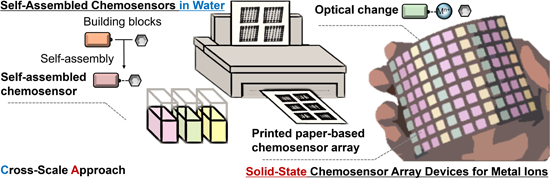
- and further amplified by optical manipulators. To induce recognizable optical responses, molecular dynamics during the association and dissociation of color manipulators are significant [36]. Dynamic covalent bonds are key motifs that contribute to the formation of self-assembled chemosensors and


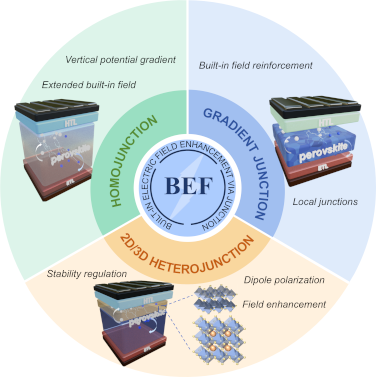
Recent progress in enhancing built-in electric fields of perovskite solar cells via junction engineering
Beilstein J. Nanotechnol. 2026, 17, 602–621, doi:10.3762/bjnano.17.42



Probing tribological evolution in atomically thin MoS2 at different scales
Beilstein J. Nanotechnol. 2026, 17, 586–597, doi:10.3762/bjnano.17.40
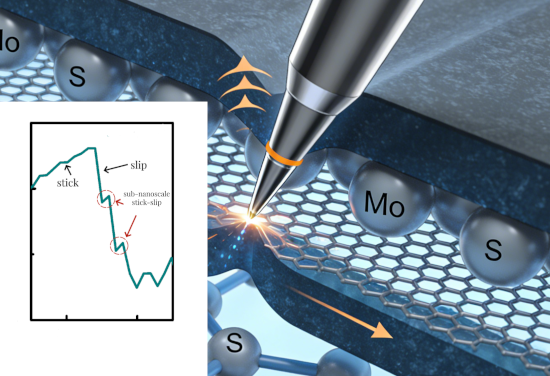
- –slip events driven by in-plane tip apex motion and modulated by contact geometry via molecular dynamics (MD) simulations and frictional force microscopy (FFM) [11][12]. Despite these theoretical and simulation insights, experimental observation and quantification of sub-nanoscale stick–slip motion in
- thin MoS2 poses considerable challenges, primarily due to the ultrasmall time and length scales involved. According to molecular dynamics simulations by Yoon et al. [11], this sub-nanoscale motion is strongly correlated with the in-plane displacement of the AFM tip apex, a motion that can be modulated


Defects and defect-mediated engineering of two-dimensional materials: challenges and open questions
Beilstein J. Nanotechnol. 2026, 17, 454–488, doi:10.3762/bjnano.17.31
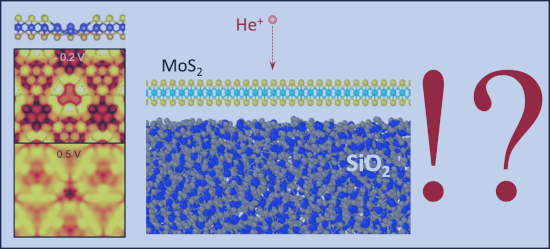
- . Despite the high reactivity of larger S vacancy clusters, several challenges remain in describing the oxidation kinetics. O2 is bound weakly to TMD surfaces with a binding energy of ≈0.14 eV [55][63][64][65]. Ab initio molecular dynamics (MD) simulations show that O2 is therefore mobile on the pristine
- density and their random distribution, which makes it computationally extremely demanding to determine structural dynamics, whether from molecular dynamics or from harmonic approximation plus finite displacements. This can nowadays be overcome by using machine learning interatomic potentials (MLIPs





Nanoinformatics: spanning scales, systems and solutions
Beilstein J. Nanotechnol. 2026, 17, 423–427, doi:10.3762/bjnano.17.28

- nanomaterial’s behaviour, preparation, or test conditions) [2]. Voyiatzis et al. computationally studied, using atomistic molecular dynamics simulations, the morphological transformations (from molten/amorphous to crystalline) during rapid cooling of 1–8 nm spherical gold and platinum nanoparticles (NPs), which
- reactivity [3]. Amini et al. combined atomistic molecular dynamics, a coarse-grained model of protein adsorption, and kinetic Monte Carlo simulations to predict the protein corona composition formed on aluminium surfaces with different crystal faces, (i.e., (100), (110), and (111)) from a simplified model of
- classical molecular dynamics and ab initio calculations revealed that TA preferentially binds to the most reactive sites on GO surfaces via oxygen-containing groups or the carbon matrix. The binding energy was dominated by van der Waals interaction forces. A dose-dependent mitigating effect of TA on the

Micro- and nanoscale effects in biological and bioinspired materials and surfaces
Beilstein J. Nanotechnol. 2026, 17, 214–217, doi:10.3762/bjnano.17.14
- characterization of functional plant tissues [19] integrating experiments and finite element models, and animal tissues [20] incorporating molecular dynamics and finite element methods. Investigating the anisotropic hygroscopic behavior of the involved materials in bending in pine cone scales, Ulrich et al. [19
- adhesion. They combined molecular dynamics for the simulation of the adhesive contact between the gecko spatula and the substrate with finite element modeling of the mechanical behavior of the adhesive seta to understand key aspects of gecko seta adhesion across scales. Besides these studies, focusing on
Safe and sustainable by design with ML/AI: A transformative approach to advancing nanotechnology
Beilstein J. Nanotechnol. 2026, 17, 176–185, doi:10.3762/bjnano.17.11
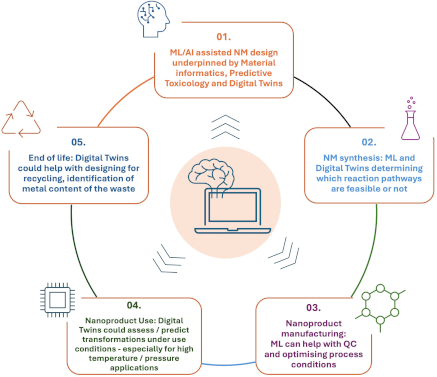
- powerful aspects of materials informatics lies in its ability to integrate machine learning with multiscale simulation tools – ranging from molecular dynamics to density functional theory – which helps researchers correlate nanoscale features such as particle size, shape, and surface functionalization with


Missing links in nanomaterials research impacting productivity and perceptions
Beilstein J. Nanotechnol. 2025, 16, 2168–2176, doi:10.3762/bjnano.16.149
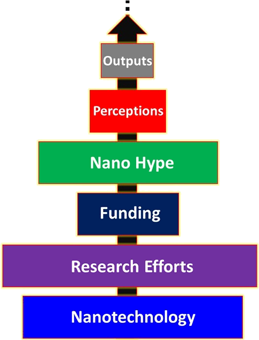
- are now accessible for real-world technological applications. In addition, nanoscience has initiated several new areas in fundamental physics and molecular dynamics, representing a profound scientific achievement of the 21st century [12]. It is noteworthy that these developments have strongly
Molecular and mechanical insights into gecko seta adhesion: multiscale simulations combining molecular dynamics and the finite element method
Beilstein J. Nanotechnol. 2025, 16, 2055–2076, doi:10.3762/bjnano.16.141
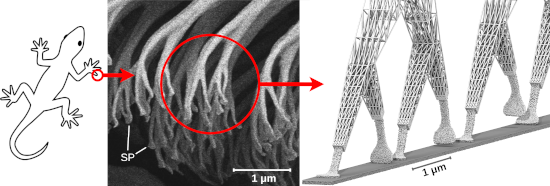
- limitations inherent in single-scale models. Keywords: finite element method; gecko adhesion; hybrid modeling; molecular dynamics; multiscale simulations; seta; spatula; Introduction Geckos possess the ability to adhere to a variety of substrates, a trait attributed to specialized micro- and nanoscale
- scales involved. In previous research, we used molecular dynamics simulations to explore various aspects of gecko adhesion [10][11][12][13]. We found that humidity increases the force required to pull a spatula off from a substrate [10][12], a phenomenon also observed in high-humidity atomic force
- around 1014 atoms for a single gecko seta. Coarse-graining [14][15] can improve the situation, but not by more than 1–2 orders of magnitude. Consequently, multiscale approaches combining continuum methods like the finite element method (FEM) [16][17][18] with particle-based molecular dynamics (MD) [19






Stereodiscrimination of guests in chiral organosilica aerogels studied by ESR spectroscopy
Beilstein J. Nanotechnol. 2025, 16, 2034–2054, doi:10.3762/bjnano.16.140
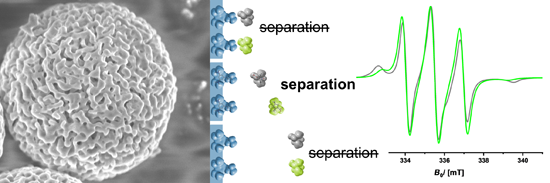
- by the methyl groups. It was shown that the line shape of the characteristic ESR signals of nitroxide spin probes depends strongly on molecular dynamics. Because of the anisotropy of Zeeman and hyperfine coupling, one can extract detailed information about the rotational dynamics. Highly mobile spin
- reported specific rotation value of 79° [65]. Enantiomeric excess values (ee) of 97% for (+)-3CP and 95% for (−)-3CP were obtained. The 3CP probe can be infiltrated into different hosts, and, from continuous wave (cw) ESR spectra, various information about the molecular dynamics can be obtained, as we have




Modeling magnetic properties of cobalt nanofilms used as a component of spin hybrid superconductor–ferromagnetic structures
Beilstein J. Nanotechnol. 2025, 16, 1557–1566, doi:10.3762/bjnano.16.110
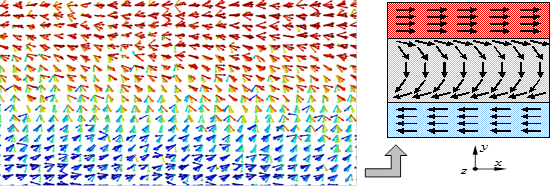
- thin films and the formation of Neel domain walls. Keywords: ferromagnetic properties; LAMMPS; mathematical modeling; MEAM; molecular dynamics; spin dynamics; Introduction Thin film structures [1][2] are increasingly employed each year in a wide range of applications, serving as functional [3][4


Time-resolved probing of laser-induced nanostructuring processes in liquids
Beilstein J. Nanotechnol. 2025, 16, 968–1002, doi:10.3762/bjnano.16.74
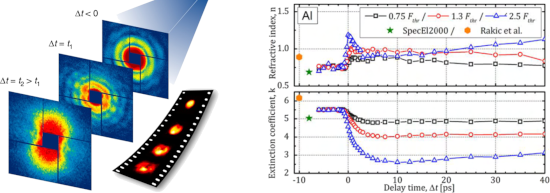
- transitions can be well modeled by classical approaches down to the nanometer scale in a local thermodynamic equilibrium [32][33][34]. A synthesis of the different coevolving phenomena with excitation and dissipation requires more detailed numerical approaches [35] or simulations. Molecular dynamics (MD


Heat-induced transformation of nickel-coated polycrystalline diamond film studied in situ by XPS and NEXAFS
Beilstein J. Nanotechnol. 2025, 16, 887–898, doi:10.3762/bjnano.16.67
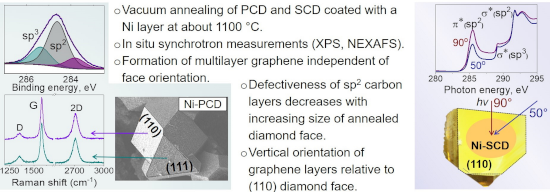
- sp3 hybridization is a metastable material. A significant activation barrier hampers its relaxation into sp2 graphitic carbon, and this transformation occurs during vacuum heating in the temperature range of 1500–1800 °C [9]. According to molecular dynamics simulations, graphitization of nonterminated


Supramolecular hydration structure of graphene-based hydrogels: density functional theory, green chemistry and interface application
Beilstein J. Nanotechnol. 2025, 16, 806–822, doi:10.3762/bjnano.16.61
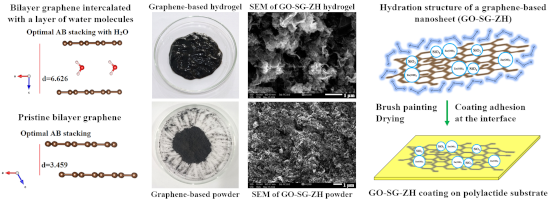
- attraction. In the molecular dynamics simulations by Hasheminejad et al., the interfacial interaction energy between graphene oxide nanosheet and polylactide matrix is assigned to van der Waals forces and hydrogen bonds [62]. The bonding network of GO-SG-ZH nanosheets in the coating is another reason for the


Nanomaterials in targeting amyloid-β oligomers: current advances and future directions for Alzheimer's disease diagnosis and therapy
Beilstein J. Nanotechnol. 2025, 16, 561–580, doi:10.3762/bjnano.16.44
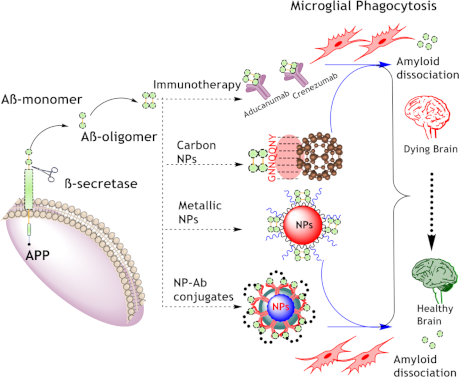
- , particularly those associated with NDs like AD. Research has demonstrated the ability of fullerenes to prevent the aggregation of Aβ peptides. For instance, molecular dynamics simulations have shown that fullerenes inhibit the fibrillation of the hydrophobic KLVFFAE peptide by disrupting the formation of β
- , thereby mitigating their neurotoxic effects [62][72]. In addition to their inhibitory capabilities, SWCNTs can serve as effective sensors for AβOs. Their ability to interfere with β-sheet formation, a hallmark of Aβ aggregation, has been confirmed through comprehensive molecular dynamics simulations
- modalities, including hydrophobic and hydrogen bonding, leading to substantial inhibition of peptide aggregation [79]. In another innovative approach, Javed et al. evaluated the inhibitory potential of casein-coated AuNPs against oligomers through molecular dynamics simulations. Their findings demonstrated


Water in nanoporous hexagonal boron nitride nanosheets: a first-principles study
Beilstein J. Nanotechnol. 2025, 16, 510–519, doi:10.3762/bjnano.16.39
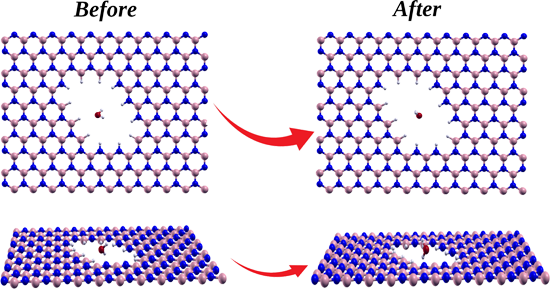
- desalination technology [4][5][6]. Computational methods have been employed to enhance the understanding of nanoscale desalination processes. In this context, the use of molecular dynamics and ab initio calculations allows for the study of the physics involved in nanostructured membrane materials designed to
- as a molecular sieve [22][23][24][25]. Theoretical studies using molecular dynamics simulations analyzed the impact of the partial charge on the h-BN membrane surface on water molecules and salt ion transport [26]. They noted that the Coulomb interaction between water molecules/ions and the channels




Impact of adsorbate–substrate interaction on nanostructured thin films growth during low-pressure condensation
Beilstein J. Nanotechnol. 2025, 16, 473–483, doi:10.3762/bjnano.16.36

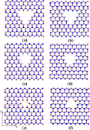
- adsorbate can be found in real experiments or can be calculated by atomistic simulations (ab initio techniques or molecular dynamics simulations). In our study, a variation in means a usage of different materials for both substrate and adsorbate to simulate the formation of stable surface structures during


Vortex lattices of layered HTSCs at different vortex–vortex interaction potentials
Beilstein J. Nanotechnol. 2025, 16, 362–370, doi:10.3762/bjnano.16.27
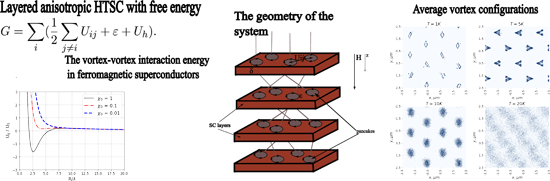
- molecular dynamics simulation of a vortex system in a superconductor with was performed, and a phase B–T diagram was obtained (B is the magnetic field and T is the temperature of the vortex system), which contains regions of a hexagonal vortex lattice, a striped structure, and a lattice of vortex clusters


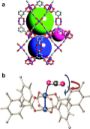
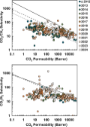
A review of metal-organic frameworks and polymers in mixed matrix membranes for CO2 capture
Beilstein J. Nanotechnol. 2025, 16, 155–186, doi:10.3762/bjnano.16.14




Mechanistic insights into endosomal escape by sodium oleate-modified liposomes
Beilstein J. Nanotechnol. 2024, 15, 1667–1685, doi:10.3762/bjnano.15.131
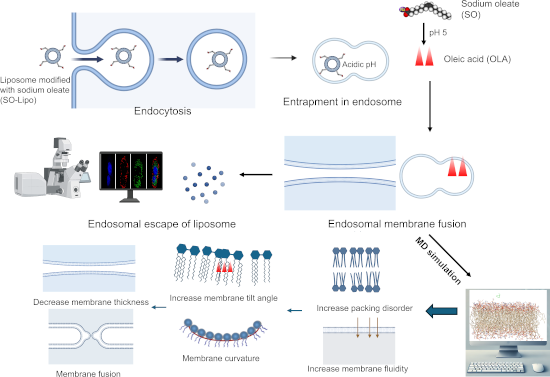
- measuring the colocalization of labeled liposomes with lysosomal markers, quantified using Pearson’s correlation coefficient. Lipid mixing assays assessed the potential fusogenic effect, and molecular dynamics (MD) simulations explored the interactions of protonated sodium oleate (SO) with the endosomal
- mechanism, facilitating cytosolic delivery with reduced cytotoxicity. This approach offers a safer and more effective option for targeted drug delivery applications. Keywords: Aurein 1.2; endosomal escape; fusogenic effect; molecular dynamics simulation; sodium oleate; Introduction The quest for efficient
- complexes with liposomal components, enhancing both liposome stability and drug encapsulation. To gain deeper insight into the mechanisms underpinning SO’s potential as an endosomal escape agent, molecular dynamics (MD) simulations have emerged as an indispensable computational tool. These simulations




Heterogeneous reactions in a HFCVD reactor: simulation using a 2D model
Beilstein J. Nanotechnol. 2024, 15, 1627–1638, doi:10.3762/bjnano.15.128
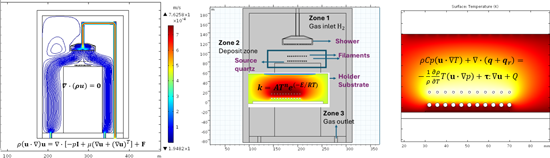
- . Different tools such as ab initio density functional theory [13][14], kinetic Monte Carlo simulations [15][16], and reactive molecular dynamics simulations [17][18] have been used to understand the chemical reactions underlying the growth of the films [19]. Modeling the reaction mechanism in both two


Integrating high-performance computing, machine learning, data management workflows, and infrastructures for multiscale simulations and nanomaterials technologies
Beilstein J. Nanotechnol. 2024, 15, 1498–1521, doi:10.3762/bjnano.15.119

- molecules based on force-field molecular dynamics (MD). While simple, this workflow exhibits the main features of more complex simulations. The consistent representation of this workflow within MAMBO can therefore be instructive of the approach pursued and gives possible hints of the ability to formalize
- within an IATA framework, there are the following: VMD (Visual Molecular Dynamics) is a molecular visualization program that provides a platform for the modelling, visualization, and analysis of molecular and biological systems. It is widely used for the development of materials’ digital twins and the
- simulations [21][22]. Modern GPUs, originally designed for gaming and multimedia applications, possess immense parallel processing capabilities that can be harnessed for scientific computations. Researchers have successfully leveraged GPUs to accelerate computationally intensive simulations, such as molecular


Effect of radiation-induced vacancy saturation on the first-order phase transformation in nanoparticles: insights from a model
Beilstein J. Nanotechnol. 2024, 15, 1453–1472, doi:10.3762/bjnano.15.117

- effects led to a polymorphic phase change, transforming the high-density fcc structure to a low-density hexagonal close-packed crystallographic phase. The investigation of the radiation stability of nanocrystalline single-phase multicomponent alloys (NiFe, NiCoFe, and NiCoCr) using molecular dynamics


Interaction of graphene oxide with tannic acid: computational modeling and toxicity mitigation in C. elegans
Beilstein J. Nanotechnol. 2024, 15, 1297–1311, doi:10.3762/bjnano.15.105
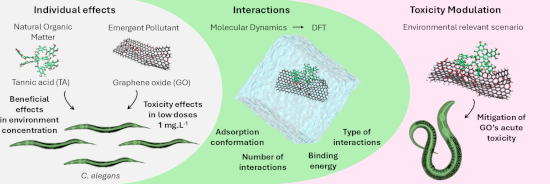
- modeling, including reactive classical molecular dynamics and ab initio calculations, we reveal that TA preferentially binds to the most reactive sites on GO surfaces via the oxygen-containing groups or the carbon matrix; van der Waals interaction forces dominate the binding energy. TA exhibits a dose
- toxicity and highlight the potential of tannic acid for the synthesis and surface functionalization of graphene-based nanomaterials, offering insights into safer nanotechnology development. Keywords: biodistribution; density functional theory; ecotoxicity; molecular dynamics; surface interactions
- are useful to predict and interpret experimental results. We performed, therefore, a multilevel study with different theory levels; reactive classical molecular dynamics enabled the exploration of the chemical and conformational changes of TA and GO, whereas ab initio calculations provided information


Atomistic insights into the morphological dynamics of gold and platinum nanoparticles: MD simulations in vacuum and aqueous media
Beilstein J. Nanotechnol. 2024, 15, 995–1009, doi:10.3762/bjnano.15.81
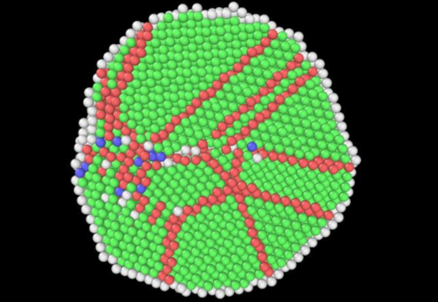
- spherical nanoparticles (NPs) upon cooling is studied through atomistic molecular dynamics simulations. The goal is to identify the morphological transformations occurring in the nanomaterials as well as to quantify their dependence on temperature, chemistry, and NP size. For diameters smaller than 3 nm
- employed to study other metallic and metal oxide nanomaterials. Keywords: crystallization; gold; molecular dynamics; nanoparticles; platinum; Introduction Nanomaterials, that is, materials with dimensions in the range of 1–100 nm [1][2], are central to a variety of developments in science and technology
- adapting theories suitable for bulk materials to NPs; examples include the classical nucleation theory [33], phenomenological models [34][35][36], as well as molecular simulations [37][38][39][40]. A molecular dynamics (MD) study of shape transformation and melting of tetrahexahedral Pt NPs has been





