Search results
Search for "SRIM" in Full Text gives 36 result(s) in Beilstein Journal of Nanotechnology.
Nanoporous Ge thin film production combining Ge sputtering and dopant implantation
Beilstein J. Nanotechnol. 2015, 6, 336–342, doi:10.3762/bjnano.6.32
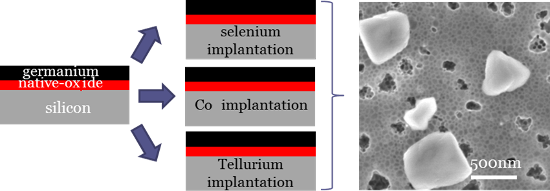
- 180 keV, and (iii) the last set of samples were co-implanted with both Se and Te atoms under the same conditions as previously mentioned. Figure 1 shows the predicted dopant and vacancy concentration profiles induced by implantation using the Stopping and Range of Ions in Matter (SRIM) software. This
- system is fully miscible, corresponding to an ideal solution [31]). Usually, a damage energy higher than 5 eV/atoms1 corresponding to a vacancy concentration of ≈1.7 × 10²² vac/cm3 leads to Ge amorphization [32]. Thus, the SRIM calculations predict the formation of an amorphous Ge layer from the surface
- images using the ImageJ software developed at the National Institute of Health. The errors in the measurements can be estimated with the original SEM image resolution. SRIM calculations of the implant distribution of Te (red) and Se (blue) atoms in Ge. The distributions of implanted ions are shown using


Synthesis of Pt nanoparticles and their burrowing into Si due to synergistic effects of ion beam energy losses
Beilstein J. Nanotechnol. 2014, 5, 1864–1872, doi:10.3762/bjnano.5.197
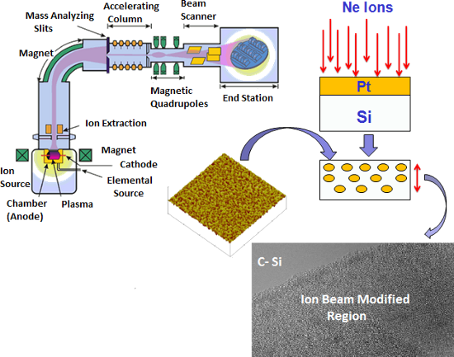
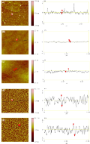
- . Results and Discussion Using stopping and range of ions in matter (SRIM) calculations [38], the energy losses (both electronic and nuclear) by neon ions in the Pt film as a function of ion energy is shown in Figure 1. Unlike swift, heavy ions (with an energy of approximately hundreds of MeV) that undergo
- energy (SRIM calculation for neon ions incident on Pt). AFM images: a) pristine film, b–e) films irradiated with 50 keV, 140 keV, 350 keV and 600 keV, respectively. Rutherford backscattering spectra of the pristine and the irradiated films (Pt–Si). SEM images: a) pristine sample, b) 350 keV ion



Microstructural and plasmonic modifications in Ag–TiO2 and Au–TiO2 nanocomposites through ion beam irradiation
Beilstein J. Nanotechnol. 2014, 5, 1419–1431, doi:10.3762/bjnano.5.154
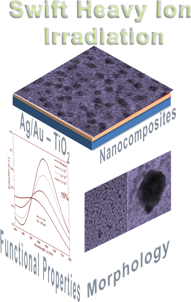
- %) were irradiated by 100 MeV Ag8+ ions at different fluences (1 × 10¹², 3 × 10¹², 1 × 10¹³ ions/cm2) by using the Pelletron accelerator facility at Inter University Accelerator Centre, New Delhi. The energy of the Ag ions was selected by “Stopping and range of ions in matter (SRIM) 2008” calculations [51


Synthesis of embedded Au nanostructures by ion irradiation: influence of ion induced viscous flow and sputtering
Beilstein J. Nanotechnol. 2014, 5, 105–110, doi:10.3762/bjnano.5.10
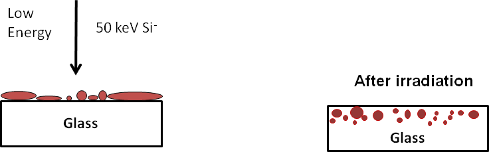
- (Rp ≈ 20 nm) of the incident ions in the metal film (t < Rp in the present study, from SRIM calculation [27]). The effect of sputtering and recoil implantation on the depth profile of Au in the sample can be simulated by using TRIDYN [27]. TRIDYN takes into account compositional changes of the target


Digging gold: keV He+ ion interaction with Au
Beilstein J. Nanotechnol. 2013, 4, 453–460, doi:10.3762/bjnano.4.53
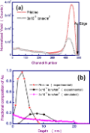
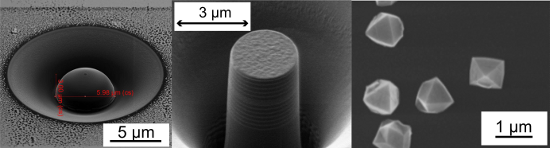
- it is backscattered, and some diffuses into the bulk or out of the material. SRIM-2011 [40] has been used to assess the percentage of backscattered helium. A gold slab with a thickness of 200 nm and 105 ions have been used in the calculations. According to these simulations 16% of the incident helium


Diamond nanophotonics
Beilstein J. Nanotechnol. 2012, 3, 895–908, doi:10.3762/bjnano.3.100
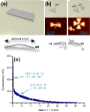
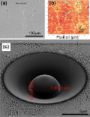
- ” (SRIM) package implements such simulations [5]. Figure 1b shows the simulated ion traces achieved with the high-aspect-ratio mica mask. The simulations confirm that the spatial accuracy of the implantation is limited by straggle to about 100 nm. Figure 2a shows a high-resolution optical microscope image
- bombardment with 1.6 GeV samarium ions. The channels appear as dark parallelograms. The inset shows the dimensions of an individual ion channel. (b) SRIM simulation of the ion implantation process through the mica mask. The thickness of the mica mask is chosen in the range 5–20 μm, such that the nitrogen ions





Pure hydrogen low-temperature plasma exposure of HOPG and graphene: Graphane formation?
Beilstein J. Nanotechnol. 2012, 3, 852–859, doi:10.3762/bjnano.3.96
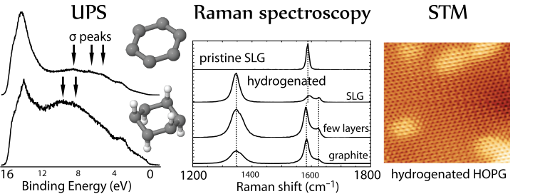
- deeper into the first 4–5 layers of HOPG, suggested by the SRIM simulations [11]. The question is: Will graphane form after the plasma exposure and if it does, is it possible to distinguish its existence from other possible surface rearrangements caused by the exposure? Before starting, it should be



Nano-structuring, surface and bulk modification with a focused helium ion beam
Beilstein J. Nanotechnol. 2012, 3, 579–585, doi:10.3762/bjnano.3.67
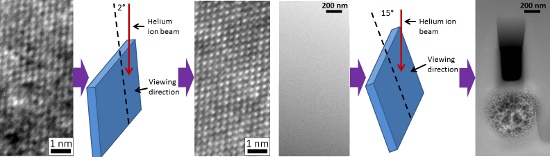
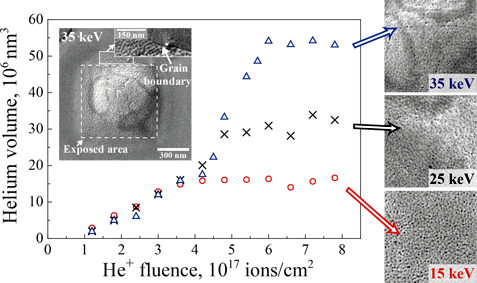
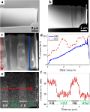
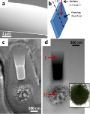
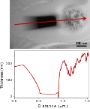
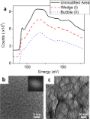
- feature is approximately at the implantation depth of 35 keV helium ions in silicon, about 318 nm (SRIM) [26]. This is made clear by the SRIM simulation image inset in Figure 4d showing the distribution of 35 keV helium ions in silicon; this simulation has the same scale as the image and correlates well
- face of the sample at an angle of 15°. (c) Bright field TEM image of the area modified by helium ions. (d) HAADF image of the modified area. “I” shows the location of the wedge shape and “II” shows the circular area with bubbles. Inset is a SRIM simulation of 35 keV helium ions in silicon with the same


Imaging ultra thin layers with helium ion microscopy: Utilizing the channeling contrast mechanism
Beilstein J. Nanotechnol. 2012, 3, 507–512, doi:10.3762/bjnano.3.58
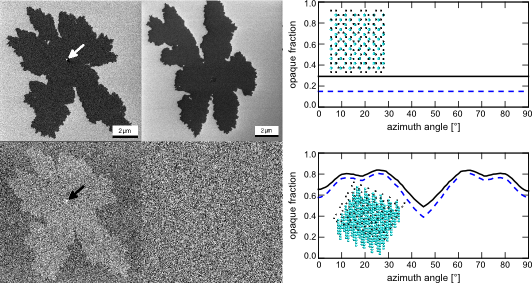
- unit-cell size, the positions of the carbon adatoms were different in these eight channels. To average over many possible configurations for the overlayer atoms, the adlayer was shifted across 25 different positions relative to the bulk. SRIM [11] calculations to obtain measures for the backscatter
- probability and the range of the helium particles were performed with SRIM-2008 and the quick Kinchin–Pease formalism [11][12]. To ensure a sound statistical result 1 × 10⁵ He ions of the selected energy were traced in appropriately thick slabs of the bulk material. Results Thin organic layers In Figure 1 HIM
- . To underline the above statement, SRIM calculations were used to obtain a generic view of the expected processes. Artificial silicon samples with a thickness of 1 μm and a 10 nm adlayer of either heavy (Pb) or light (Li) elements, and without an adlayer were compared. 1 × 10⁵ He+ ions with a PE of 35


Channeling in helium ion microscopy: Mapping of crystal orientation
Beilstein J. Nanotechnol. 2012, 3, 501–506, doi:10.3762/bjnano.3.57
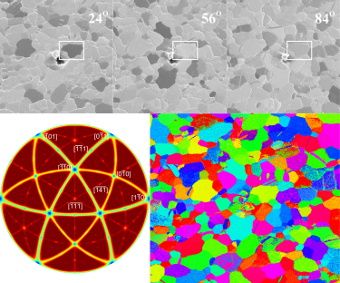
- into the vacuum chamber. In addition the samples were cleaned for 15 min in the load lock by using a 10 W air plasma. SRIM-2011 [5] was used to assess the damage caused by the swift helium atoms. The Monte Carlo code was setup to track the full damage cascade and 1 × 10⁶ ions were used. To obtain a
- for this is rooted in the low number of ions used per pixel. In the present case only 2375 ions are used per pixel, of which roughly 20% are backscattered, according to SRIM calculations. However, not all of these 500 ions will be counted by the detector. Different to the SE images, BSHe images
- sample areas and therefore not affect the SE images directly. Using SRIM [5] and a PE of 15 keV into gold, we calculate that 49 vacancies are generated per ion. After a fluence of 4.9 × 1014 cm−2, necessary to record one image, the defect density at a depth of 3 nm is 4% for the 0 K SRIM simulation. If




Preparation and characterization of supported magnetic nanoparticles prepared by reverse micelles
Beilstein J. Nanotechnol. 2010, 1, 24–47, doi:10.3762/bjnano.1.5