


Search results
Search for "Tauc plot" in Full Text gives 28 result(s) in Beilstein Journal of Nanotechnology.
Microstructural and plasmonic modifications in Ag–TiO2 and Au–TiO2 nanocomposites through ion beam irradiation
Beilstein J. Nanotechnol. 2014, 5, 1419–1431, doi:10.3762/bjnano.5.154
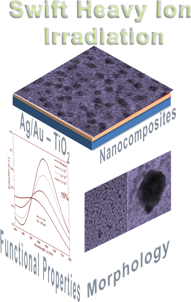
- wavelengths, which indicates an improvement in crystallinity of the matrix. From Tauc plot analyses for both nanocomposites, a shift of ca. 0.1 eV in the band-edge energy of TiO2 (between pristine and 1 × 10¹³ ions/cm2) is observed, which also confirms the structural changes in the TiO2 matrix. The red shift


Characterization and photocatalytic study of tantalum oxide nanoparticles prepared by the hydrolysis of tantalum oxo-ethoxide Ta8(μ3-O)2(μ-O)8(μ-OEt)6(OEt)14
Beilstein J. Nanotechnol. 2014, 5, 1082–1090, doi:10.3762/bjnano.5.121
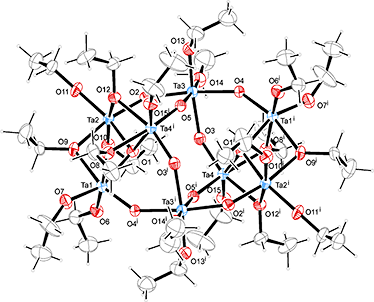
- characterized by various techniques such as TGA-DTA-DSC, UV–vis DRS, XRD, SEM, TEM, particle size analyzer (DLS) and the Brunauer–Emmett–Teller (BET) method. The band gap of the particles was calculated by using the Tauc plot. The photocatalytic activity of Ta2O5 nanoparticles was tested by the degradation of
- the organic dye rhodamine B. Keywords: bandgap; tantalum-oxo-ethoxide; Tauc plot; tantalum pentoxide (Ta2O5); Introduction Metal alkoxides, being excellent precursors in the sol–gel process for preparation of metal oxides have attained huge attention of researchers. Several attempts have been made
- material, E is the photon energy, Eg is the band gap energy and n is a constant of different values, 1/2, 3/2, 2 and 3, depending on the type of electronic transition, i.e., permitted/prohibited-direct or indirect transition. The band gap is calculated from a Tauc plot [27][28][29][30]. The band gap of the


Mesoporous cerium oxide nanospheres for the visible-light driven photocatalytic degradation of dyes
Beilstein J. Nanotechnol. 2014, 5, 517–523, doi:10.3762/bjnano.5.60
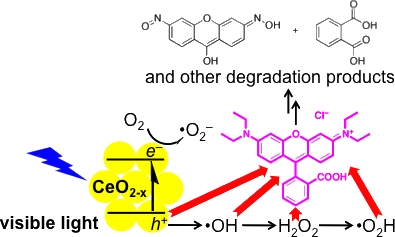
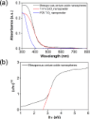
- P25 TiO2 nanomaterials. The estimated band gap from the Tauc plot is approximately 2.7 eV (Figure 2b), which corresponds to an absorption edge in the blue region (460 nm). The reduced band gap compared to CeO2 can be attributed to the presence of oxygen vacancies, as previously reported [32]. The
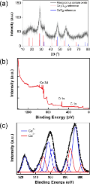
- spectrum. (c) High-resolution XPS spectrum of mesoporous cerium oxide (black circles) with the overall fit (black) and the fits to Ce4+ (blue) and Ce3+ (red). (a) UV–vis diffuse reflectance spectra of cerium oxide nanospheres (black), 7 nm CeO2 (red) nanopowder, and P25 TiO2 (blue). (b) Tauc plot for

Other Beilstein-Institut Open Science Activities



