


Search results
Search for "band alignment" in Full Text gives 32 result(s) in Beilstein Journal of Nanotechnology.
Synthesis and applications of carbon nanomaterials for energy generation and storage
Beilstein J. Nanotechnol. 2016, 7, 149–196, doi:10.3762/bjnano.7.17
















Functionalized nanostructures for enhanced photocatalytic performance under solar light
Beilstein J. Nanotechnol. 2014, 5, 994–1004, doi:10.3762/bjnano.5.113
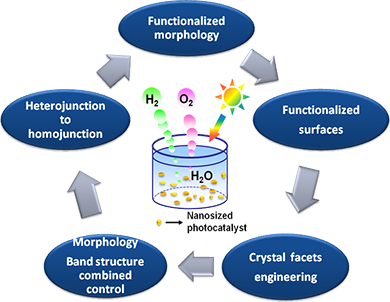
- nanoscale, i.e., materials with the same compositions but different phases with certain band alignment. We conclude this review with perspectives on nanostructure design that might direct future research of this technology. Keywords: functionalized nanostructures; hydrogen; photocatalysis; photocatalytic
- with well-tailored band alignment provides a powerful means to the improvement of the photocatalytic activity. In the process of our study, we have also paid special attention on the nanoscale control of the material morphology and construction of functionalized nanostructures to promote charge
- junction-free semiconductors [66]. Depending on the band gaps and the electronic affinity of semiconductors, semiconductor heterostructures can be divided into three different cases: type-I, type-II and type-III band alignment [67]. In a type-II band alignment, the band offsets in the conduction and


Biomolecule-assisted synthesis of carbon nitride and sulfur-doped carbon nitride heterojunction nanosheets: An efficient heterojunction photocatalyst for photoelectrochemical applications
Beilstein J. Nanotechnol. 2014, 5, 770–777, doi:10.3762/bjnano.5.89
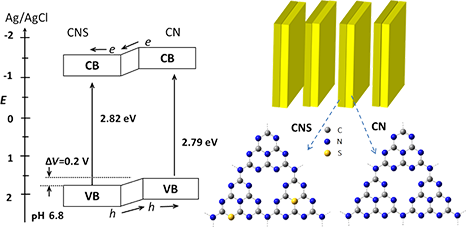
- ). This type-II band alignment means that once CN and CNS are electronically coupled, a well-matched band structure for charge separation will be formed. In this case, the photogenerated electrons are transferred from CN to CNS, while the photogenerated holes are transferred from CNS to CN, leading to an
- photoelectrode, which can be attributed to the large contact area between the CN/CNS photoelectrode and the electrolyte as well as an appropriate band alignment of the CN/CNS interface. It has been well-established that photocurrent is generated because of the diffusion of photogenerated electrons to the back


Nanostructure sensitization of transition metal oxides for visible-light photocatalysis
Beilstein J. Nanotechnol. 2014, 5, 696–710, doi:10.3762/bjnano.5.82
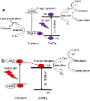
- the band alignment between CdS and CdSe, the co-sensitized ZnO nanowire arrayed photoanode exhibited almost the entire visible-light absorption and fast electron transfer from CdSe quantum dots to ZnO nanowires and thereby the IPCE value can reach 45% at 0 V vs Ag/AgCl, as demonstrated in Figure 4c




Synthesis of indium oxi-sulfide films by atomic layer deposition: The essential role of plasma enhancement
Beilstein J. Nanotechnol. 2013, 4, 750–757, doi:10.3762/bjnano.4.85
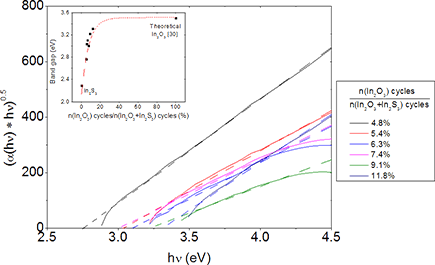
- of their properties [13][14][15]. It is therefore a suitable technique for the deposition of buffer layers. Platzer-Björkman et al. have used ALD to improve the energy-band alignment between the CIGS and the front electrode by controlling the oxygen concentration in Zn(S,O) buffer layers [4][16



Low-temperature synthesis of carbon nanotubes on indium tin oxide electrodes for organic solar cells
Beilstein J. Nanotechnol. 2012, 3, 524–532, doi:10.3762/bjnano.3.60
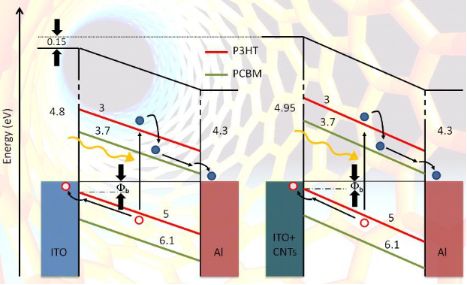
- states of ITO–CNT lying lower than those of ITO. A similar kind of band alignment is almost achieved in the standard cell architecture by the insertion of a layer of poly(3,4-ethylene dioxythiophene):(polystyrene sulfonic acid) (PEDOT:PSS). This polymer is used to improve the contact (and reduce the




Dense lying self-organized GaAsSb quantum dots on GaAs for efficient lasers
Beilstein J. Nanotechnol. 2011, 2, 333–338, doi:10.3762/bjnano.2.39
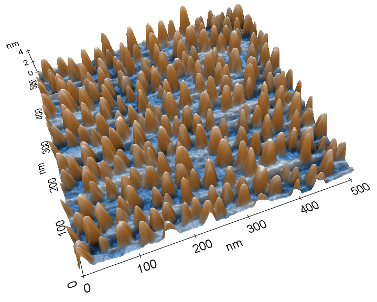
- (SK) growth, depending on the precise control of the Sb/Ga V/III flux ratio, coverage, and growth temperature. Furthermore these parameters influence dot shape, size and density. The staggered (type-II) band alignment with a large valence band offset provides hole confinement. The electronic states


Other Beilstein-Institut Open Science Activities



