


Search results
Search for "biodegradation" in Full Text gives 36 result(s) in Beilstein Journal of Nanotechnology.
The different ways to chitosan/hyaluronic acid nanoparticles: templated vs direct complexation. Influence of particle preparation on morphology, cell uptake and silencing efficiency
Beilstein J. Nanotechnol. 2019, 10, 2594–2608, doi:10.3762/bjnano.10.250
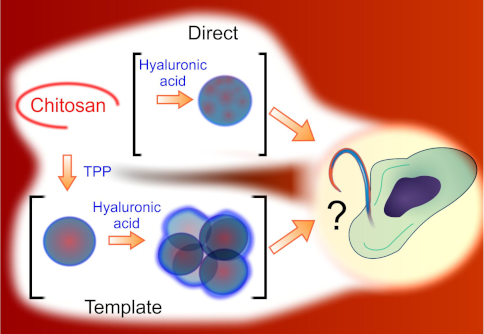
- as the cationic component in polyplexes and other drug delivery vehicles [1][2][3]. In comparison to other polycations, its main advantages are the low toxicity and its biodegradability. Biodegradation can occur both enzymatically and oxidatively [4]. A number of methods can be employed to prepare



Nanoconjugates of a calixresorcinarene derivative with methoxy poly(ethylene glycol) fragments for drug encapsulation
Beilstein J. Nanotechnol. 2018, 9, 2057–2070, doi:10.3762/bjnano.9.195
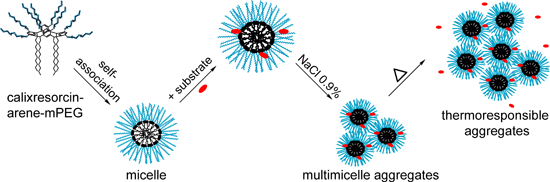
- stability of the nanocontainer and prevents premature release and biodegradation of the drug; the conjugation of PEG and calixresorcinarene will yield an amphiphile with improved binding properties due to the contribution of macrocycle platform to the interaction with substrates. This can lead to an


Atomic-level characterization and cilostazol affinity of poly(lactic acid) nanoparticles conjugated with differentially charged hydrophilic molecules
Beilstein J. Nanotechnol. 2018, 9, 1328–1338, doi:10.3762/bjnano.9.126
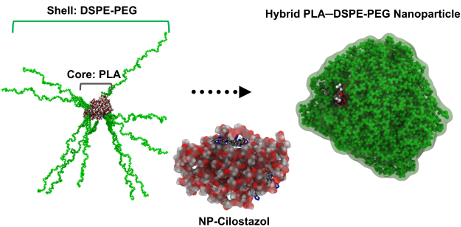
- many other nanosystems concerning their biodegradation, biocompatibility and highly modifiable physical and mechanical properties [1][4][5][6]. Polymeric materials also have demonstrated superior efficacy to deliver therapeutic agents at the site of the disease or damaged area and protecting drugs


Facile synthesis of silver/silver thiocyanate (Ag@AgSCN) plasmonic nanostructures with enhanced photocatalytic performance
Beilstein J. Nanotechnol. 2017, 8, 2781–2789, doi:10.3762/bjnano.8.277
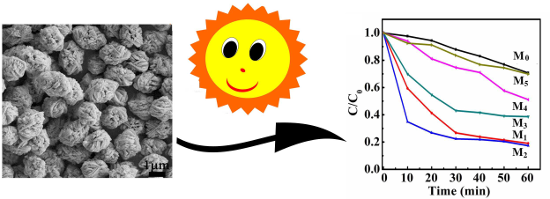
- intensively investigated in recent years, and various methods such as adsorption, biodegradation, photocatalytic degradation and chemical oxidation have been developed [1][2][3][4]. Among them, photocatalytic degradation is considered as one of the most effective strategies due to its high removal efficiency


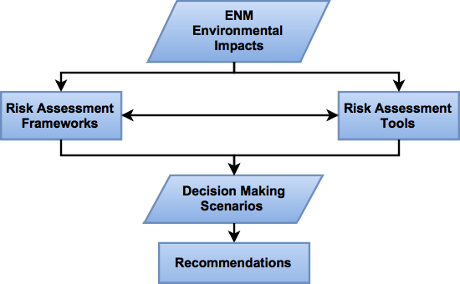
Needs and challenges for assessing the environmental impacts of engineered nanomaterials (ENMs)
Beilstein J. Nanotechnol. 2017, 8, 989–1014, doi:10.3762/bjnano.8.101

High photocatalytic activity of Fe2O3/TiO2 nanocomposites prepared by photodeposition for degradation of 2,4-dichlorophenoxyacetic acid
Beilstein J. Nanotechnol. 2017, 8, 915–926, doi:10.3762/bjnano.8.93
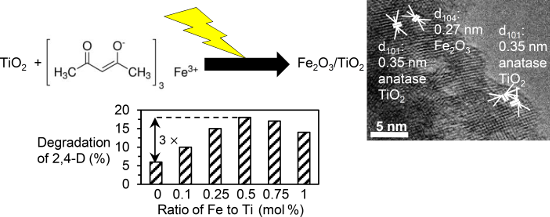
- be eliminated from the water source utilizing efficient approaches. Various removal methods of 2,4-D have been developed, including adsorption [24], biodegradation [25], ozonation [26], and photocatalytic degradation [15][20][21][22][27][28][29][30][31][32], of which the latter has been recognized


An efficient recyclable magnetic material for the selective removal of organic pollutants
Beilstein J. Nanotechnol. 2016, 7, 1447–1453, doi:10.3762/bjnano.7.136
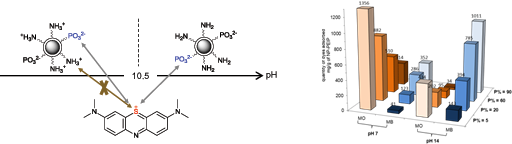
- hazard for human health, even at low concentrations [1][2][3]. Many technologies such as photodegradation, biodegradation, the Fenton process, or extraction by liquid membranes have been developed to eliminate these compounds in wastewater [4][5][6]. Among them, adsorption-based methods are extensively


Fabrication of hybrid nanocomposite scaffolds by incorporating ligand-free hydroxyapatite nanoparticles into biodegradable polymer scaffolds and release studies
Beilstein J. Nanotechnol. 2015, 6, 2217–2223, doi:10.3762/bjnano.6.227
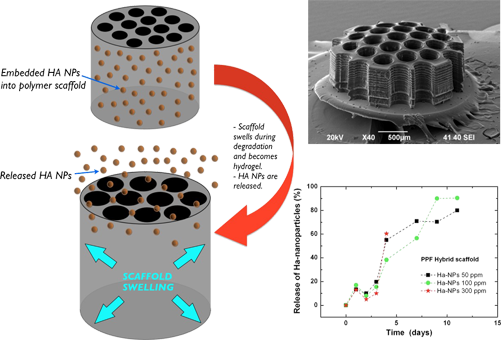
- gradual release of the hydroxyapatite nanoparticles over thin film biodegradation is reported. Keywords: biodegradable scaffolds; biodegradation; hydroxyapatite; laser ablation in liquid; stereolithography; Introduction Interfaces between osteochondral prosthetics and the surrounding bone tissue are of


PLGA nanoparticles as a platform for vitamin D-based cancer therapy
Beilstein J. Nanotechnol. 2015, 6, 1306–1318, doi:10.3762/bjnano.6.135
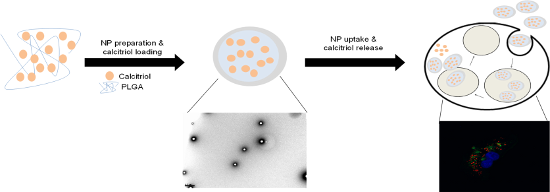
- release of calcitriol adsorbed onto the NP surface. The sustained release over the next 168 h could be attributed to the diffusion of vitamin from the NP core into the release medium. In aqueous medium, PLGA suffers biodegradation by hydrolytic cleavage of its ester linkages into monomers. During


Imaging the intracellular degradation of biodegradable polymer nanoparticles
Beilstein J. Nanotechnol. 2014, 5, 1905–1917, doi:10.3762/bjnano.5.201
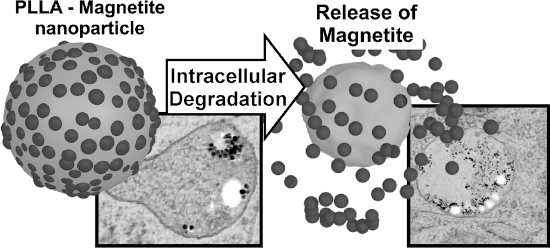
- ., number of detached magnetite crystals, and the number of nanoparticles in one endosome), we demonstrate the importance of TEM studies for such applications in addition to fluorescence studies (flow cytometry and confocal laser scanning microscopy). Keywords: biodegradation; mesenchymal stem cells; PLLA
- nanoparticles. When fitting the flow cytometry data, the result is a decay constant of (34.1 h)−1 (see dashed line in Figure 1), which is much larger than expected from our preliminary cell doubling experiments. Accordingly, the MSCs lose NPs due to exocytosis or degradation processes. The biodegradation of


Structural, optical and photocatalytic properties of flower-like ZnO nanostructures prepared by a facile wet chemical method
Beilstein J. Nanotechnol. 2013, 4, 763–770, doi:10.3762/bjnano.4.87
- industries are usually resistant to biodegradation. Due to their stability and large degree of organics present in them, these pollutants pose severe ecological problems by depleting the dissolved oxygen content of water and releasing toxic compounds that endanger the aquatic life. During an anaerobic





