


Search results
Search for "biphenyl" in Full Text gives 32 result(s) in Beilstein Journal of Nanotechnology.
Distribution of functional groups in periodic mesoporous organosilica materials studied by small-angle neutron scattering with in situ adsorption of nitrogen
Beilstein J. Nanotechnol. 2012, 3, 428–437, doi:10.3762/bjnano.3.49
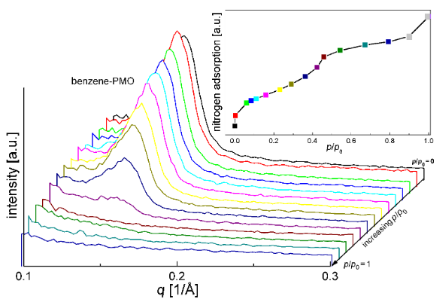
- ], divinylbenzene [12] or biphenyl [13]. However, direct experimental proofs for this molecular-scale periodicity are only rarely given. Gas sorption [14], wide-angle X-ray scattering (WAXS), i.e., powder X-ray diffraction (XRD), and IR spectroscopy [15] are commonly used as analysis tools for porous materials in


Electron-beam patterned self-assembled monolayers as templates for Cu electrodeposition and lift-off
Beilstein J. Nanotechnol. 2012, 3, 101–113, doi:10.3762/bjnano.3.11
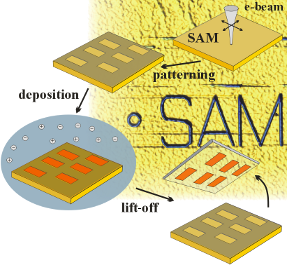
- surface, similar to alkanethiol SAMs [29][30][49][50] and other biphenyl based thiols previously studied [15][25][26][33]. The shift of about −0.27 V to +0.3 V is, however, significantly smaller compared to a long chain alkanethiol such as octadecanethiol for which the shift amounts to about −0.6 V. We





X-ray spectroscopy characterization of self-assembled monolayers of nitrile-substituted oligo(phenylene ethynylene)s with variable chain length
Beilstein J. Nanotechnol. 2012, 3, 12–24, doi:10.3762/bjnano.3.2
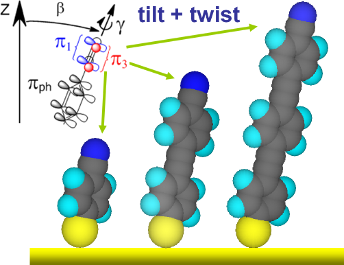
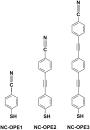
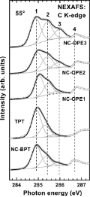
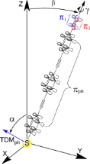
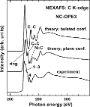
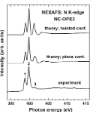
- . The twist angle for the NC-OPE3 SAMs is higher than that for the NC-TP1 monolayers and presumably even higher than that for the NC-TP0 film (on the basis of the values for the biphenyl-based SAMs [29]). In summary, the introduction of the –C≡C– groups into the oligophenyl backbone results in an



When “small” terms matter: Coupled interference features in the transport properties of cross-conjugated molecules
Beilstein J. Nanotechnol. 2011, 2, 862–871, doi:10.3762/bjnano.2.95
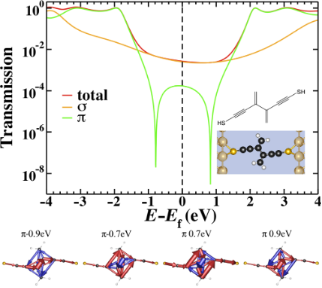
- transport, e.g., from the σ-systems, inelastic processes, etc., may become physically relevant since the nodes of each contribution will not necessarily coincide. Recently, calculations of transport through biphenyl-based molecular junctions suggest that, for sufficiently large bias voltages, interference




Direct monitoring of opto-mechanical switching of self-assembled monolayer films containing the azobenzene group
Beilstein J. Nanotechnol. 2011, 2, 834–844, doi:10.3762/bjnano.2.93
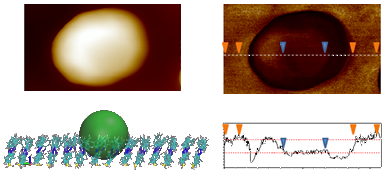
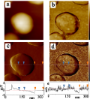
- isomerization of the azo group in such molecules have been examined macroscopically by a number of techniques, modulations of the elastic modulus upon isomerization in self-assembled films were not yet measured directly. Here, we examine the mechanical response upon optical switching of bis[(1,1'-biphenyl)-4-yl
- atomic force microscopy (AFM) and atomistic computational study of the change in local stiffness, as induced by the optical cis↔trans conversion in a SAM of 4'-{[(1,1'-biphenyl)-4-yl]diazenyl}-(1,1'-biphenyl)-4-thiol (thio-2-DA). The experimental variation in stiffness shows quantitative agreement with
- deformations (normal modes) that comprise the major contribution to
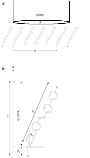
for [(1,1'-biphenyl)-4-yl] [4'-sulfanyl-(1,1'-biphenyl)-4-yl]diazene (2-DA) are shown in Figure 5 for both isomers. For the molecule in the trans-configuration, it corresponds to a stretching of the whole molecule along the principle axis



Mechanical characterization of carbon nanomembranes from self-assembled monolayers
Beilstein J. Nanotechnol. 2011, 2, 826–833, doi:10.3762/bjnano.2.92
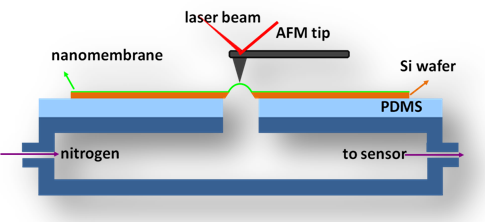
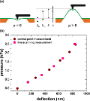
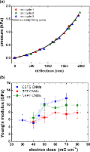
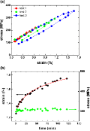
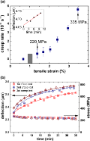
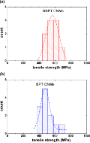
- nm that are fabricated by electron-induced crosslinking of aromatic self-assembled monolayers (SAMs). A novel type of in situ bulge test employing an atomic force microscope (AFM) is utilized to investigate their mechanical properties. A series of biphenyl-based molecules with different types of
- terminal and/or anchor groups were used to prepare the CNMs, such as 4'-[(3-trimethoxysilyl)propoxy]-[1,1'-biphenyl]-4-carbonitrile (CBPS), 1,1'-biphenyl-4-thiol (BPT) and 4-nitro-1,1'-biphenyl-4-thiol (NBPT). The elastic properties, viscoelastic behaviors and ultimate tensile strength of these biphenyl
- was prepared on a rectangular opening in a silicon substrate by using the procedure described previously [9]. The CNM was formed from a self-assembled monolayer of 4'-[(3-trimethoxysilyl)propoxy]-[1,1'-biphenyl]-4-carbonitrile (CBPS) on silicon nitride membranes, which was cross-linked with a dose of

On the reticular construction concept of covalent organic frameworks
Beilstein J. Nanotechnol. 2010, 1, 60–70, doi:10.3762/bjnano.1.8
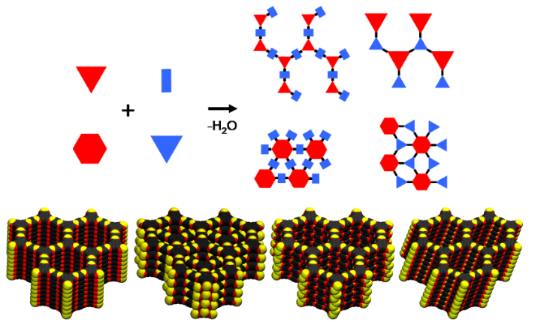
- of experimental COF synthesis, to calculate formation energies of COFs in order to predict their energetic stability. Molecular units, 1,4-phenylenediboronic acid (BDBA), [1,1’-biphenyl]-4,4'-diylboronic acid (BPDA), 5’-(4-boronophenyl)-[1,1’:3’,1”-terphenyl]-4,4”-diboronic acid (BTPA), benzene-1,3,5




Other Beilstein-Institut Open Science Activities



