


Search results
Search for "descriptors" in Full Text gives 30 result(s) in Beilstein Journal of Nanotechnology.
Nanoinformatics for environmental health and biomedicine
Beilstein J. Nanotechnol. 2015, 6, 2449–2451, doi:10.3762/bjnano.6.253

- components calculated from nanoparticle size and surface properties using Kriging estimations [14]. Another contribution reports on the development of models to predict the cytotoxicity of PAMAM dendrimers using molecular descriptors [15]. Nanomaterials that have potential to cause disease (e.g., TiO2
Predicting cytotoxicity of PAMAM dendrimers using molecular descriptors
Beilstein J. Nanotechnol. 2015, 6, 1886–1896, doi:10.3762/bjnano.6.192
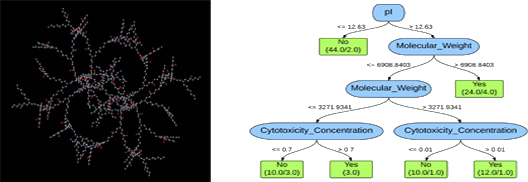
- journal articles. The results indicate that data mining and machine learning can be effectively used to predict the cytotoxicity of PAMAM dendrimers on Caco-2 cells. Keywords: data mining; machine learning; molecular descriptors; poly(amido amine) dendrimers (PAMAM); Introduction In silico approaches
- potentially be expanded to other nanomaterials in the future. Results and Discussion Five different analyses were performed to classify a dendrimer as toxic or nontoxic using different combinations of molecular descriptors and experimental conditions. The first analysis utilized all the molecular descriptors
- available in MarvinSketch (see Experimental section and Table S1 in Supporting Information File 1). The second analysis involved an automatic feature selection method in which the molecular descriptors that were used had a nonzero rank according to the ChiSquaredAttributeEval method in Weka (see details in


Nanotechnology in the real world: Redeveloping the nanomaterial consumer products inventory
Beilstein J. Nanotechnol. 2015, 6, 1769–1780, doi:10.3762/bjnano.6.181
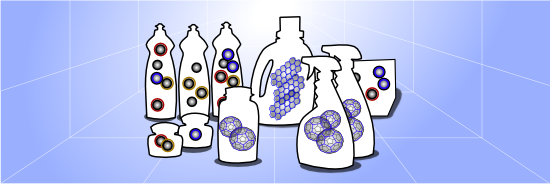
- eight new descriptors for consumer products, including information pertaining to the nanomaterials contained in each product. The project was motivated by the recognition that a diverse group of stakeholders from academia, industry, and state/federal government had become highly dependent on the
- nanotechnology. This effort resulted in archiving 316 products in the Health and Fitness category – mainly in the Personal Care and Clothing subcategories – with 86 and 78 products archived between 2012 and 2014, respectively. New nanomaterial descriptors Eight new product descriptors were introduced to
- the product, potential exposure pathways, “how much we know”, “researchers say”. The experimental section of this paper describes all new product descriptors. The results of the five new quantitative descriptors are presented and discussed below. Since the “nanomaterial shape and size”, “coating and



The eNanoMapper database for nanomaterial safety information
Beilstein J. Nanotechnol. 2015, 6, 1609–1634, doi:10.3762/bjnano.6.165
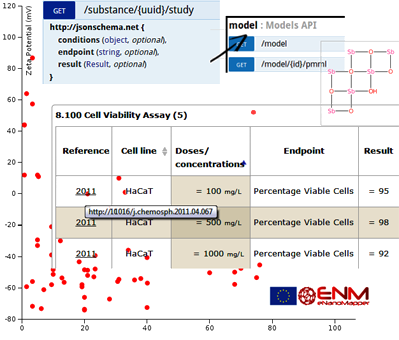
- descriptors of engineered nanoparticles (mainly metal-based) and their potential toxicity. This dataset nicely demonstrates the complexity of the nanosafety domain. The ModNanoTox database provides physicochemical descriptors and toxic activities of nanoparticles from several studies. The database version
- from August 2013 includes 86 assays with more than 100 different endpoints affecting 45 species. Unfortunately, only a few nanoparticles (usually fewer than three) have been tested for each endpoint. Physicochemical descriptors for the characterisation of nanoparticles are incomplete as well (about 75
- cases the number of measured nanoparticle properties was very low. Most studies report only two to four different nanoparticle properties (descriptors) and the descriptor types are very inconsistent (overall 36 different descriptors, which results in very sparse matrices with a high number of missing


Influence of surface chemical properties on the toxicity of engineered zinc oxide nanoparticles to embryonic zebrafish
Beilstein J. Nanotechnol. 2015, 6, 1568–1579, doi:10.3762/bjnano.6.160
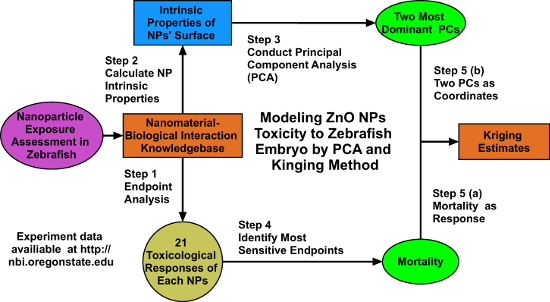
- are more closely related to the fate and effects of ZnO NPs than the core composition alone [18][19][22]. Thus, it is expected that surface chemical properties can be employed as descriptors to model the toxicity of various types of engineered ZnO NPs. The development of such relationships between a
- extract descriptors useful as coordinates to develop a model of how surface chemistry impacts ZnO NP toxicity. Selected surface features used in the PCA were those deemed likely to influence biological interactions with the NP surface. Size (SZ) was chosen as it has been reported by others to influence NP
- consists of 8 property descriptors: size (SZ), Log D, polarizability (PL), polar surface area (PS), van der Waals surface (VS), solvent-accessible surface area (SASA), molar refractivity (RF) and Dreiding energy (DE) with 10 surface modified and 7 bare ZnO NPs (17 ZnO NP datasets × 8 properties). Each




Other Beilstein-Institut Open Science Activities



