


Search results
Search for "dielectric" in Full Text gives 463 result(s) in Beilstein Journal of Nanotechnology. Showing first 200.
Low-temperature AFM with a microwave cavity optomechanical transducer
Beilstein J. Nanotechnol. 2025, 16, 1873–1882, doi:10.3762/bjnano.16.130
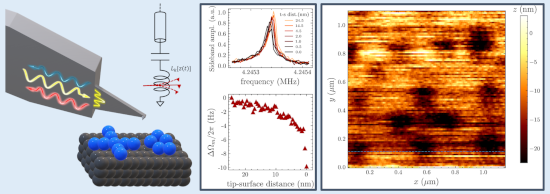
- in the literature [28][29][30]. The main limitation to the internal quality factor of our microwave resonators is the highly disordered low-stress Si–N layer, which causes significant dielectric losses [31]. As discussed above, the figure of merit of a displacement detector should be evaluated with


Electrical, photocatalytic, and sensory properties of graphene oxide and polyimide implanted with low- and medium-energy silver ions
Beilstein J. Nanotechnol. 2025, 16, 1794–1811, doi:10.3762/bjnano.16.123
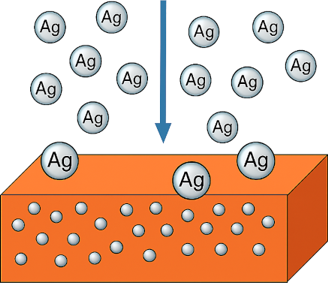
- controlled modification of the electrical properties of dielectric and semiconducting materials [7]. When Ag ions are implanted into polymer substrates, such as polyimide (PI) or graphene oxide (GO), fundamental changes occur at the molecular and electronic levels, leading to a significant decrease in the


Ambient pressure XPS at MAX IV
Beilstein J. Nanotechnol. 2025, 16, 1677–1694, doi:10.3762/bjnano.16.118
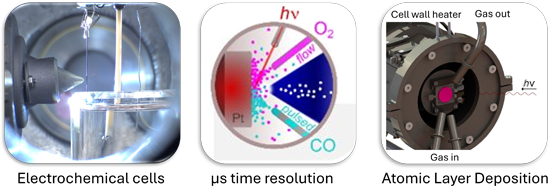
- , even on topologically complex surfaces, making it essential for the fabrication of next-generation devices [46][47][48]. In the semiconductor industry, ALD enables the creation of nanoscale transistors and high-k dielectric materials, essential for shrinking transistor dimensions and enhancing





Modeling magnetic properties of cobalt nanofilms used as a component of spin hybrid superconductor–ferromagnetic structures
Beilstein J. Nanotechnol. 2025, 16, 1557–1566, doi:10.3762/bjnano.16.110
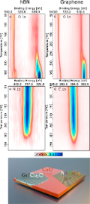
- ], reinforcing, light-reflecting, conductive, and dielectric materials. Their utilization extends to contacts, printed circuit boards, and integrated circuit elements in microelectronics, as well as to the fabrication of optical filters, the component base of optoelectronics, and advanced lithographic processes


Transient electronics for sustainability: Emerging technologies and future directions
Beilstein J. Nanotechnol. 2025, 16, 1545–1556, doi:10.3762/bjnano.16.109

- such as Mg and Mo have been deposited onto bioresorbable polymer substrates in the form of resistive-type sensors or interconnects using shadow masking techniques [14][48][63][64]. In addition, semiconductor or dielectric materials such as ZnO and MgO have been patterned and deposited using shadow
- semiconductor processes, the substitution of conventional dielectric and metal layers with biodegradable counterparts suggests the feasibility of wafer-scale foundry integration (Figure 2d) [80]. For example, the foundry-scale fabrication of transient complementary metal-oxide-semiconductor devices (inverter


Laser processing in liquids: insights into nanocolloid generation and thin film integration for energy, photonic, and sensing applications
Beilstein J. Nanotechnol. 2025, 16, 1428–1498, doi:10.3762/bjnano.16.104
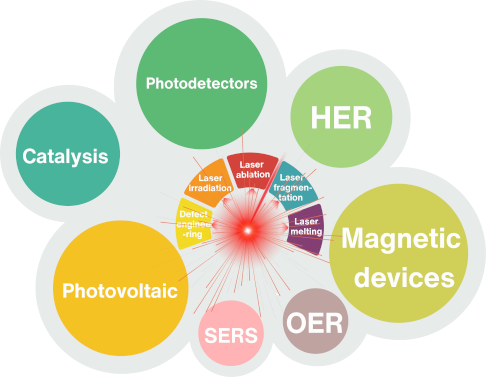
- illustrations of the pulsed laser heating mechanism are presented in Figure 7f,g. Factors such as laser fluence, irradiation time, and solvent properties, such as dielectric constant and thermal conductivity, must be carefully controlled to optimize nanoparticle formation [49][68][69][75]. Other factors like






The role of biochar in combating microplastic pollution: a bibliometric analysis in environmental contexts
Beilstein J. Nanotechnol. 2025, 16, 1401–1416, doi:10.3762/bjnano.16.102

- type and size, of 98.4% for PP (1–2 mm), 98.2% for cellulose acetate (1–2 mm), 91.7% for PE (286.7 µm), and 93.2% for polymethyl methacrylate (6.3 µm) [77]. The dielectric properties of MPs also influence electrocoagulation performance; for example, PVC (insulator 10 × 105 Ω·cm) undergoes optimal



Wavelength-dependent correlation of LIPSS periodicity and laser penetration depth in stainless steel
Beilstein J. Nanotechnol. 2025, 16, 1302–1315, doi:10.3762/bjnano.16.95
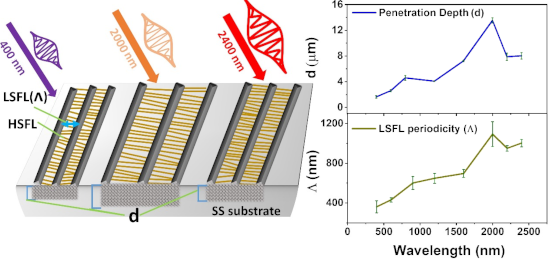
- modulation of the net localized energy distribution on the surface, and this field absorption is manifested as LIPSS on the surface. This process depends on several experimental factors, namely, incident wavelength, polarization, material dielectric, dielectric, fluence of the laser, pulse width, repetition
- angle, the period of the resulting ripples can be determined using the equation [57][58][59]: where Λ is the ripple periodicity (LSFL spatial periodicity), λ is the incident wavelength, and εd and εm are the dielectric constants of the medium and metal, respectively. εd = 1 (dielectric constant of the
- on tissue penetration during light–tissue interaction. They found that higher wavelengths result in greater penetration depth, while larger spot sizes do not significantly increase penetration depth [63]. The penetration depth depends on the material’s dielectric properties and the interface’s




Piezoelectricity of hexagonal boron nitrides improves bone tissue generation as tested on osteoblasts
Beilstein J. Nanotechnol. 2025, 16, 1068–1081, doi:10.3762/bjnano.16.78
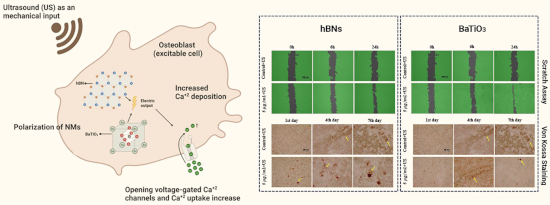
- , making them particularly attractive for biomedical applications. [21][22]. Barium titanate (BaTiO3) is one of the most well-known piezoelectric nanomaterials (NMs), characterized by a cubic structure with four polymorphs which change depending on the temperature and a high dielectric constant. All its


Time-resolved probing of laser-induced nanostructuring processes in liquids
Beilstein J. Nanotechnol. 2025, 16, 968–1002, doi:10.3762/bjnano.16.74
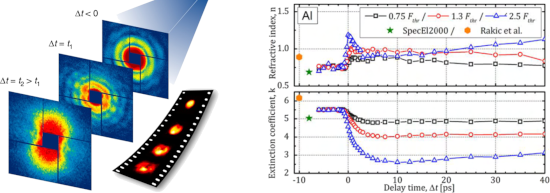
- given by the dielectric functions of metal and medium and are described by Mie theory [113]. Mie theory allows one to derive absolute absorption and scattering cross sections of primarily spherical or core–shell objects, but also different shapes by extensions of the Mie–Gans [114] theory or numerical
- nanobubbles [127] shown in Figure 8B. The SPR of liquid metal particles, such as gold, should drastically change because of the change of the dielectric function. Nevertheless, the melting transition has never been detected spectroscopically on an ultrafast timescale. In thin-film geometry, the optical


Heat-induced transformation of nickel-coated polycrystalline diamond film studied in situ by XPS and NEXAFS
Beilstein J. Nanotechnol. 2025, 16, 887–898, doi:10.3762/bjnano.16.67
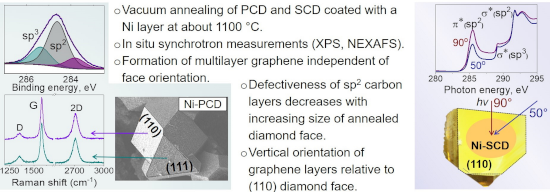
- of diamond surfaces is important for many applications, which require the formation of thin conductive electrodes on dielectric substrates. Transition metal catalysts can facilitate the graphitization process, which depends on the diamond face orientation. In the present work, the role of a nickel
- surface. Our results can be useful for controlling the growth of graphitic coatings on dielectric diamond surfaces with a polycrystalline structure and grains of different sizes and crystallographic orientations. Experimental The growth of PCD films on silicon substrates was performed using PE CVD with a


Morphology and properties of pyrite nanoparticles obtained by pulsed laser ablation in liquid and thin films for photodetection
Beilstein J. Nanotechnol. 2025, 16, 785–805, doi:10.3762/bjnano.16.60
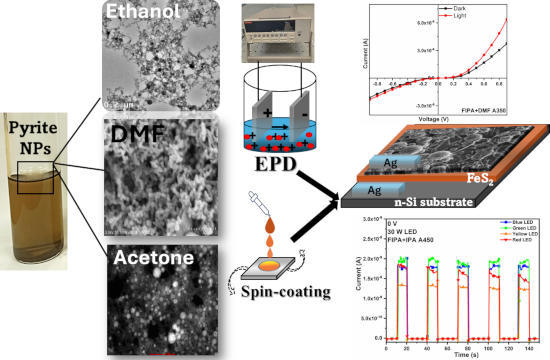
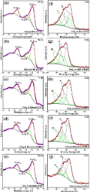
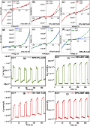
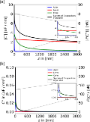
- experimental variables that cause the kinetics of the nanoparticles formation to change, resulting in nanoparticles with different sizes and morphologies [40]. Thermodynamic properties such as density, dielectric constant, viscosity, vapor pressure, and optical properties of the solvents are some of the






Nanoscale capacitance spectroscopy based on multifrequency electrostatic force microscopy
Beilstein J. Nanotechnol. 2025, 16, 637–651, doi:10.3762/bjnano.16.49

- , enabling the measurement of the local dielectric function over a wide range of frequencies. We demonstrate the reliable operation of MFH-EFM using standard atomic force microscopy equipment plus an external lock-in amplifier up to a frequency of 5 MHz, which can in principle be extended to gigahertz
- frequencies and beyond. Our results show a significant reduction of signal background from long-range electrostatic interactions, resulting in highly localized measurements. Combined with refined tip–sample capacitance models, MFH-EFM will enhance the precision of quantitative studies on dielectric effects in
- nanoscale systems across materials science, biology, and nanotechnology, complementing established methods in the field. Keywords: atomic force microscopy; capacitance gradients; dielectric constant; dielectric spectroscopy; heterodyne frequency mixing; Kelvin probe force microscopy; multifrequency AFM




Water in nanoporous hexagonal boron nitride nanosheets: a first-principles study
Beilstein J. Nanotechnol. 2025, 16, 510–519, doi:10.3762/bjnano.16.39
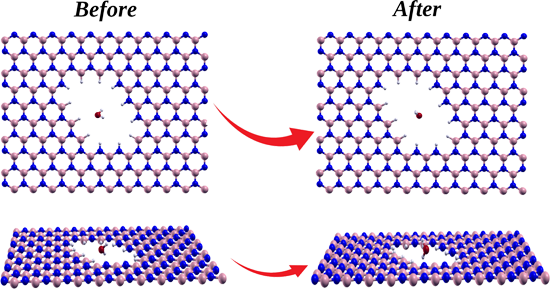
- boron nitride (h-BN) [19]. Among these materials, h-BN stands out because of its properties, which are similar to those of graphene. It is composed of alternating boron and nitrogen atoms arranged in a honeycomb-like crystalline structure, characterized by high thermal stability, low dielectric constant




Tailoring of physical properties of RF-sputtered ZnTe films: role of substrate temperature
Beilstein J. Nanotechnol. 2025, 16, 333–348, doi:10.3762/bjnano.16.25
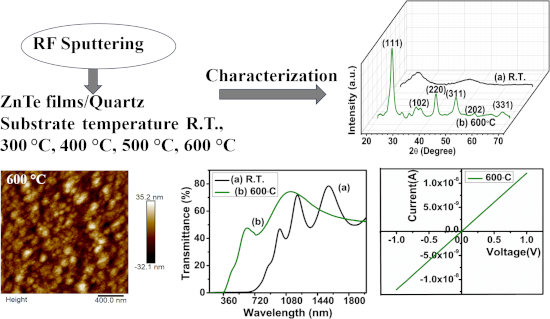
- ]. The dielectric constant and the dielectric loss of the deposited ZnTe films exhibit a similar pattern and were also found to decrease with increasing substrate temperature (see below). Photoluminescence studies Photoluminescence (PL) studies were carried out to analyse the films’ electronic features


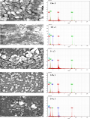


Enhancing mechanical properties of chitosan/PVA electrospun nanofibers: a comprehensive review
Beilstein J. Nanotechnol. 2025, 16, 286–307, doi:10.3762/bjnano.16.22

- chitosan/PVA nanofibers using dielectric barrier discharge (DBD) plasma and reported enhanced wettability, mechanical properties, and biocompatibility of the fibers. The argon and oxygen plasma treatments led to significant cross-linking of the fibers, which improved tensile strength and Young’s modulus


Recent advances in photothermal nanomaterials for ophthalmic applications
Beilstein J. Nanotechnol. 2025, 16, 195–215, doi:10.3762/bjnano.16.16
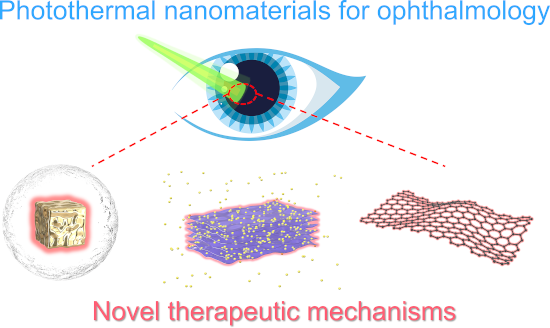
- the dielectric environment present during their synthesis (see below in Figure 2b) [48][49]. Because of the direct occurrence of photothermal conversion on the surfaces of LSPR metals and its rapid nature, combined with the metals’ inherent high thermal conductivity and strong hydrophilicity, LSPR


Theoretical study of the electronic and optical properties of a composite formed by the zeolite NaA and a magnetite cluster
Beilstein J. Nanotechnol. 2025, 16, 44–53, doi:10.3762/bjnano.16.5
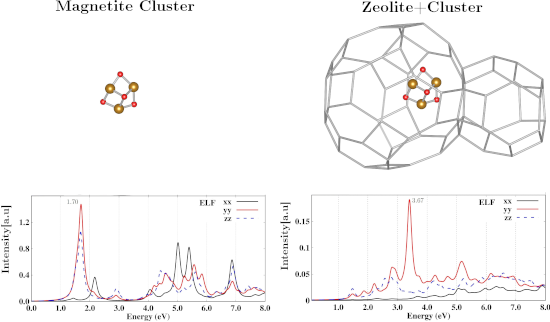
- evident that for energies below 6.8 eV (the value that corresponds to the zeolite bandgap), the value of ε2 is practically zero. Under such circumstances, the velocity (v) of electromagnetic wave propagation in a dielectric medium can be described as , where c is the speed of light in a vacuum. Within


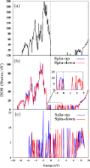


Fabrication of hafnium-based nanoparticles and nanostructures using picosecond laser ablation
Beilstein J. Nanotechnol. 2024, 15, 1639–1653, doi:10.3762/bjnano.15.129
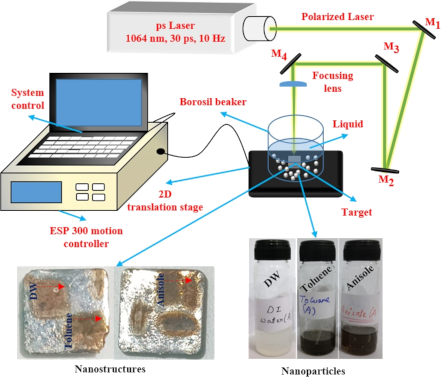
- [8] compared to bulk Hf. HfO2 is a wide-bandgap (5.68 eV) material with a high dielectric constant (≈25) [9][10]. HfC has a very high melting point (≈3900 °C) and ranks among the hardest materials, with a Vickers hardness value exceeding 20 GPa [4][11]. The properties vary substantially depending on




Heterogeneous reactions in a HFCVD reactor: simulation using a 2D model
Beilstein J. Nanotechnol. 2024, 15, 1627–1638, doi:10.3762/bjnano.15.128
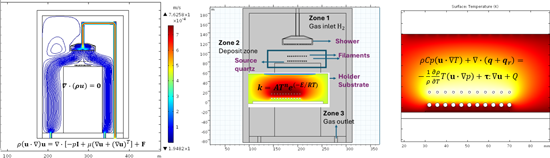
- for the subsequent growth of the SiOx films. These SiOx films have interesting properties and embedded nanostructures, which make them excellent dielectric, optoelectronic, and electroacoustic materials for the fabrication of devices compatible with silicon-based technology. Keywords: 2D model


Lithium niobate on insulator: an emerging nanophotonic crystal for optimized light control
Beilstein J. Nanotechnol. 2024, 15, 1415–1426, doi:10.3762/bjnano.15.114
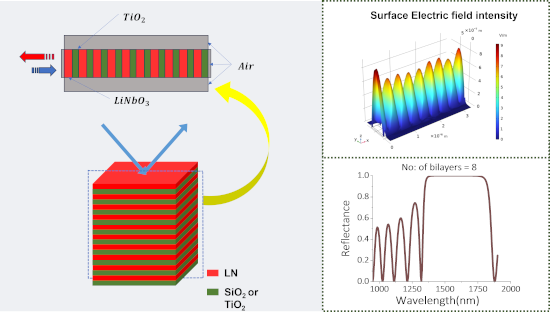
- high dielectric constant enables the fabrication of photonic crystals characterized by high-quality factors and minimal losses [17][18][19][20][21][22][23]. The combination of LiNbO3 and TiO2 in multi-stacked 1D PhC holds promise for optical applications [5]. The birefringence and electro-optic


Mn-doped ZnO nanopowders prepared by sol–gel and microwave-assisted sol–gel methods and their photocatalytic properties
Beilstein J. Nanotechnol. 2024, 15, 1283–1296, doi:10.3762/bjnano.15.104
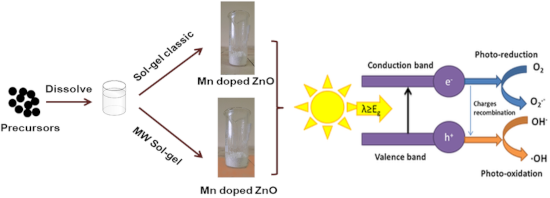
- dielectric properties of material [17]. Therefore, instantaneous decomposition of the precursors occurs, leading to the formation of a supersaturated solution. Consequently, appropriate conditions for obtaining materials with well-defined properties (i.e., monodispersed nanoparticles from rapid and brief


Quantum-to-classical modeling of monolayer Ge2Se2 and its application in photovoltaic devices
Beilstein J. Nanotechnol. 2024, 15, 1153–1169, doi:10.3762/bjnano.15.94
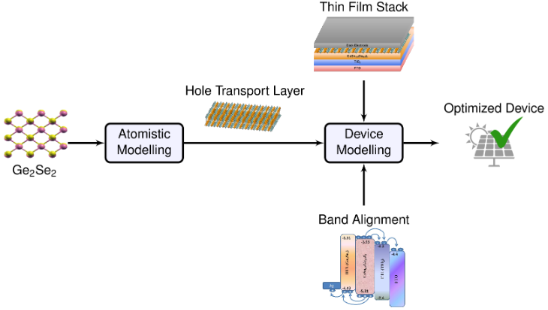
- coefficient and a high dielectric constant inspired the design of a monolayer Ge2Se2-based solar cell, exhibiting a high open circuit voltage of Voc = 1.11 V, a fill factor of 87.66%, and more than 28% power conversion efficiency at room temperature. Our findings advocate monolayer Ge2Se2 for various
- wavelength are summarized in Figure 5, depicting the dielectric function εr (real and imaginary parts) and the refractive index n for monolayer Ge2Se2. The real and imaginary components of the dielectric function correspond to dispersive and absorption effects of the material. We observe that the
- investigated structure exhibits strongly anisotropic optical properties for which the parametric values depend on the direction of the chosen plane. Dielectric function and absorption coefficient The static dielectric constants (real part of εr at ω = 0), along the in-plane (XX) and out-of-plane (ZZ) direction




Unveiling the potential of alginate-based nanomaterials in sensing technology and smart delivery applications
Beilstein J. Nanotechnol. 2024, 15, 1077–1104, doi:10.3762/bjnano.15.88
- ]. The polymer film’s soil moisture sensing capabilities were proved by measuring the dielectric constant of the polymer with soil samples containing low and high moisture (Figure 7). According to the results, the polymer film has excellent moisture sensing characteristics at frequencies as low as a few


Signal generation in dynamic interferometric displacement detection
Beilstein J. Nanotechnol. 2024, 15, 1070–1076, doi:10.3762/bjnano.15.87
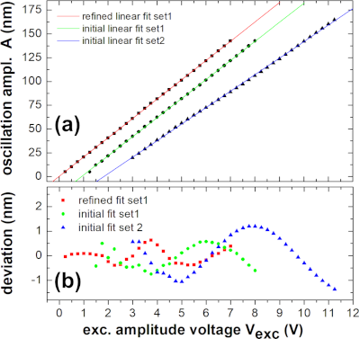
- a Michelson interferometer. Experiments reported here are performed with the dielectric/vacuum interface of the bare fiber end acting as the first mirror and a metal-coated silicon cantilever as the second mirror. We keep the fiber–cantilever distance d always large enough to work in the Michelson
- beams with almost identical power. The first part is directed to a power meter for control purposes, while the second part is guided to the interferometer in the UHV [11]. The fiber end in the interferometer is carefully cleaved to achieve high optical quality for the dielectric/vacuum interface having





