


Search results
Search for "direct writing" in Full Text gives 31 result(s) in Beilstein Journal of Nanotechnology.
Micro- and nano-surface structures based on vapor-deposited polymers
Beilstein J. Nanotechnol. 2017, 8, 1366–1374, doi:10.3762/bjnano.8.138
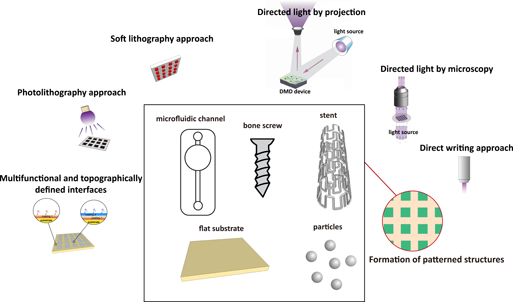
- such as light-directed patterning and direct-writing approaches. The limitations for patterning on non-flat surfaces are resolution and cost. With the requirement of chemical control and/or precise accessibility to the linkage with functional molecules, chemically and topographically defined interfaces
- attempted by direct electron beam (e-beam) lithography on vapor-deposited PPMA coatings, and 200 nm-sized features were obtained on the vapor-deposited poly(propargyl methacrylate) (PPMA) films [34]. Direct writing using a two-photon laser was also demonstrated on poly(p-xylylene) to fabricate 3D nano
- -/microstructures [35]. Similarly, direct writing using a scanning probe microscopy-based nanolithographic technique (dip-pen nanolithography, DPN) was used to deliver chemical substances with submicrometer features on a wide range of poly(p-xylylene) deposited substrates [36]. An array of micro-sized plasma was


Nanoantenna-assisted plasmonic enhancement of IR absorption of vibrational modes of organic molecules
Beilstein J. Nanotechnol. 2017, 8, 975–981, doi:10.3762/bjnano.8.99
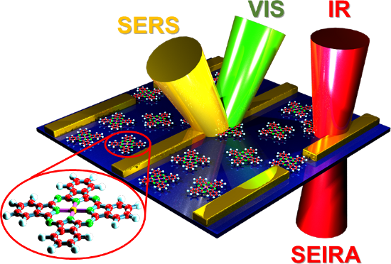
- real biological assays. Experimental The uniform periodic arrays of linear Au nanoantennas with length 900 and 1900 nm and period of 5 µm were fabricated on (001)-oriented Si substrates by a direct writing nanolithographic machine (Raith-150, Raith GmbH, Germany) and covers an area of 3 × 3 mm2



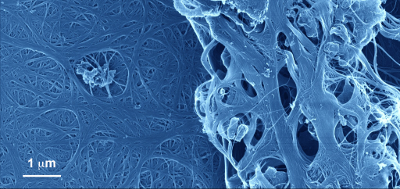
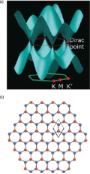
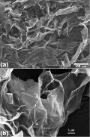
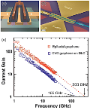
Synthesis and applications of carbon nanomaterials for energy generation and storage
Beilstein J. Nanotechnol. 2016, 7, 149–196, doi:10.3762/bjnano.7.17















Near-field visualization of plasmonic lenses: an overall analysis of characterization errors
Beilstein J. Nanotechnol. 2015, 6, 2069–2077, doi:10.3762/bjnano.6.211
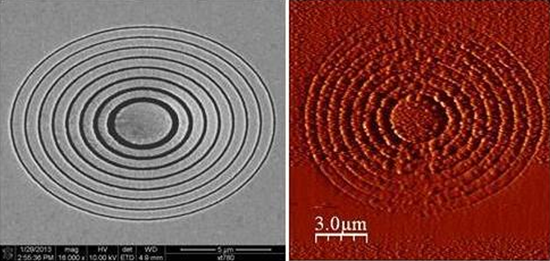
- elliptical slits. The focusing performance of the structures was studied before [22]. The structures can be fabricated and measured by using focused ion beam (FIB) direct writing technique and near-field scanning optical microscope (NSOM) respectively, as shown in Figure 1. However, from the point of view of
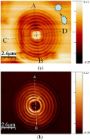
- Figure 8. A lens with σ = 1 (circular slits) was milled using FIB direct writing. But the fabricated structure is deformed along the long (as indicated by A–B line) and the short axis (as indicated by C–D line) due to stigmation during patterning, as shown in Figure 8a. The dotted circular and elliptical




Tunable magnetism on the lateral mesoscale by post-processing of Co/Pt heterostructures
Beilstein J. Nanotechnol. 2015, 6, 1082–1090, doi:10.3762/bjnano.6.109
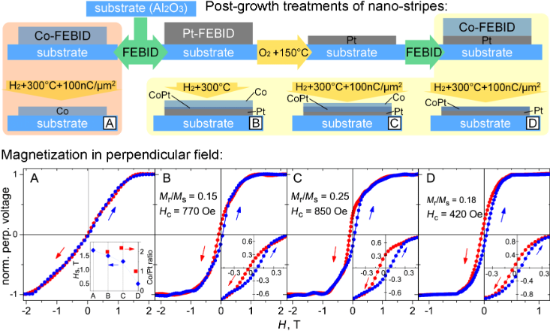
- film techniques or by an alternative approach, as used by us, namely the direct writing of metal-based layers by focused electron beam induced deposition (FEBID) [18][19]. The resolution of FEBID is better than 10 nm laterally and 1 nm vertically [18][19] and, thus, its proven applications range from
- the formation of the CoPt L10 phase with strongly increased magnetic anisotropy compared to pure Co. Here, we employ direct writing of Pt and Co layers by FEBID and demonstrate by means of in situ post-processing how to locally tune the coercive field and the remanent magnetization of layered Co/Pt


Focused electron beam induced deposition: A perspective
Beilstein J. Nanotechnol. 2012, 3, 597–619, doi:10.3762/bjnano.3.70
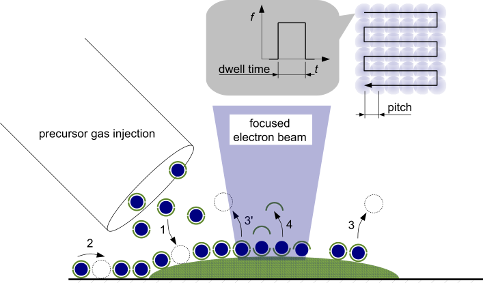
- ), Station 17, CH-1015 Lausanne, Switzerland 10.3762/bjnano.3.70 Abstract Background: Focused electron beam induced deposition (FEBID) is a direct-writing technique with nanometer resolution, which has received strongly increasing attention within the last decade. In FEBID a precursor previously adsorbed on
- ) is receiving strongly increasing attention as a direct-writing technique for nanostructures due to its great versatility. In FEBID a previously adsorbed molecular precursor is dissociated in the focus of an electron beam provided by a scanning or transmission electron microscope (SEM/TEM). By and


Other Beilstein-Institut Open Science Activities



