


Search results
Search for "dodecanethiol" in Full Text gives 31 result(s) in Beilstein Journal of Nanotechnology.
Synthesis, characterization, and growth simulations of Cu–Pt bimetallic nanoclusters
Beilstein J. Nanotechnol. 2014, 5, 1371–1379, doi:10.3762/bjnano.5.150
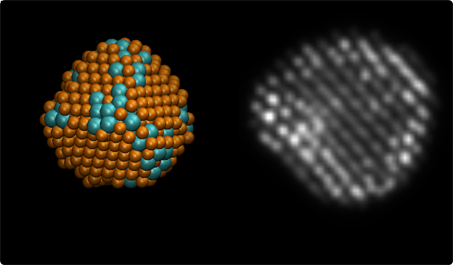
- . Experimental Chemicals and materials Reagent-grade chemicals from Sigma-Aldrich such as chloroplatinic acid hydrate (H2PtCl6·xH2O, 99.9%), copper(I) acetate (CuCO2CH3, 97%), tetraoctylammonium bromide (TOAB, 99%), hexadecyltrimethylammonium bromide (CTAB), sodium borohydrate (NaBH4), 1-dodecanethiol, toluene
- formation of Cu nanoparticles. Then 36 μL of 1-dodecanethiol was added to stabilize the Cu nanoparticles. After preparing the Cu nanoparticles, 3 mL of the Pt precursor solution was quickly added into the colloidal solution and after 5 min of waiting NaBH4 (72 μL, 4.6 M) was added and the heating was


Purification of ethanol for highly sensitive self-assembly experiments
Beilstein J. Nanotechnol. 2014, 5, 1254–1260, doi:10.3762/bjnano.5.139
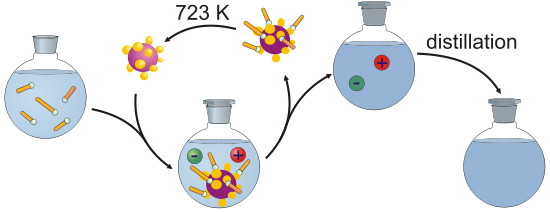
- preparation conditions were tested by exposing them to solutions of a test substance (dodecanethiol). As proof of concept, the applicability for ethanol purification was demonstrated by employing the sensoric principle developed by Bohn et al. [29][32]. Results and Discussion Several methods exist to deposit
- thiols and other surface-active impurities from ethanol was tested by varying the gold load at the zeolite as well as the gold-NP preparation temperature. Dodecanethiol was used as test substance for these chemisorption experiments because it binds effectively and fast to gold surfaces [3]. In a typical
- test, one gram of the zeolite loaded with different amounts of gold-NPs was stirred into solutions of dodecanethiol in ethanol. After ten minutes, the solution was tested for remaining thiol using Ellman’s reagent. By increasing the concentrations of the solutions in small steps until the test became

Surface assembly and nanofabrication of 1,1,1-tris(mercaptomethyl)heptadecane on Au(111) studied with time-lapse atomic force microscopy
Beilstein J. Nanotechnol. 2014, 5, 26–35, doi:10.3762/bjnano.5.3
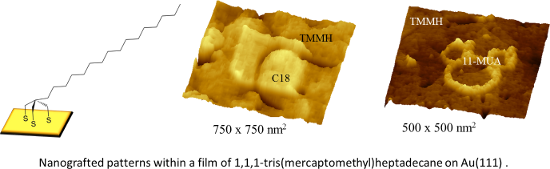
- ; essentially, the well-known dimensions of n-alkanethiol monolayers furnish an in situ ruler for local measurements of the thickness of molecular films [7][34][35][36]. Our protocols for nanografting used either dodecanethiol or TMMH as matrix SAMs that were prepared by immersion in ethanolic solutions. Areas
- the TMMH matrix. Since a double layer of MUA would be 3.0 nm thick, this analysis likewise indicates a height of ~1 nm for the SAM derived from TMMH. Further experiments were conducted with nanografting of TMMH nanopatterns within a methyl-terminated dodecanethiol SAM (Figure 7). The dodecanethiol SAM
- was prepared from 1 mM ethanolic solution, and the TMMH nanografted patterns were prepared with 0.01 mM solution. The expected thickness of a dodecanethiol SAM is 1.5 nm, as a reference for evaluating the thickness of TMMH nanostructures. Four nanopatterns were written within the methyl-terminated SAM


Functionalised zinc oxide nanowire gas sensors: Enhanced NO2 gas sensor response by chemical modification of nanowire surfaces
Beilstein J. Nanotechnol. 2012, 3, 368–377, doi:10.3762/bjnano.3.43
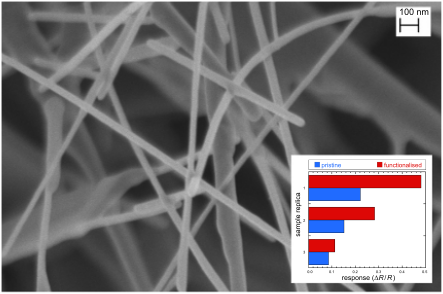
- (THMA) and dodecanethiol (DT), was studied. The response towards ammonia, nitrous oxide and nitrogen dioxide was investigated for three sensor configurations, namely pure ZnO nanowires, organic-coated ZnO nanowires and ZnO nanowires covered with a sparse layer of organic-coated ZnO nanoparticles
- in response caused by sensor batch variations being misconstrued as a result of the functionalisation process. The first ligand studied was dodecanethiol (DT), which can readily form a self-assembled monolayer at the ZnO surface simply by exposure of the nanowires to an ethanolic solution containing
- several plates or wires. Ex situ functionalisation of NP- and NW-powder ZnO samples by either DT or THMA was confirmed by FTIR measurements. The FTIR spectra given in Figure 3 are of a ZnO nanowire sensor sample and samples that had been exposed to either 10 mM dodecanethiol or THMA solution for 24 h


X-ray spectroscopy characterization of self-assembled monolayers of nitrile-substituted oligo(phenylene ethynylene)s with variable chain length
Beilstein J. Nanotechnol. 2012, 3, 12–24, doi:10.3762/bjnano.3.2
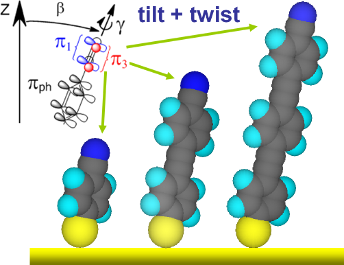
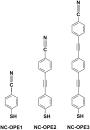
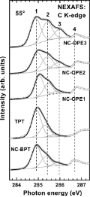
- qualitative analysis of the HRXPS spectra, we estimated the packing density and effective thickness of the target films on the basis of the HRXPS data. The packing density was estimated by a comparison of the S2pthiolate/Au4f intensity ratios of the target films with those for the reference dodecanethiol (DDT



Manipulation of gold colloidal nanoparticles with atomic force microscopy in dynamic mode: influence of particle–substrate chemistry and morphology, and of operating conditions
Beilstein J. Nanotechnol. 2011, 2, 85–98, doi:10.3762/bjnano.2.10
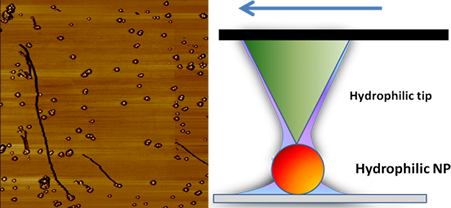
- , as determined from transmission electron microscopy (TEM) images, was 25 ± 5 nm (Figure 11). Coated gold nanoparticles Dodecanethiol for methyl terminated monolayers and 11-mercapto-1-undecanol for hydroxyl terminated monolayers were obtained from Sigma-Aldrich and used as received. Hydroxyl or


Other Beilstein-Institut Open Science Activities



