


Search results
Search for "electrocatalysts" in Full Text gives 33 result(s) in Beilstein Journal of Nanotechnology.
Synthesis of graphene–transition metal oxide hybrid nanoparticles and their application in various fields
Beilstein J. Nanotechnol. 2017, 8, 688–714, doi:10.3762/bjnano.8.74
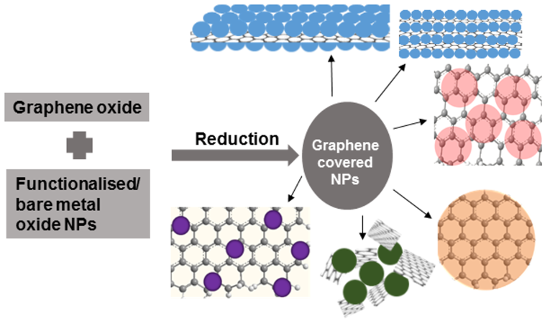
- et al. where the graphene was synthesised by the arc discharge method and the Pt–graphene hybrid electrocatalysts were prepared using a polyol process. This structure exhibits enhanced electrochemical performance due to the strong metal–support interaction and proposed synergetic effect [94]. A
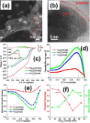
- ) [118] and applications in energy storage [119]. ORR is the key step of renewable energy technologies including fuel cells and water splitting. For excellent electrocatalysts, one of the most important factors is long-term running stability. The long term running stability of the Cr2O3–rGO hybrid makes
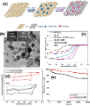
- cost cathode electrocatalysts used for high capacity anode materials for LIBs [121][122][123][124]. The catalytic performance is associated with the morphology, size and coupling of the hybrid materials. Synergistic catalytic-supported interaction between N-doped rGO and Mn2O4 is used for the vanadium






Fundamental properties of high-quality carbon nanofoam: from low to high density
Beilstein J. Nanotechnol. 2016, 7, 2065–2073, doi:10.3762/bjnano.7.197
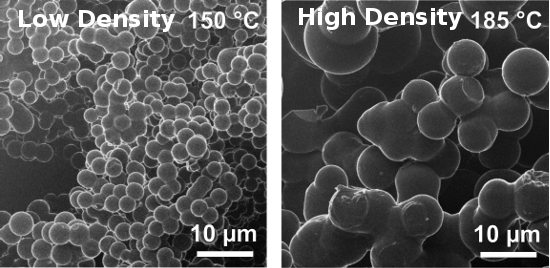
- electrodes [2]. Copper nanofoams containing both micropores and nanopores have been produced for potential use in energy applications [3], and furthermore, copper nanofoam substrates were used for the production of electrocatalysts [4]. Gold nanofoams have been found to show excellent catalytic properties [5


Electrocatalysis on the nm scale
Beilstein J. Nanotechnol. 2015, 6, 1008–1009, doi:10.3762/bjnano.6.103

- to that developed for the solid–gas interface) is within reach, given the rapid progress in both theory and experiment. Furthermore, the employment of modern strategies from nanotechnology for the systematic fabrication of optimized, nanostructured electrodes and electrocatalysts sets the stage and
- molecules [9], are presented. The potential of in situ microscopy [10] and in situ spectroscopy [8][9], in addition to electrochemical measurements for the characterization of electrode surfaces/electrocatalysts and for the mechanistic understanding of electrocatalytic reactions is illustrated. Finally, the
Manganese oxide phases and morphologies: A study on calcination temperature and atmospheric dependence
Beilstein J. Nanotechnol. 2015, 6, 47–59, doi:10.3762/bjnano.6.6
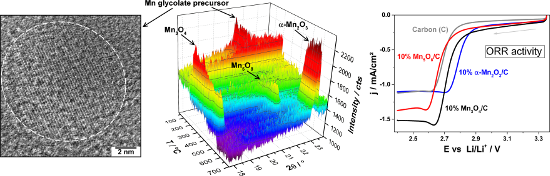
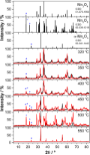
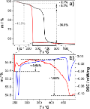
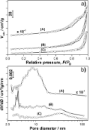
- the splinter-like pieces. A surface area of approximately 20 m2/g and pore diameters from 4 to 7 nm were also reported for Mn2O3 discs synthesized for the use as electrode material by Zhang et al. [17]. However, we believe a larger pore size to be advantageous for application as electrocatalysts, as





Liquid fuel cells
Beilstein J. Nanotechnol. 2014, 5, 1399–1418, doi:10.3762/bjnano.5.153
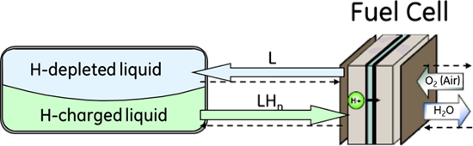
- exchange membranes; direct alcohol fuel cells; direct borohydride fuel cells; electrocatalysts; liquid fuel cells; organic fuel; proton exchange membranes; Introduction Fuel cells are considered to be one of the key elements of the “hydrogen economy”, in which hydrogen generated from renewable energy
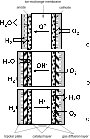
- ]. Solid inorganic proton conductors (e.g., sintered zirconium phosphate) allow for increasing the working temperature up to 150–250 °C [9]. Only platinum group metal (PGM) electrocatalysts are stable enough in the low-pH environment of PEMs. Platinum is the best electrocatalyst for both hydrogen oxidation
- GE and used composite electrodes (a Pt black mixed with Teflon) and an AEM impregnated with 30% KOH [10]. An advantage of AEM fuel cells is that it is possible to use non-PGM electrocatalysts while classic PGM-oxide catalysts are less corrosion stable [11]. In general, AEMs have a lower conductivity

3D-nanoarchitectured Pd/Ni catalysts prepared by atomic layer deposition for the electrooxidation of formic acid
Beilstein J. Nanotechnol. 2014, 5, 162–172, doi:10.3762/bjnano.5.16
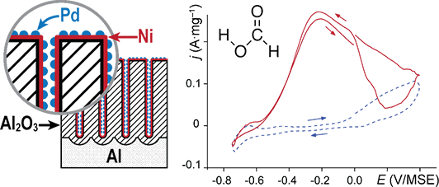
- H2-annealed NiO layers after the deposition of Pd. Figure 12 shows the forward and reverse scans of the third CV cycle on Pd/Ni electrocatalysts deposited onto an AAO membrane in 0.5 M H2SO4 before and after adding 1 M HCOOH. From cycle number 1 until cycle number 3, a decrease of the
- oxidation of formic acid on Pd/Ni electrocatalysts with the increase of Pd mass. Note that it can also be because of the mass transport effect [43] since diffusion into such narrow channels can differ strongly from standard 2D models. Conclusion In this study, well-defined Pd/Ni nanocatalysts grown by ALD
- connected to the ALD chamber and driven by a SQM-160 controller for data acquisition. The morphology of Al2O3 templates and Pd/Ni electrocatalysts has been observed by SEM and TEM using, respectively, JEOL 6320-F and JEOL 3010 equipment. Some additional morphological investigations have been carried out by


Design criteria for stable Pt/C fuel cell catalysts
Beilstein J. Nanotechnol. 2014, 5, 44–67, doi:10.3762/bjnano.5.5
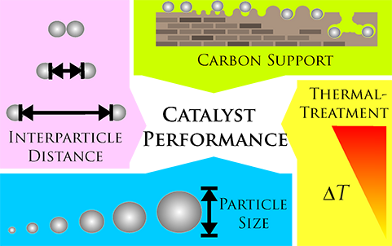
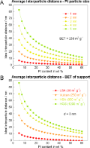
- , 40237 Düsseldorf, Germany Department of Heterogeneous Catalysis, Max-Planck-Institut für Kohlenforschung, Kaiser-Wilhelm-Platz 1, 45470 Mülheim an der Ruhr, Germany 10.3762/bjnano.5.5 Abstract Platinum and Pt alloy nanoparticles supported on carbon are the state of the art electrocatalysts in proton
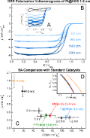
- environmental conditions, for instance in moisturized air, were also reported [50],[61][62][63]. Aiming for a visualization of the degradation processes that electrocatalysts undergo under electrochemical conditions, our group has developed an electron microscopic method to study identical locations of
- confirmed in sulfuric acid (see Table 1 and Figure S2 in Supporting Information File 1). Macroscopic stability investigation While cathode electrocatalysts are rather stable under constant fuel cell operating conditions for hundreds or even thousands of hours, they can degrade rapidly if subjected to more




Some reflections on the understanding of the oxygen reduction reaction at Pt(111)
Beilstein J. Nanotechnol. 2013, 4, 956–967, doi:10.3762/bjnano.4.108
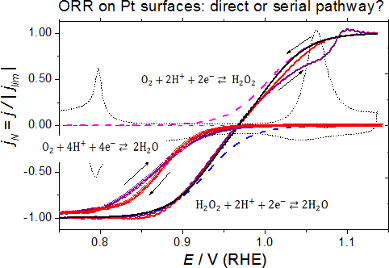
- electrocatalysts for fuel-cell cathodes is only possible through a cooperative approach between theory and experiments. Keywords: hydrogen peroxide oxidation; hydrogen peroxide reduction; oxygen reduction; Pt(111); stepped surfaces; Introduction Nowadays, the oxygen reduction reaction (ORR) is arguably one of
- step (RDS) on Pt, which would be an essential step toward an optimized design of new ORR electrocatalysts [15]. Results and Discussion Ideally, the surface structure and composition of a catalyst remain unchanged over the whole potential range in which a probe reaction is scrutinized. However, as can
- ][54]. Surface sensitive reactions Since early works [55][56], it has been known that there are volcano type responses when the ORR current densities, at a chosen potential, are plotted for different electrocatalysts as a function of either the adsorption bond strength, ΔGads, of the Oads, OHads and


Other Beilstein-Institut Open Science Activities



