


Search results
Search for "energy related" in Full Text gives 30 result(s) in Beilstein Journal of Nanotechnology.
Structural and thermoelectric properties of TMGa3 (TM = Fe, Co) thin films
Beilstein J. Nanotechnol. 2013, 4, 461–466, doi:10.3762/bjnano.4.54
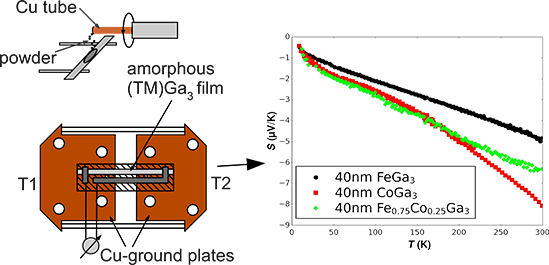
- ≤ 300 K. Keywords: amorphous metal films; energy related; intermetallic compounds; nanomaterials; Seebeck coefficient; thermoelectric properties; thin metal films; Introduction Intermetallic compounds usually behave as metals. In some cases, however, when a compound contains both, d- and p-block


Influence of the solvent on the stability of bis(terpyridine) structures on graphite
Beilstein J. Nanotechnol. 2013, 4, 269–277, doi:10.3762/bjnano.4.29
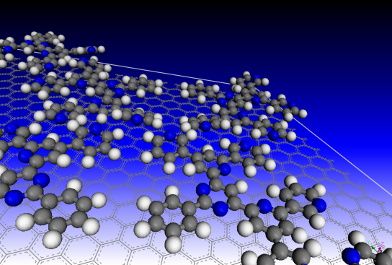
- various network structures as a function of the chemical potential is derived yielding a sequence in agreement with the experiment. Keywords: computer simulations; energy related; force-field calculations; nanomaterials; solvation; Introduction The controlled formation of structured surfaces by the


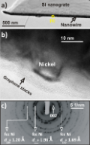
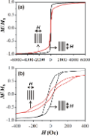
Highly ordered ultralong magnetic nanowires wrapped in stacked graphene layers
Beilstein J. Nanotechnol. 2012, 3, 846–851, doi:10.3762/bjnano.3.95
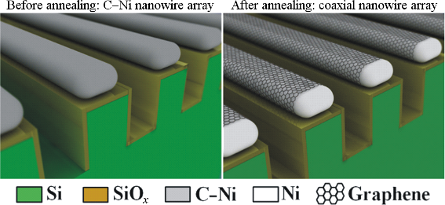
- , sensors, and energy-related devices [17][18][19]. The combination between the electrical properties of graphene and the magnetic properties of 1D ferromagnetic nanostructures would offer wide prospects for spintronic applications. Fabricating coaxial nanowires with ferromagnetic cores and graphene


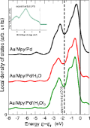
Influence of water on the properties of an Au/Mpy/Pd metal/molecule/metal junction
Beilstein J. Nanotechnol. 2011, 2, 384–393, doi:10.3762/bjnano.2.44
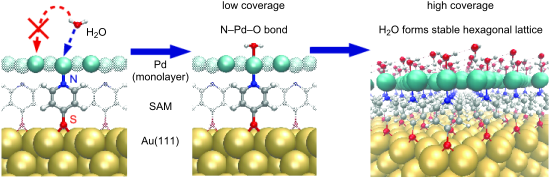
- structure with every second water molecule bound to the metal surface via the oxygen atom. The other water molecules have one hydrogen atom either pointing away from the surface (Hup) or towards the surface (Hdown). In such an arrangement the adsorption energy related to one H2O in the gas phase is higher

![[Graphic 1]](/bjnano/content/inline/2190-4286-2-44-i1.png?max-width=637&scale=0.945456) )R3...
)R3...


![[Graphic 2]](/bjnano/content/inline/2190-4286-2-44-i2.png?max-width=637&scale=1.18182) = 1/3 ML. Plott...
= 1/3 ML. Plott...
Structural and magnetic properties of ternary Fe1–xMnxPt nanoalloys from first principles
Beilstein J. Nanotechnol. 2011, 2, 162–172, doi:10.3762/bjnano.2.20
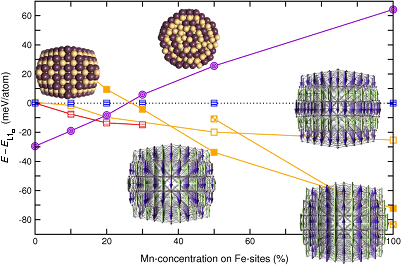
- the energy related to internal lattice defects, such as twin boundaries, by deliberate design of the alloy composition. This could effectively disfavor multiply twinned morphologies, while the resulting trends can be monitored on the electronic level in the framework of large scale density functional


Other Beilstein-Institut Open Science Activities



