Search results
Search for "femtosecond laser" in Full Text gives 38 result(s) in Beilstein Journal of Nanotechnology.
Laser-assisted fabrication of gold nanoparticle-composed structures embedded in borosilicate glass
Beilstein J. Nanotechnol. 2017, 8, 2454–2463, doi:10.3762/bjnano.8.244
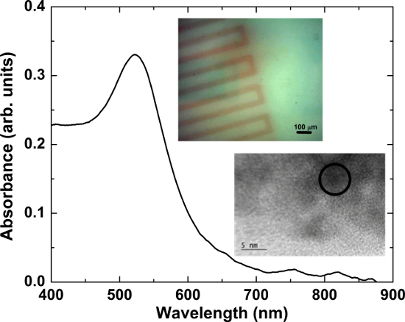
- irradiating the glass by nanosecond and femtosecond laser pulses over a wide range of fluences and number of applied pulses. The irradiation by nanosecond laser pulses (emitted by a Nd:YAG laser system) induced defect formation, expressed by brown coloration of the glass sample, only at a wavelength of 266 nm
- . At 355, 532 and 1064 nm, no coloration of the sample was observed. The femtosecond laser irradiation at 800 nm also induced defects, again observed as brown coloration. The absorbance spectra indicated that this coloration was related to the formation of oxygen deficiency defects. After annealing
- with dimensions of 10 × 10 × 3 mm and polished. We chose borosilicate glass because of its low thermal expansion coefficient and good resistance to the high thermal gradients likely to be induced by laser processing. The samples were irradiated by nanosecond and femtosecond laser pulses with different


The longstanding challenge of the nanocrystallization of 1,3,5-trinitroperhydro-1,3,5-triazine (RDX)
Beilstein J. Nanotechnol. 2017, 8, 452–466, doi:10.3762/bjnano.8.49
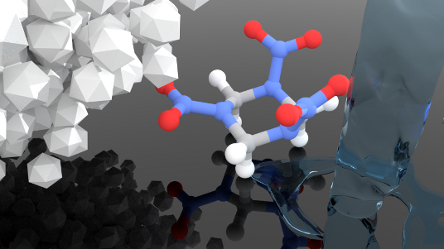
- our everyday electronic devices for decades, PVD applied on energetic materials will never be able to reach a production of several hundred of grams per hour. However, PVD is suitable for the current trend to create ”pyrotechnic integrated circuits”. Femtosecond laser ablation is used for nanoparticle


The role of morphology and coupling of gold nanoparticles in optical breakdown during picosecond pulse exposures
Beilstein J. Nanotechnol. 2016, 7, 869–880, doi:10.3762/bjnano.7.79
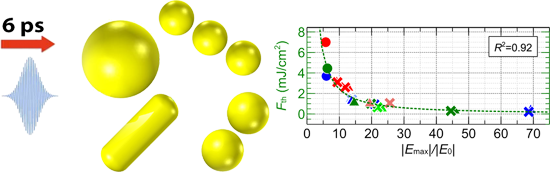
- optical breakdown process [37][42][43]. Hatef and Meunier [43] recently reported the impact of size and inter-particle distance for femtosecond laser pulse widths on the energy absorption by gold nanosphere dimers and by the plasma surrounding the dimers. They showed that the energy deposition in the




Controlled graphene oxide assembly on silver nanocube monolayers for SERS detection: dependence on nanocube packing procedure
Beilstein J. Nanotechnol. 2016, 7, 9–21, doi:10.3762/bjnano.7.2
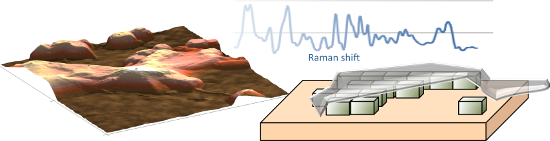
- distance permits the creation of an efficient hot spot distribution. Additionally, recent experiments on localized surface plasmon emission via delayed femtosecond laser pulses confirmed that small clusters lead to a plasmonic response that provides the highest peak intensity [60]. Conclusion Here we


Nanostructuring of GeTiO amorphous films by pulsed laser irradiation
Beilstein J. Nanotechnol. 2015, 6, 893–900, doi:10.3762/bjnano.6.92
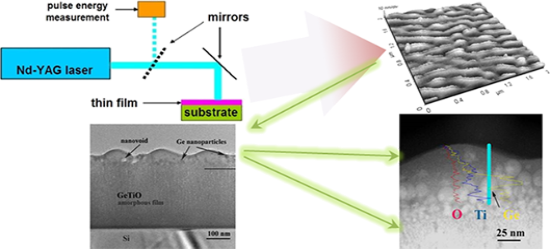
- to the laser wavelength or harmonics [27]. This happens at all wavelengths and pulse durations, as in the case of femtosecond laser irradiation [28]. The stress-induced periodic-ripples mechanism demonstrated for crystalline Si [29] could be used for amorphous materials if we define a stress yield


Current state of laser synthesis of metal and alloy nanoparticles as ligand-free reference materials for nano-toxicological assays
Beilstein J. Nanotechnol. 2014, 5, 1523–1541, doi:10.3762/bjnano.5.165
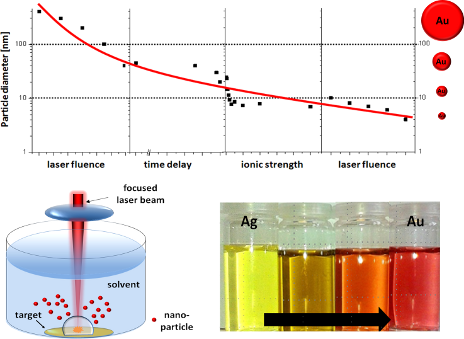
- plume while in the case of nanosecond pulses the plasma plume may absorb further energy from the laser pulse, which may be responsible for homogenization of the ejected material [24][48][49] and hence more narrow size distributions. In the case of femtosecond laser ablation, particularly at high laser
- obtained from PLAL in deionized water using picosecond (black curve) and nanosecond (red curve) pulses. B) Gold nanoparticles obtained from femtosecond laser ablation showing a bimodal particle size distribution. (Reprinted with permission from [50]. Copyright 2003 AIP Publishing ICC). Size control of


Observation and analysis of structural changes in fused silica by continuous irradiation with femtosecond laser light having an energy density below the laser-induced damage threshold
Beilstein J. Nanotechnol. 2014, 5, 1334–1340, doi:10.3762/bjnano.5.146
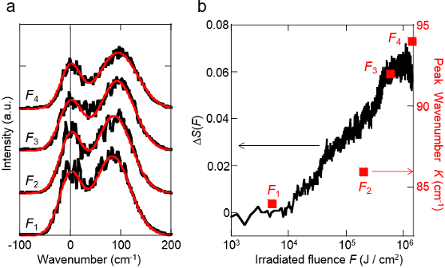
- continuous irradiation with laser light having an energy density below the LIDT. Therefore, here we focused on the degradation in performance of an optical component caused by continuous irradiation with femtosecond laser light having a low energy density, i.e., laser-induced degradation. We performed an in
- photogenerated carriers in a degraded silica substrate and a damaged silica substrate and observed a Raman signal originating from a specific molecular structure of silica. From these findings, we concluded that compositional changes in the molecular structure occurred during degradation due to femtosecond laser
- irradiation having an energy density below the LIDT. Keywords: compositional change in molecular; femtosecond laser; fused silica; laser-induced damage; laser-induced degradation; Introduction Since the invention of the laser, it has been widely known that damages occur at the surface or interior of optical


Dry friction of microstructured polymer surfaces inspired by snake skin
Beilstein J. Nanotechnol. 2014, 5, 1091–1103, doi:10.3762/bjnano.5.122

- originated from moulds of polishing paper (FibrMet Discs, Buehler GmbH, Düsseldorf, Germany) with different grain sizes (Ra: 0.3 µm, 1 µm, 3 µm, 9 µm, and 12 µm) (Figure 3b). The master for the third type of surfaces was produced from zirconium oxide surface microstructured by femtosecond laser ablation
- . Structuring was performed with a commercially available amplified Ti:Sapphire femtosecond laser system (Femtopower Compact Pro, Femtolasers GmbH, Austria). The systems delivers sub-30-fs pulses at a central wavelength of 800 nm with a pulse energy of up to 1 mJ, and a repetition rate of 1 kHz. An x–y


Energy dissipation in multifrequency atomic force microscopy
Beilstein J. Nanotechnol. 2014, 5, 494–500, doi:10.3762/bjnano.5.57
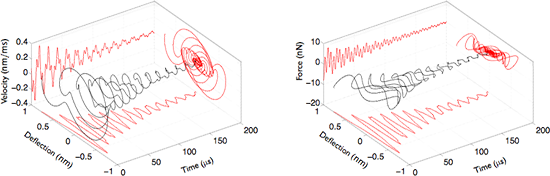
- action. Moreover, the techniques outlined in this work will find applications in a variety of fields of interest for nanotechnology. Few-cycle AFM will be useful to characterize the mechanical contact properties of nanostructures produced by femtosecond laser ablation [22], while wavelets techniques will


Mapping of plasmonic resonances in nanotriangles
Beilstein J. Nanotechnol. 2013, 4, 588–602, doi:10.3762/bjnano.4.66
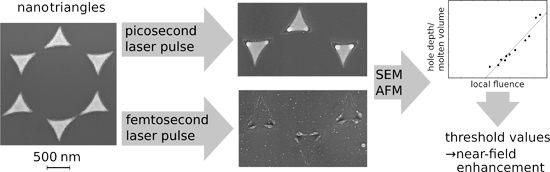
- of high field enhancement. These two techniques are variations of the same methods: The substrates carrying the nanostructures are irradiated with pulsed laser light. The ablation experiments are realized by using irradiation with femtosecond laser pulses, i.e., pulses shorter than the internal heat
- inside the triangle. Results and Discussion Femtosecond laser ablation General features We first give an overview over the general features of femtosecond plasmonic ablation. Figure 5 shows an SEM micrograph of a typical femtosecond ablation site on a sample, which consists of gold nano-triangles
- prepared by colloid lithography. The plasmonic structures were irradiated with a single femtosecond laser pulse with a total energy of 30 μJ. The irradiation intensity increases towards the center of the irradiated spot, and, since the spot profile is known, the local fluence can be determined by measuring


Femtosecond-resolved ablation dynamics of Si in the near field of a small dielectric particle
Beilstein J. Nanotechnol. 2013, 4, 501–509, doi:10.3762/bjnano.4.59
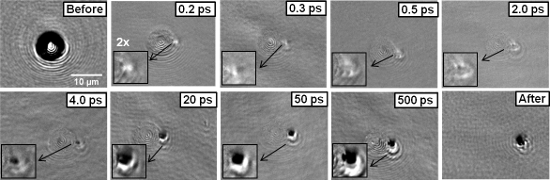
- “Rocasolano”, CSIC, Serrano 119, 28006 Madrid, Spain 10.3762/bjnano.4.59 Abstract In this work we analyze the ablation dynamics of crystalline Si in the intense near field generated by a small dielectric particle located at the material surface when being irradiated with an infrared femtosecond laser pulse
- . Further details regarding the preparation procedure and optical properties of the different substrates and particles used, as well as near field imaging using GST films can be found elsewhere [11]. Femtosecond laser irradiation and time-resolved microscopy Figure 2 shows a scheme of the set-up used for


Femtosecond time-resolved photodissociation dynamics of methyl halide molecules on ultrathin gold films
Beilstein J. Nanotechnol. 2011, 2, 618–627, doi:10.3762/bjnano.2.65
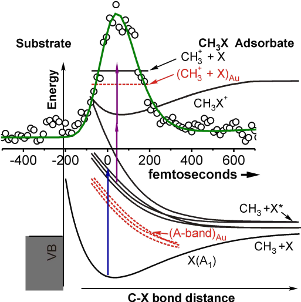
- chloride, adsorbed on a metal surface was investigated in real time by means of femtosecond-laser pump–probe mass spectrometry. A weakly interacting gold surface was employed as substrate because the intact adsorption of the methyl halide molecules was desired prior to photoexcitation. The gold surface was
- at all. Keywords: femtosecond laser spectroscopy; gold; methyl halide photodissociation; surface chemistry; time-of-flight mass spectrometry; Introduction The understanding of the mechanisms involved in the light-induced excitation and fragmentation of organic molecules on metal substrates is of


Zirconium nanoparticles prepared by the reduction of zirconium oxide using the RAPET method
Beilstein J. Nanotechnol. 2011, 2, 198–203, doi:10.3762/bjnano.2.23
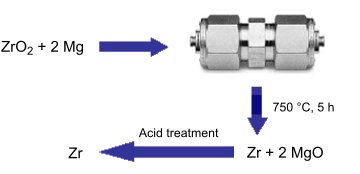
- zirconium rod in isopropyl alcohol has been described [7]. This process produces a colloidal solution of zirconium nanoparticles. Moreover, it was shown that the size distribution of nanoparticles can be greatly reduced by employing femtosecond laser pulses for ablation. A plasma induced cathodic discharge