


Search results
Search for "functionalized nanoparticles" in Full Text gives 30 result(s) in Beilstein Journal of Nanotechnology.
A facile method for the preparation of bifunctional Mn:ZnS/ZnS/Fe3O4 magnetic and fluorescent nanocrystals
Beilstein J. Nanotechnol. 2015, 6, 1743–1751, doi:10.3762/bjnano.6.178
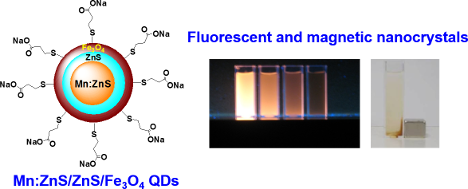
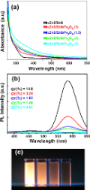
- clearly confirmed the growth of the Fe3O4 shell around the Mn:ZnS/ZnS core. Note also that these functionalized nanoparticles could be easily redispersed in aqueous medium after purification and drying (Figure 4a). The room temperature, magnetic harvesting of the heterostructured nanocrystals could be




Comparative evaluation of the impact on endothelial cells induced by different nanoparticle structures and functionalization
Beilstein J. Nanotechnol. 2015, 6, 300–312, doi:10.3762/bjnano.6.28
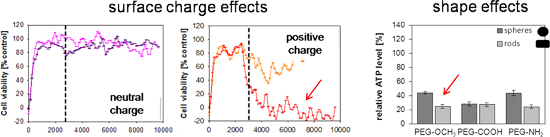
- endothelial cells. These findings are attributed to a rapid internalization of the NH2-functionalized nanoparticles in combination with the damage of intracellular membranes. Interestingly, the endocytotic pathway seems to be a size-dependent process whereas nanoparticles with a size of 20 nm are internalized
- nanoparticles. The uptake rate was normalized as the percentage of cells with nanoparticles. Impact of different shaped and functionalized nanoparticles on the cellular ATP-level of different endothelial cells after 24 h and 72 h of incubation. Relative cellular ATP-levels were detected by ATPLite assay. (a




The fate of a designed protein corona on nanoparticles in vitro and in vivo
Beilstein J. Nanotechnol. 2015, 6, 36–46, doi:10.3762/bjnano.6.5
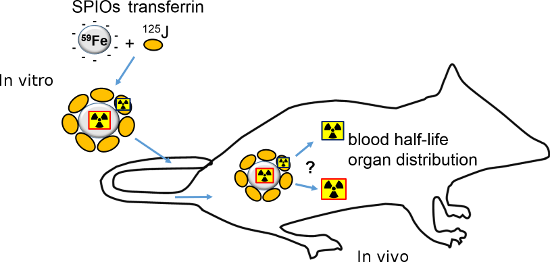
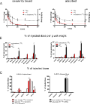
- fate of functionalized nanoparticles also in vivo. Results Particle synthesis and characterization Radiolabelling of both the nanoparticle cores and of adsorbed proteins offers a way to follow and quantify the fate of a designed protein corona not only in vitro but also in vivo. For this purpose, we


Mammalian cell growth on gold nanoparticle-decorated substrates is influenced by the nanoparticle coating
Beilstein J. Nanotechnol. 2014, 5, 2479–2488, doi:10.3762/bjnano.5.257
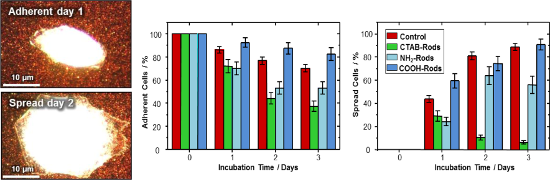
- apical application of the same functionalized nanoparticles are presented elsewhere [18][19][20]. Results System We investigate the growth of mammalian epithelial kidney (MDCK II) cells seeded on glass substrates decorated with gold nanorods (38 × 17 nm, Supporting Information of [20]) and compare the
- nanoparticles on substrate require in order to prevent their removal by cells seem to be necessary. In previous studies, the cytotoxic impact of apical exposure of the same functionalized nanoparticles to the same epithelial cell line (MDCK II) was presented [18] and the cellular uptake was quantified [20]. It


Manipulation of gold colloidal nanoparticles with atomic force microscopy in dynamic mode: influence of particle–substrate chemistry and morphology, and of operating conditions
Beilstein J. Nanotechnol. 2011, 2, 85–98, doi:10.3762/bjnano.2.10
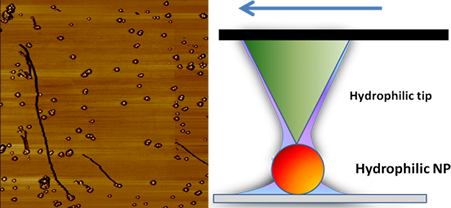
- often heterogeneous in their chemical composition, functionalized nanoparticles provide good model systems to study and tune the mobility of nano-objects on these substrates. As a next step, the role of the hydrohilicity and hydrophobicity of the functional grafting on spherical Au nanoparticles is


Other Beilstein-Institut Open Science Activities



