


Search results
Search for "gas-sensing properties" in Full Text gives 30 result(s) in Beilstein Journal of Nanotechnology.
Gas sensing properties of nanocrystalline diamond at room temperature
Beilstein J. Nanotechnol. 2014, 5, 2339–2345, doi:10.3762/bjnano.5.243
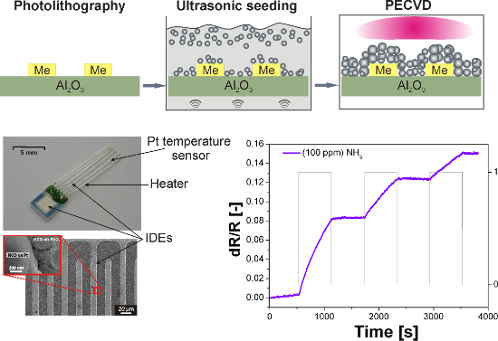
- Prague, Czech Republic 10.3762/bjnano.5.243 Abstract This study describes an integrated NH3 sensor based on a hydrogenated nanocrystalline diamond (NCD)-sensitive layer coated on an interdigitated electrode structure. The gas sensing properties of the sensor structure were examined using a reducing gas
- ) and a visible development of diamond nanocrystal faceting. Moreover, the NCD primarily grew on the IDEs as was previously found [9]. The gas-sensing properties of the hydrogenated NCD sensor with a sparse electrode arrangement of 200 µm were tested against a sequence of NH3 pulses (Figure 1b). These
- + IDEs with a separation of 50 µm) coated with the NCD layer after 40 min of nucleation time. The coating exhibited a continuous diamond layer with diamond grains up to 80 nm in size. The gas-sensing properties of the hydrogenated NCD sensor with a dense electrode arrangement of 50 µm was also tested


Room temperature, ppb-level NO2 gas sensing of multiple-networked ZnSe nanowire sensors under UV illumination
Beilstein J. Nanotechnol. 2014, 5, 1836–1841, doi:10.3762/bjnano.5.194
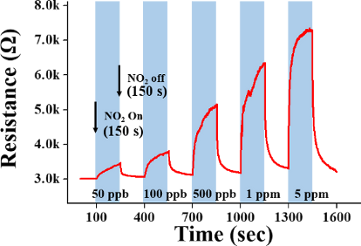
- Department of Nano-Optical Engineering, Korea Polytechnic University, 2121 Jeongwang-dong, Shiheung city, Gyeonggi-do, 429-793, Republic of Korea 10.3762/bjnano.5.194 Abstract Reports of the gas sensing properties of ZnSe are few, presumably because of the decomposition and oxidation of ZnSe at high
- diodes [5] and UV photodetectors [6]. On the other hand, there are almost no reports on the gas sensing properties of ZnSe. This might be due to the decomposition and oxidation of ZnSe at temperatures above 200 °C [7] and a lack of good sensing performance at room temperature. In recent years, one
- enhance the sensing performance of ZnSe, 1D nanostructure-based sensors at room temperature. In this study, multiple-networked ZnSe nanowire sensors were fabricated and examined for their room-temperature, NO2-gas sensing properties under UV illumination. Unlike individual 1D nanostructure sensors



Highly NO2 sensitive caesium doped graphene oxide conductometric sensors
Beilstein J. Nanotechnol. 2014, 5, 1073–1081, doi:10.3762/bjnano.5.120
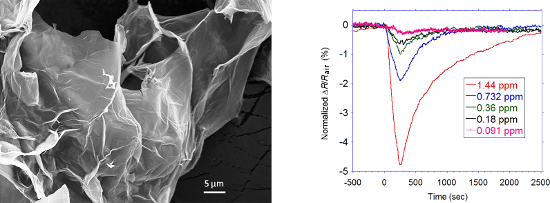
- the oxygen defects that act as low energy adsorption sites. To further enhance its gas sensing properties, reduced GO can be doped with alkali metals [18], similarly to what has been done in other carbon materials, to tune up the electronic properties for sensing applications [44]. Different research




Gas sensing with gold-decorated vertically aligned carbon nanotubes
Beilstein J. Nanotechnol. 2014, 5, 910–918, doi:10.3762/bjnano.5.104
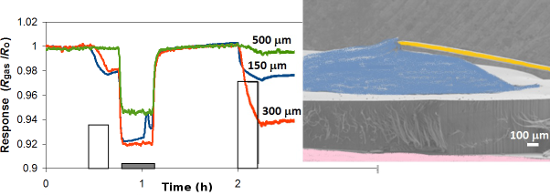
- fitted by a doublet of Doniach–Sunjic lineshapes with an asymmetric parameter of 0.12, the core level shift between 4f7/2 and 4f5/2 being 3.68 eV, in agreement with tabulated values [30]. Gas sensing properties Sensors based on Au-decorated VA-CNTs with different lengths responded to NO2 at room


Functionalised zinc oxide nanowire gas sensors: Enhanced NO2 gas sensor response by chemical modification of nanowire surfaces
Beilstein J. Nanotechnol. 2012, 3, 368–377, doi:10.3762/bjnano.3.43
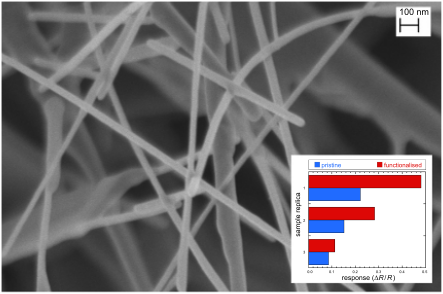
- eV) at 150 W (15 kV, 10 mA) were used as the incident radiation. Multiplex high-resolution scans were achieved at an analyser pass energy of 20 eV, in steps of 0.10 eV. Characterisation of the electrical and gas-sensing properties was carried out using a two-probe technique by applying a constant 0.2


Other Beilstein-Institut Open Science Activities



