


Search results
Search for "magnetic hyperthermia" in Full Text gives 31 result(s) in Beilstein Journal of Nanotechnology.
Antitumor magnetic hyperthermia induced by RGD-functionalized Fe3O4 nanoparticles, in an experimental model of colorectal liver metastases
Beilstein J. Nanotechnol. 2016, 7, 1532–1542, doi:10.3762/bjnano.7.147
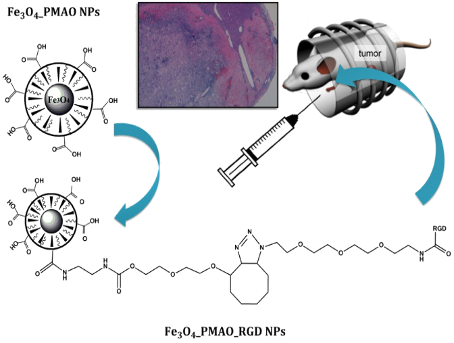
- the Basque Country, UPV/EHU, 20018 Donostia, Spain, Galdakao Usansolo Hospital, 48960 Bizkaia, Spain 10.3762/bjnano.7.147 Abstract This work reports important advances in the study of magnetic nanoparticles (MNPs) related to their application in different research fields such as magnetic hyperthermia
- achieved. The nanoparticles were characterized by transmission electron microscopy (TEM), vibrating sample magnetometry (VSM), electron magnetic resonance (EMR) spectroscopy and magnetic hyperthermia. The nanoparticles present superparamagnetic behavior with very high magnetization values, which yield
- alternating magnetic field in order to achieve hyperthermia. The evolution of an in vivo model has been described, resulting in a significant reduction in tumor viability. Keywords: magnetite nanoparticles; magnetic hyperthermia; RGD functionalization; tumor targeting; Introduction Colorectal liver


An adapted Coffey model for studying susceptibility losses in interacting magnetic nanoparticles
Beilstein J. Nanotechnol. 2015, 6, 2173–2182, doi:10.3762/bjnano.6.223
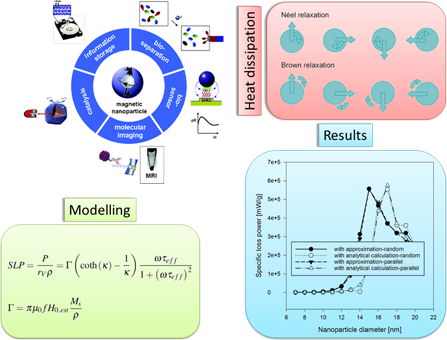
- frequencies and amplitudes of external magnetic fields for biomedical applications, especially for tumor therapy by magnetic hyperthermia. Keywords: hyperthermia; magnetic nanoparticles; relaxation process; specific loss power; susceptibility losses; Introduction Magnetic nanoparticles are important for
- basis for practical magnetic hyperthermia than small nanoparticles [6]. Usually, the magnetite nanoparticles used in hyperthermia have a diameter above 53 nm but below the diameter above which objects are no more considered to be “nano” (100 or 200 nm, according to the bibliographic sources). Actually
- , magnetite is considered the most favourable material in magnetic hyperthermia. At about 30 nm particle diameter the behaviour of magnetite nanoparticles changes from single-domain to multi-domain state [7], representing the critical dimension of magnetite-based nanoparticles. The tendency for agglomeration


Comparative evaluation of the impact on endothelial cells induced by different nanoparticle structures and functionalization
Beilstein J. Nanotechnol. 2015, 6, 300–312, doi:10.3762/bjnano.6.28
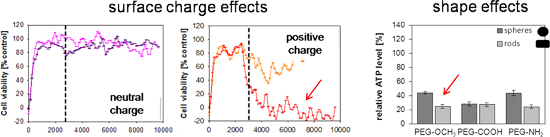
- ; Introduction To advance the field of nanomedicine, innovative nanoparticle formulations with suitable properties for diagnostic imaging, therapy (e.g., magnetic hyperthermia), delivery of drugs and siRNA have been developed. Apart from their feasibility for the respective application many of these


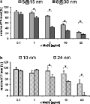


Influence of surface-modified maghemite nanoparticles on in vitro survival of human stem cells
Beilstein J. Nanotechnol. 2014, 5, 1732–1737, doi:10.3762/bjnano.5.183
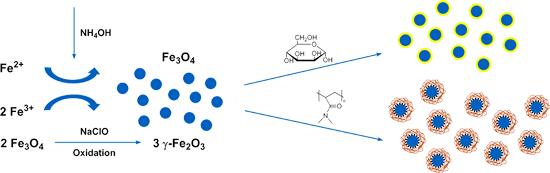
- , magnetic hyperthermia or magnetofection. Transmission electron micrographs of (a) non-coated, (b) D-mannose- and (c) PDMAAm-coated γ-Fe2O3 nanoparticles. Effect of non-coated, D-mannose- and PDMAAm-coated γ-Fe2O3 on the in vitro survival of 4BL human cells at different concentrations of particles in the


Carbon dioxide hydrogenation to aromatic hydrocarbons by using an iron/iron oxide nanocatalyst
Beilstein J. Nanotechnol. 2014, 5, 760–769, doi:10.3762/bjnano.5.88
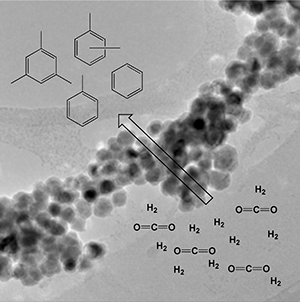
- been developed [34][35][36][37][38][39][40][41]. The application of such materials in cancer diagnosis and cancer treatment, such as MRI and magnetic hyperthermia are intensively studied [42][43][44]. The use of iron-containing nanomaterials as catalysts for the methanol oxidation reaction [45], and


Magnetic-Fe/Fe3O4-nanoparticle-bound SN38 as carboxylesterase-cleavable prodrug for the delivery to tumors within monocytes/macrophages
Beilstein J. Nanotechnol. 2012, 3, 444–455, doi:10.3762/bjnano.3.51
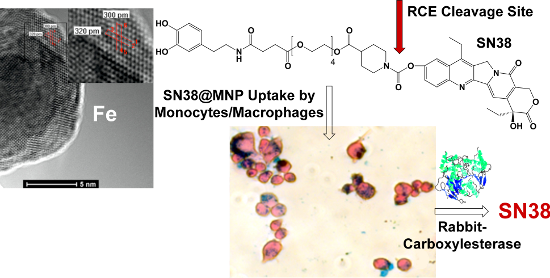
- the payload of tumor-homing double-stable RAW264.7 cells; (2) Release of chemotherapeutic SN38 at the cancer site by means of the self-containing Tet-On Advanced system; (3) Provide localized magnetic hyperthermia to enhance the cancer treatment, both by killing cancer cells through magnetic heating
- , biocompatibility, and potential for targeted accumulation at the tumor site, ultra-small magnetic nanoparticles are the prime candidates for application in magnetic hyperthermia [32][33][34]. We have developed a magnetic core/shell Fe/Fe3O4 nanoparticle platform, which can generate substantial heat within a
- Brownian. In Neel relaxation, the nanoparticles do not move, but the direction of magnetization inside the particles rotates. In Brownian relaxation, the whole particle rotates against resistance due to the viscosity of the surrounding medium. For the localized magnetic hyperthermia application using our


Other Beilstein-Institut Open Science Activities



