


Search results
Search for "mechanical exfoliation" in Full Text gives 34 result(s) in Beilstein Journal of Nanotechnology.
In-situ monitoring by Raman spectroscopy of the thermal doping of graphene and MoS2 in O2-controlled atmosphere
Beilstein J. Nanotechnol. 2017, 8, 418–424, doi:10.3762/bjnano.8.44
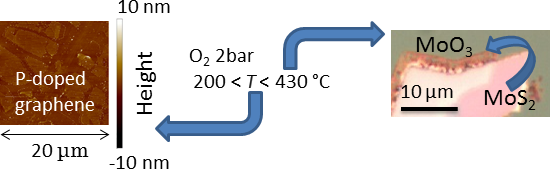
- 25 min. Heating and cooling were executed in controlled atmosphere. MoS2 samples were obtained by mechanical exfoliation of bulk natural molybdenite crystals, obtained from SPI (http://www.2spi.com). The exfoliation was based on thermal release tape and thermocompression printing on a SiO2 (300 nm
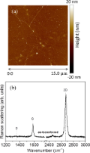
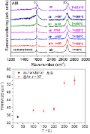
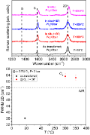


Nitrogen-doped twisted graphene grown on copper by atmospheric pressure CVD from a decane precursor
Beilstein J. Nanotechnol. 2017, 8, 145–158, doi:10.3762/bjnano.8.15
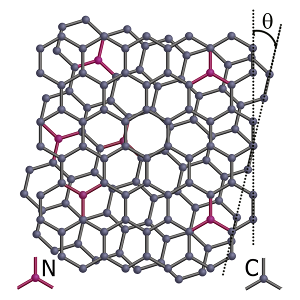
- consists of mechanical exfoliation, which imposes severe mechanical, uncontrolled defects in the sample. The most common and preferable is the wet-chemical etching of the catalyst (substrate). Usually a poly(methylmethacrylate) (PMMA) scaffold is applied to coat the graphene surface and support it during


Characterisation of thin films of graphene–surfactant composites produced through a novel semi-automated method
Beilstein J. Nanotechnol. 2016, 7, 209–219, doi:10.3762/bjnano.7.19
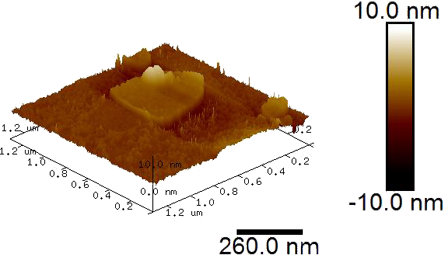
- subsequent reduction to graphene [5], and secondly it guarantees single-layer or few-layer graphene, rather than the potentially larger products or graphene sheets with an uneven size distribution that might be produced in other techniques such as mechanical exfoliation (the “scotch tape” method). The




Synthesis and applications of carbon nanomaterials for energy generation and storage
Beilstein J. Nanotechnol. 2016, 7, 149–196, doi:10.3762/bjnano.7.17
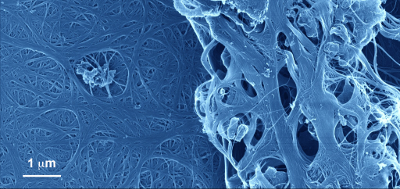
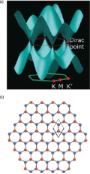
- industry in the development of this technology. There are more than ten processes available to synthesize graphene but only the following five can be reasonably considered in terms of quality and material scalability (Figure 14) [81]: Mechanical exfoliation Chemical exfoliation Chemical exfoliation via
- graphene oxide CVD Synthesis on SiC Each of these methods has its advantages and disadvantages in terms of quality, yield production and applications, as summarized in Table 1. In particular, mechanical exfoliation most likely produces the best samples in terms of charge carrier mobility but is probably
- production of high quality graphene on a large scale. However, a possible application timeline has already appeared in the literature indicating when possible electronic device prototypes could be expected in the future (Figure 15) [81]. Mechanical exfoliation. The mechanical exfoliation method was















Enhanced model for determining the number of graphene layers and their distribution from X-ray diffraction data
Beilstein J. Nanotechnol. 2015, 6, 2113–2122, doi:10.3762/bjnano.6.216
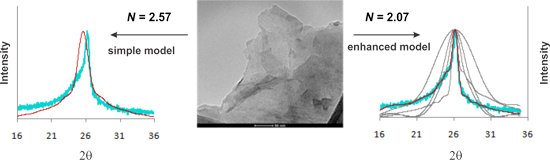
- attracted great interest in terms of fundamental studies as well as potential applications [2]. To date, several methods have been used to produce high-quality graphene sheets, such as mechanical exfoliation of graphite, chemical vapor deposition (CVD) of gases containing carbon atoms on the surface of


Electroburning of few-layer graphene flakes, epitaxial graphene, and turbostratic graphene discs in air and under vacuum
Beilstein J. Nanotechnol. 2015, 6, 711–719, doi:10.3762/bjnano.6.72
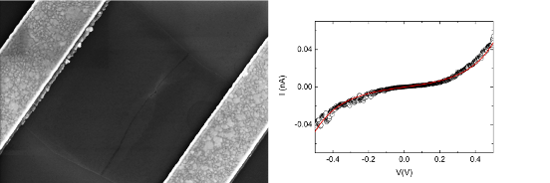
- first consider the case of few-layer graphene flakes obtained by the mechanical exfoliation technique (see Experimental for more details). A typical flake is shown in the inset of Figure 1a. Several electrical contacts are fabricated on the same sample, leading to a certain number of nearly identical
- optimal working conditions for the different types of device. We believe that these results will contribute to the realization of reliable graphene based electrodes for molecular electronics and spintronics. Experimental Few-layer graphene flakes were deposited by the standard “scotch tape” mechanical
- exfoliation method from natural graphite pieces on top of a p-doped silicon wafer coated with 300 nm of oxide. Flakes of suitable thickness (1 to approx. 20 layers) were located with an optical microscope on the basis of their contrast with the substrate. In some cases, the effective number of layers is also



X-ray photoelectron spectroscopy of graphitic carbon nanomaterials doped with heteroatoms
Beilstein J. Nanotechnol. 2015, 6, 177–192, doi:10.3762/bjnano.6.17
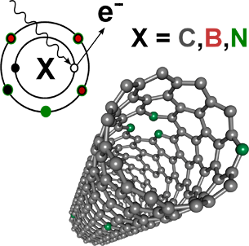
- chemical vapor deposition in a high-vacuum system and a triisopropyl borate precursor [182], and the important role of B adhesion to Fe catalyst particles was also highlighted. For boron-doped graphene, successful synthesis recipes range from the mechanical exfoliation of boron-doped graphite [183] to


Highly NO2 sensitive caesium doped graphene oxide conductometric sensors
Beilstein J. Nanotechnol. 2014, 5, 1073–1081, doi:10.3762/bjnano.5.120
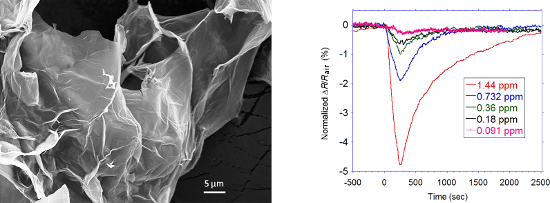
- processes to make pristine graphene sheets, like chemical vapour deposition, epitaxial growth or mechanical exfoliation [30][31][32][33]. By dispersion and sonication of graphite oxide in aqueous solution or organic solvent, a colloidal suspension of GO sheets is produced. The density of oxygen functional




Micro- and nanoscale electrical characterization of large-area graphene transferred to functional substrates
Beilstein J. Nanotechnol. 2013, 4, 234–242, doi:10.3762/bjnano.4.24
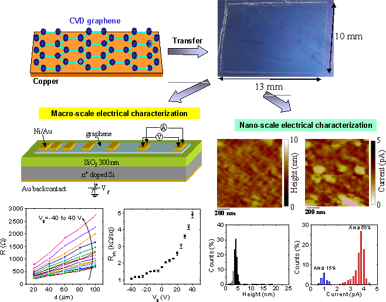
- flexible organic solar cells [9][10]. Currently, the most used method of graphene production for basic studies is the mechanical exfoliation of graphite [1], which was the first method to obtain graphene under ambient laboratory conditions. This method yields graphene fragments of excellent crystalline



Other Beilstein-Institut Open Science Activities



