Search results
Search for "microfabrication" in Full Text gives 38 result(s) in Beilstein Journal of Nanotechnology.
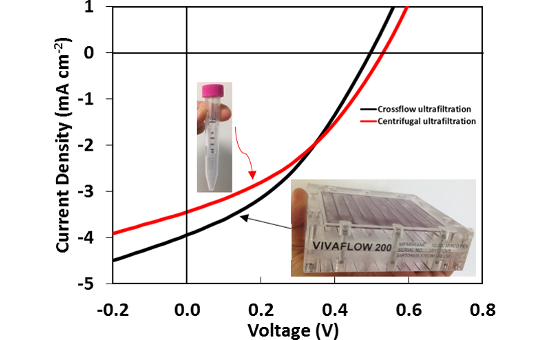
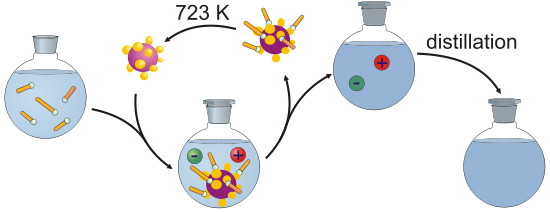
Optimisation of purification techniques for the preparation of large-volume aqueous solar nanoparticle inks for organic photovoltaics
Beilstein J. Nanotechnol. 2018, 9, 649–659, doi:10.3762/bjnano.9.60
- node of the Australian National Fabrication Facility, a company established under the National Collaborative Research Infrastructure Strategy to provide nano- and microfabrication facilities for Australia’s researchers. The authors thank the University of Newcastle Electron Microscopy and X-ray Unit.


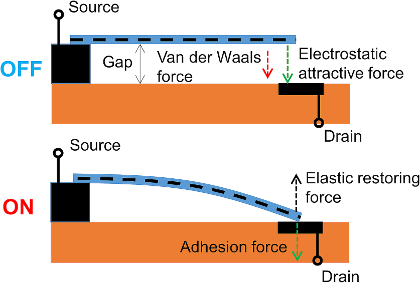
Review: Electrostatically actuated nanobeam-based nanoelectromechanical switches – materials solutions and operational conditions
Beilstein J. Nanotechnol. 2018, 9, 271–300, doi:10.3762/bjnano.9.29
- nanostructures (nanowires, nanotubes, nanorods, graphene) with a good uniformity and desired properties. The microfabrication routine may be supplemented with some bottom-up approaches. Dielectrophoresis [33], controlled nanomaterial growth [34], and nanomanipulation [9] have been demonstrated as useful methods
- microfabrication process to configure the NEM switch, posing challenges for large-scale production. To facilitate the fabrication of graphene-based devices, direct growth of nanocrystalline graphene on insulating substrates using regular thin film process techniques (example of growth process is shown in Figure


Multimodal cantilevers with novel piezoelectric layer topology for sensitivity enhancement
Beilstein J. Nanotechnol. 2017, 8, 358–371, doi:10.3762/bjnano.8.38
- methods, piezoelectric transduction seems to be the only one capable of simultaneously serving as an actuator and a sensor even with a single active layer [39][40]. A set of cantilever designs exist which integrate a piezoelectric transducer onto the cantilever as part of the microfabrication process [41
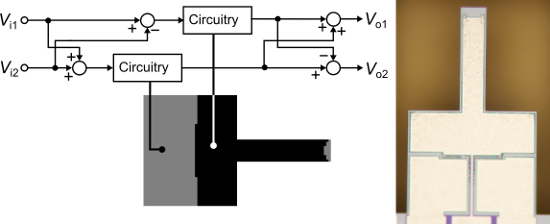
- designs are shown in Figure 2m–p. The cantilevers are fabricated using the PiezoMUMPs microfabrication process available from the company MEMSCAP Inc [54]. The device layer is a 10 μm thick layer of single-crystal-silicon deposited on a (100) oriented wafer. A 0.5 μm layer of AlN and a 1 μm layer of
- microfabrication process used to fabricate the cantilevers requires the two piezoelectric transducers share a common terminal [54]. The common terminal has to be grounded to electrically isolate them from each other. Therefore, the actuation and sensing circuits are applied to a grounded load. Two instrumentation


Precise in situ etch depth control of multilayered III−V semiconductor samples with reflectance anisotropy spectroscopy (RAS) equipment
Beilstein J. Nanotechnol. 2016, 7, 1783–1793, doi:10.3762/bjnano.7.171
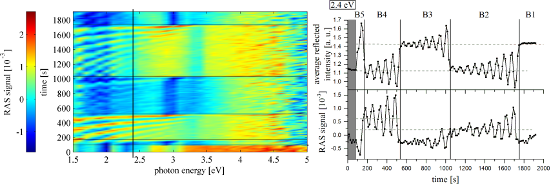
- -etching is an essential step of many lithographic processes, e.g., in semiconductor device fabrication, and offers several advantages over wet-etching as for instance the opportunity to achieve anisotropic etching and vertical etch flanks [10][11]. As the requirements for accuracy in microfabrication


Nano- and microstructured materials for in vitro studies of the physiology of vascular cells
Beilstein J. Nanotechnol. 2016, 7, 1620–1641, doi:10.3762/bjnano.7.155
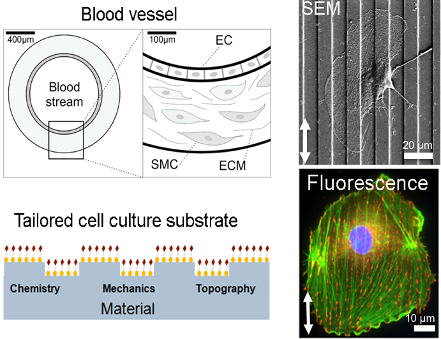
- desired surface feature size. In particular, some methods are not suited for structuring surface topographies in the nanometer range. 1.2 Microfabrication techniques Microfabrication techniques are mainly used to generate surface structures in the micrometer range, which is the size scale of cells. In
- order to give an overview of different microfabrication techniques, relevant examples for different approaches such as optical (photolithography [49]), mechanical (hot embossing [50] and surface cracking [51][52]) or chemical (replica molding [53][54], phase separation micromolding [55][56][57], gas
- nanostructures of few tens of nanometers, for example (Figure 4B) [53] After further modifications, the elastomer substrate can be used for cell experiments. Phase separation micromolding is an alternative, less common microfabrication technique for structured substrates. This technique consists of separating a



A scanning probe microscope for magnetoresistive cantilevers utilizing a nested scanner design for large-area scans
Beilstein J. Nanotechnol. 2015, 6, 451–461, doi:10.3762/bjnano.6.46
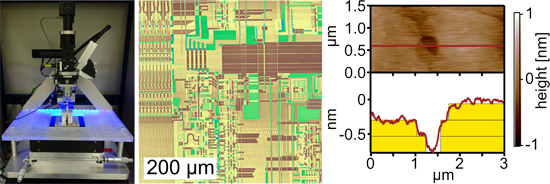
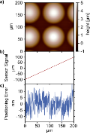
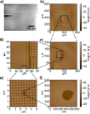
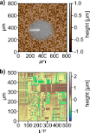
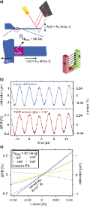
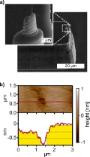
- ]. Micro-machined cantilevers on the other hand are more versatile and can be mass-produced [21]. Additionally, cantilevers produced by silicon-based microfabrication methods allow for the integration of multiple additional features such as doping for better electrical conductance or the integration of


Poly(styrene)/oligo(fluorene)-intercalated fluoromica hybrids: synthesis, characterization and self-assembly
Beilstein J. Nanotechnol. 2014, 5, 2450–2458, doi:10.3762/bjnano.5.254
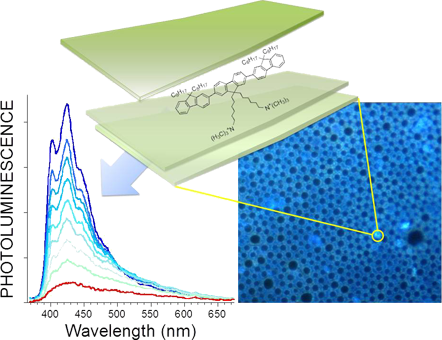
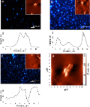
- microfabrication system. Such patterns hold great promise for several up-to-date applications, including nanostructures for optoelectronic devices [28][29][30], microfiltration membranes [31][32], and plasmonic sensors [33]. In a recently published study [11], we applied the BF pattering technique to a hybrid




Purification of ethanol for highly sensitive self-assembly experiments
Beilstein J. Nanotechnol. 2014, 5, 1254–1260, doi:10.3762/bjnano.5.139
- modification [4], e.g., as etch resist for microfabrication [5][6], as support for molecular systems like metal-organic frameworks or biomolecules [7], or for the tuning of electronic properties of metal surfaces [8][9][10][11][12], to mention just a few. One reason for the popularity of SAMs is their ease of

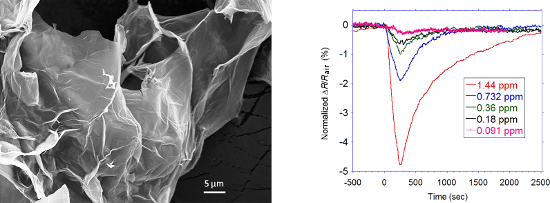
Highly NO2 sensitive caesium doped graphene oxide conductometric sensors
Beilstein J. Nanotechnol. 2014, 5, 1073–1081, doi:10.3762/bjnano.5.120
- Strategy to provide nano and microfabrication facilities for Australia’s researchers.




qPlus magnetic force microscopy in frequency-modulation mode with millihertz resolution
Beilstein J. Nanotechnol. 2012, 3, 174–178, doi:10.3762/bjnano.3.18
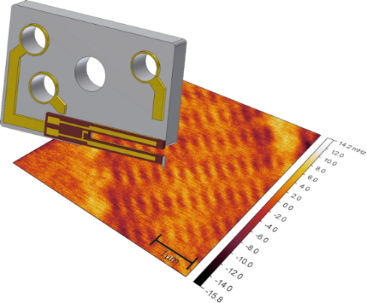
- , magnetically coated silicon cantilevers are used. These cantilevers are produced in large quantity by microfabrication techniques. Typical probe features are spring constants on the order of 10 Nm−1 and resonance frequencies of about 100 kHz. Another type of force sensor is made from a quartz (SiO2) tuning


Fabrication of multi-parametric platforms based on nanocone arrays for determination of cellular response
Beilstein J. Nanotechnol. 2011, 2, 545–551, doi:10.3762/bjnano.2.58
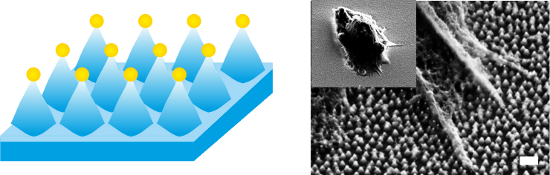
- both [7] have been conducted, which has led to the accumulation of basic knowledge concerning cell morphology changes. However, long-term cellular response to nanostructures has not been understood due to the lack of material integrity. In addition, mainly standard microfabrication techniques including


Magnetic nanoparticles for biomedical NMR-based diagnostics
Beilstein J. Nanotechnol. 2010, 1, 142–154, doi:10.3762/bjnano.1.17
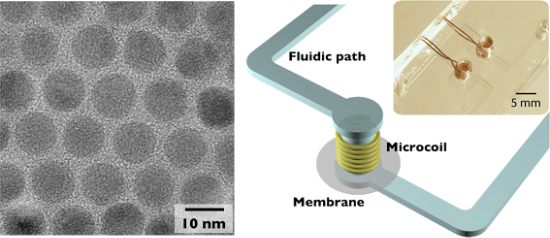
- nanomaterials, bioconjugation chemistry and microfabrication. As a novel technique, DMR offers a number of unique advantages, such as high detection sensitivity, rapid target measurement from minimal sample volumes, and the ability to profile a wide range of targets in a multiplexed manner. With new


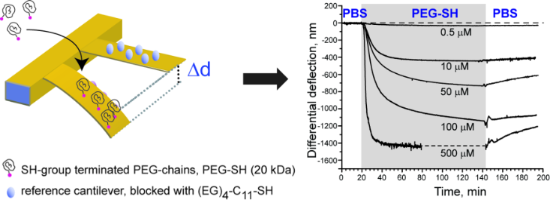
Sensing surface PEGylation with microcantilevers
Beilstein J. Nanotechnol. 2010, 1, 3–13, doi:10.3762/bjnano.1.2
- ) and the Swiss National Science Foundation. We would like to gratefully acknowledge the Cleven Becker Foundation. We also express our thanks to IBM Research (IBM Zurich Research GmbH) for microfabrication support.