


Search results
Search for "molybdenum disulfide" in Full Text gives 27 result(s) in Beilstein Journal of Nanotechnology.
DNA origami deposition on native and passivated molybdenum disulfide substrates
Beilstein J. Nanotechnol. 2014, 5, 501–506, doi:10.3762/bjnano.5.58
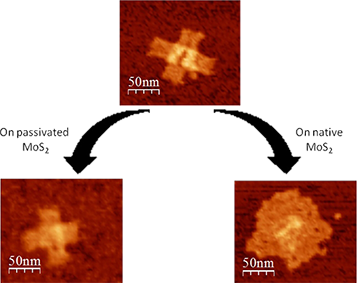
- prerequisite for the successful fabrication of hybrid DNA origami/semiconductor-based biomedical sensor devices. Molybdenum disulfide (MoS2) is an ideal substrate for such future sensors due to its exceptional electrical, mechanical and structural properties. In this work, we performed the first investigations
- significantly longer times. These findings will be beneficial for the fabrication of future DNA origami/MoS2 hybrid electronic structures. Keywords: atomic force microscopy (AFM); DNA origami; molybdenum disulfide (MoS2); pyrene; 1-pyrenemethylamine; surface modification; Introduction Since it was first
- properties, so as to enable complex and diverse circuit designs, thereby providing functionality essential for the construction of sensing biodevices with extraordinary sensitivity, rapid readout and good stability. As a layered two-dimensional (2D) material, molybdenum disulfide (MoS2) exhibits robust


Effect of contaminations and surface preparation on the work function of single layer MoS2
Beilstein J. Nanotechnol. 2014, 5, 291–297, doi:10.3762/bjnano.5.32
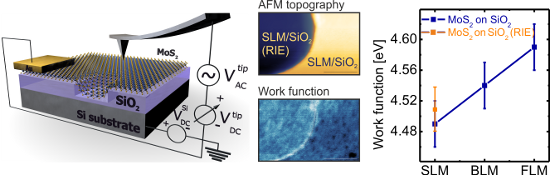
- , two-dimensional materials are being targeted in a variety of research areas like surface physics, electrical engineering, chemistry and biomedical applications [1][2][3][4]. The 2D-material getting the most attention besides graphene are single layers of molybdenum disulfide (SLM) which consist of a


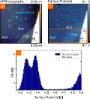
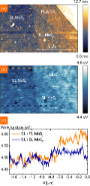

Other Beilstein-Institut Open Science Activities



