Search results
Search for "nanorods" in Full Text gives 230 result(s) in Beilstein Journal of Nanotechnology. Showing first 200.
Classification and application of metal-based nanoantioxidants in medicine and healthcare
Beilstein J. Nanotechnol. 2024, 15, 396–415, doi:10.3762/bjnano.15.36
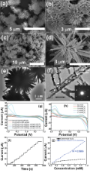
- is caused by protein denaturation at high temperatures. Impressively, Co3O4 nanomaterials with different morphologies (nanoplates, nanorods, and nanocubes) exhibited the highest relative activity at very high pH (pH 9) and temperature (90 °C) [39]. Similar results were also reported for platinum
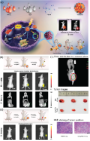
- reduction in infarction size, TNF-α levels, cardiac fibrosis, and improvement in cardiac systolic function. Gold nanorods serving as surface-enhanced Raman scattering probes have demonstrated sensitivity for the early detection of ICAM-1, a significant signal for screening atherosclerosis, particularly in


CdSe/ZnS quantum dots as a booster in the active layer of distributed ternary organic photovoltaics
Beilstein J. Nanotechnol. 2024, 15, 144–156, doi:10.3762/bjnano.15.14
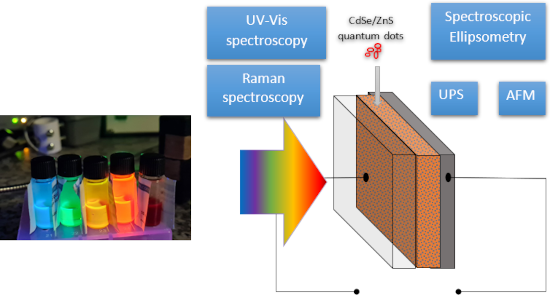
- -transport and smoothing layer. Concerning the postulated use of nanorods as acceptors, weight ratios in the active layer of P3HT:PCB71M:QD of 2:1:1 were used so that the weight ratio of donor:acceptors is 1:1. The device efficiency achieved in the simulations in both architectures was increased relative to




In situ optical sub-wavelength thickness control of porous anodic aluminum oxide
Beilstein J. Nanotechnol. 2024, 15, 126–133, doi:10.3762/bjnano.15.12
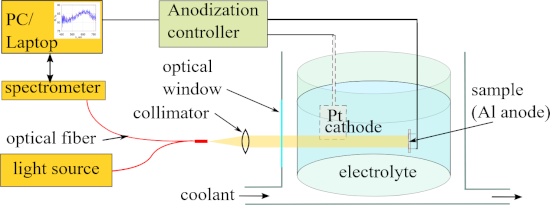
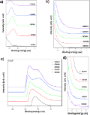
- zinc oxide nanorods embedded within the PAAO template [13]. Recently, it was demonstrated that the PAAO thickness tuning can increase the signal intensity and refractometric sensitivity of localized surface plasmon resonance (LSPR) sensors constructed using gold nanoparticles, which are deposited on


New application of bimetallic Ag/Pt nanoplates in a colorimetric biosensor for specific detection of E. coli in water
Beilstein J. Nanotechnol. 2024, 15, 95–103, doi:10.3762/bjnano.15.9
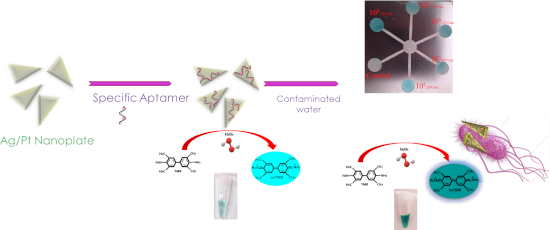
- ]. Nanomaterials have improved the ability to detect pathogens in water and food by enhancing signals and sensitivity. These materials, which encompass nanoparticles, nanorods, nanowires, and nanoclusters, can be combined with aptamers, antibodies, enzymes, and other ligands to display unique physical, chemical


Influence of conductive carbon and MnCo2O4 on morphological and electrical properties of hydrogels for electrochemical energy conversion
Beilstein J. Nanotechnol. 2024, 15, 57–70, doi:10.3762/bjnano.15.6
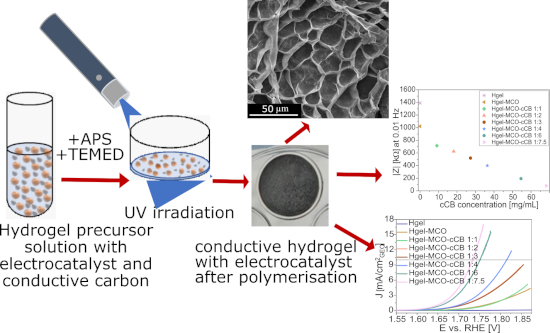
- surface for the sample Hgel-MCO-cCB 1:3 showed the presence of MCO and cCB particles in the hydrogel scaffold, confirming their entrapment in the polymer matrix (Figure 1b and Figure 1e). A similar composite structure with gold nanorods suspended in the PNIPAAm matrix was observed by Nakielski et al. [47


Density functional theory study of Au-fcc/Ge and Au-hcp/Ge interfaces
Beilstein J. Nanotechnol. 2023, 14, 1093–1105, doi:10.3762/bjnano.14.90
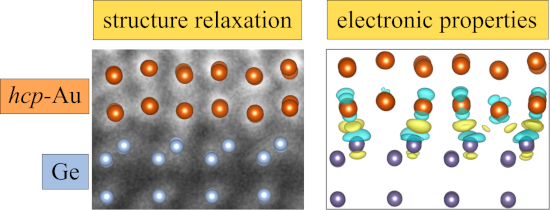
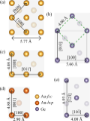
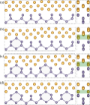
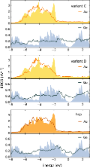
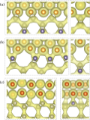
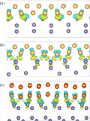
- . Recently, nanostructures including different polytypes of gold have been observed in various experiments and have gained interest regarding potential applications. For example, the interface regions of polytypic gold nanorods were found to be highly active in catalysis [15]. The hexagonal phases seen in





A visible-light photodetector based on heterojunctions between CuO nanoparticles and ZnO nanorods
Beilstein J. Nanotechnol. 2023, 14, 1018–1027, doi:10.3762/bjnano.14.84
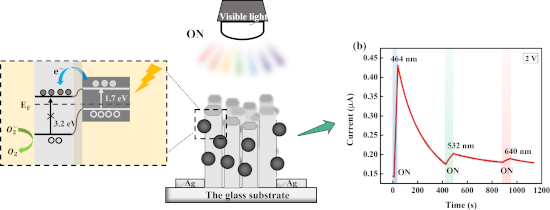
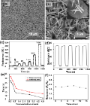
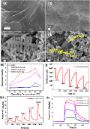
- , have gained much attention from many research teams. This study describes a low-cost photodetector based on CuO nanoparticles and ZnO nanorods operating in a wide range of light wavelengths (395, 464, 532, and 640 nm). Particularly, under 395 nm excitation, the heterostructure device exhibits high
- nanoparticles and ZnO nanorods obtained via a simple and cost-effective synthesis process has great potential for optoelectronic applications. Keywords: CuO nanoparticles; heterojunction; optoelectronics; visible-light photodetector; ZnO nanorods; Introduction Optoelectronics is a field to accelerate the
- ., temperature, concentrations of chemicals, and annealing time). ZnO nanorods and nanowires have attracted great interest in photodetectors because their chemical and physical properties are exceptional for electronics applications, and their fabrication strategies are more facile than those of other structures


Nanoarchitectonics of photothermal materials to enhance the sensitivity of lateral flow assays
Beilstein J. Nanotechnol. 2023, 14, 988–1003, doi:10.3762/bjnano.14.82
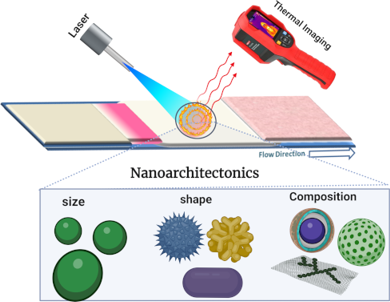
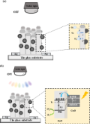
- architecture of the gold nanoparticles, their plasmonic absorption can be tuned from the visible to the NIR region. Among the different structures of gold, gold nanorods are commonly used as photothermal agents because of the tuneable aspect ratio, anisotropic architecture, and high photoconversion efficiency
- (PCE). However, studies report that gold nanorods suffer from poor photostability, and loss of shape and NIR LSPR upon laser irradiation [39]. By using palladium nanostructures, photothermal stability could be achieved to some extent as they did not change their shape upon laser irradiation. Palladium
- , SERS, fluorescence, and photothermal applications [45]. For instance, compared to spherical architectures, anisotropic nanoscale architectures, such as nanostars, nanoflowers, nanopopcorns, nanorods, and nanocages, exhibit superior SERS and photothermal conversion activities [46][47]. Therefore, it is


Carboxylic acids and light interact to affect nanoceria stability and dissolution in acidic aqueous environments
Beilstein J. Nanotechnol. 2023, 14, 762–780, doi:10.3762/bjnano.14.63
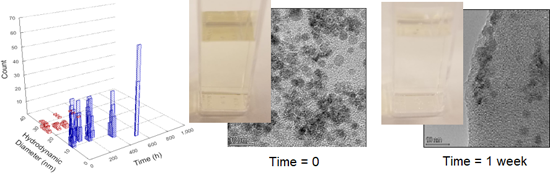
- resulted in loss or overcoating of the surface citrate, and, in some cases, agglomeration [10]. Exposure to vitamin C and glutathione led to dissolution-accompanied aggregation of mesoporous silica CeO2 nanoparticles [35]. The shortening of ceria nanorods from 25 to 8 nm after 14 days at 200 °C was
Metal-organic framework-based nanomaterials as opto-electrochemical sensors for the detection of antibiotics and hormones: A review
Beilstein J. Nanotechnol. 2023, 14, 631–673, doi:10.3762/bjnano.14.52


Plasmonic nanotechnology for photothermal applications – an evaluation
Beilstein J. Nanotechnol. 2023, 14, 380–419, doi:10.3762/bjnano.14.33
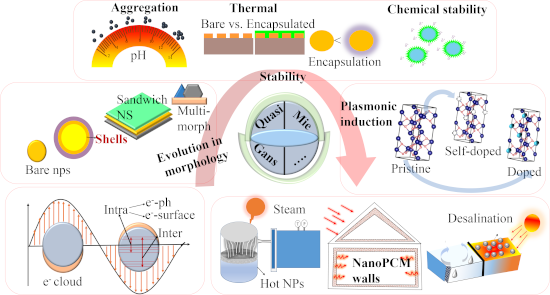
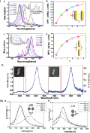
- as spheres and nanorods. 2.1 The plasmonic oscillation frequency The optical response of plasmonic nanoparticles, such as AuNPs, to incident electromagnetic radiation depends on their size, shape, morphology, proximity to one another, as well as the surrounding medium [32]. The vast changes in
- of proximity as well as morphology influence considerably the LSPR properties, for example, in Au nanorods and nanospheres. In contrast, nanospheres and nanorods exhibited considerable tunability of the LSPR due to changes to the localized electromagnetic field of the plasmons due to changing
- with respect to changing parameters of the material under consideration can be developed with a few examples of the theoretically arrived optical cross sections of a few generic morphologies of nanoparticles and will be discussed next for the case of nanospheres, nanorods, and nanomatryushkas. The




Bismuth-based nanostructured photocatalysts for the remediation of antibiotics and organic dyes
Beilstein J. Nanotechnol. 2023, 14, 291–321, doi:10.3762/bjnano.14.26
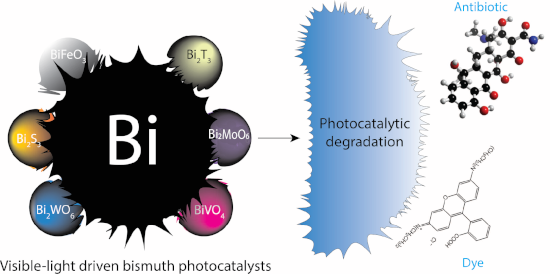
- photocatalyst that can be applied industrially for the remediation of a variety of pollutants in contaminated water. First, photocatalytic activity is significantly influenced by the morphology (e.g., nanoplates, nanotubes, nanowires, nanorods, nanocuboids, nanoflakes, nanosheets, nanocapsules, nanocasts, or
- bismuth, other semiconductors can be used with it to achieve better performance. In a recent study, Chava et al. [167] synthesised bismuth quantum dots anchored to 1-D cadmium sulfide as a plasmonic photocatalyst using a facile solvothermal procedure. To create heterostructure nanorods, Schottky contacts


Concentration-dependent photothermal conversion efficiency of gold nanoparticles under near-infrared laser and broadband irradiation
Beilstein J. Nanotechnol. 2023, 14, 205–217, doi:10.3762/bjnano.14.20
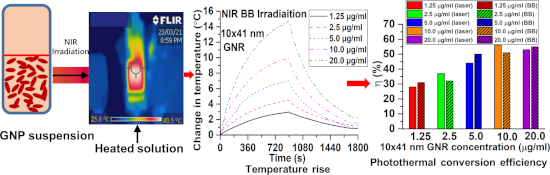
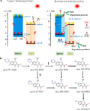
- evaluated. Results show that for a concentration of 20.0 µg/mL, 40 nm gold nanospheres, 25 × 47 nm gold nanorods (GNRs), and 10 × 41 nm GNRs show a 4–110% higher photothermal conversion efficiency under NIR broadband irradiation than under NIR laser irradiation. Broadband irradiation seems suitable to
- broadband light source and a near-infrared laser (for comparison). Gold nanospheres (GNSs) of 40 nm diameter and gold nanorods (GNRs) of sizes 25 × 47 nm, 10 × 38 nm, and 10 × 41 nm were examined. The photothermal conversion efficiency for these GNPs is reported for different nanoparticle concentrations and
- laser or broadband irradiation. Broadband irradiation results in a much higher efficiency for 25 × 47 nm GNRs, whose peak absorption wavelength highly differs from the irradiation wavelength. A photothermal conversion efficiency of 53% for 10 × 41 nm gold nanorods, as determined in our study, has also




Solvent-induced assembly of mono- and divalent silica nanoparticles
Beilstein J. Nanotechnol. 2023, 14, 52–60, doi:10.3762/bjnano.14.6
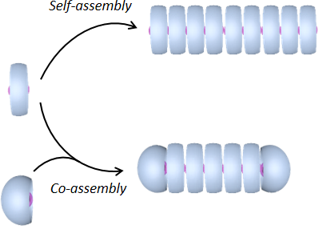
- by liquid bridging [23], and into a series of structures under an AC electric field [24]. The linear self-assembly of patchy gold nanorods tethered with hydrophobic polymer chains at both ends can be triggered by solvophobic attractions induced by a change in solvent quality [25]. By using post
- -assembly ligand photo-cross-linking [26] or by adding monofunctional nanospheres into a suspension of bifunctional gold nanorods [27], it has been shown that the average degree of polymerization of the resulting chains can be controlled. The reduction of solvent quality may also be employed to induce the
- act as chain stoppers, as their addition into suspensions of soft patchy nanoparticles [36], gold nanorods [27], or silver nanoplates [37] allowed for the control of chain length. We thus studied the capability of 1-PSN to act as chain stoppers when they are mixed with 2-PSN, whose solvent-induced


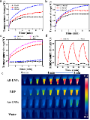
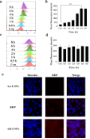
Facile preparation of Au- and BODIPY-grafted lipid nanoparticles for synergized photothermal therapy
Beilstein J. Nanotechnol. 2022, 13, 1432–1444, doi:10.3762/bjnano.13.118
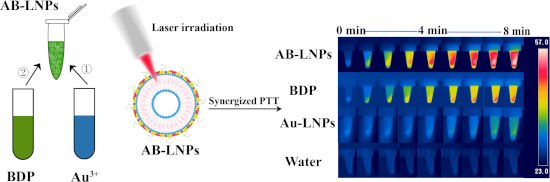
- near-infrared (NIR) absorption [2]. Various gold nanoscale platforms, including nanostars, nanorods, nanospheres, nanoshells, and nanocages, have been designed as PTAs for PTT. Gold nanorods (ca. 50 nm), nanoshells (ca. 130 nm), and nanoparticles with large sizes (>50 nm) are suitable for PTT because




Recent trends in Bi-based nanomaterials: challenges, fabrication, enhancement techniques, and environmental applications
Beilstein J. Nanotechnol. 2022, 13, 1316–1336, doi:10.3762/bjnano.13.109
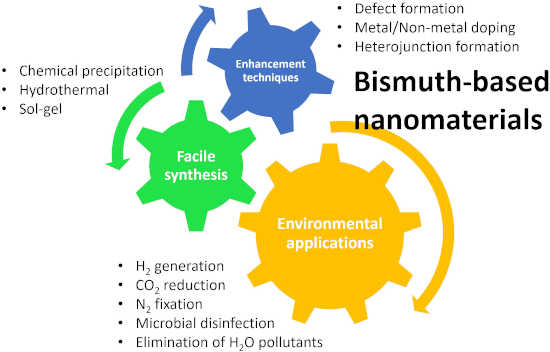
- visible light. Xiao and colleagues have shown a straightforward synthesis approach for fabricating Bi2WO6 nanosheet rods [65]. They discovered that the hydrolysis of the precursor Bi(NO3)3 may quickly result in the formation of Bi6O5(OH)3(NO3)5·3H2O nanorods, which then acted as templates for the
- plasmonic photocatalyst. Nanospheres, nanorods, and nanosheets can be synthesized using various techniques. Hydrothermal calcination, template synthesis, precipitation, reverse micro-emulsion, sonochemical procedures, and microwave methods are typical techniques for fabricating Bi-based nanostructures [77
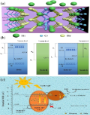
- ]. Without any additional agent, the fabricated heterojunction completely degraded a RhB dye solution within 20 min. BiVO4 nanorods photogenerated hydroxyl radicals rather than super oxides because of the more positive oxidation potential of BiVO4 (2.31 V). MoS2 sheets favored the photogeneration of




Enhanced electronic transport properties of Te roll-like nanostructures
Beilstein J. Nanotechnol. 2022, 13, 1284–1291, doi:10.3762/bjnano.13.106
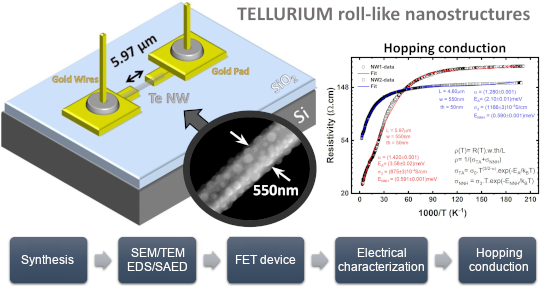
- ), nanorods (NRs), nanowires (NWs), nanobelts (NBs), nanotubes (NTs), nanoflowers (NFs) and chiral nanostructures [6][7][8][9][10]. Trigonal tellurium (t-Te) MLs have also been recently proposed as a silicon successor for nanoelectronics because of their high hole mobility and current density [3]. Combining




Efficient liquid exfoliation of KP15 nanowires aided by Hansen's empirical theory
Beilstein J. Nanotechnol. 2022, 13, 788–795, doi:10.3762/bjnano.13.69
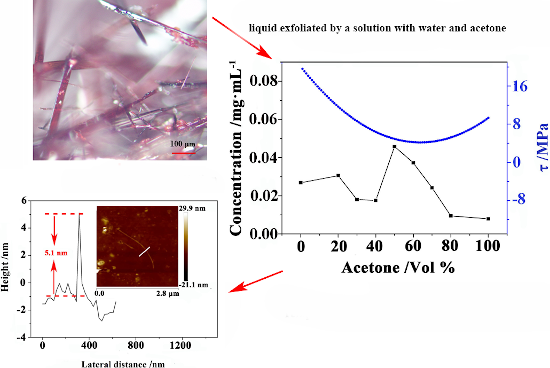
- nanoparticles as anode materials to promote the rapid diffusion and electron transfer of lithium, and Rongjun Zhao prepared n-butanol gas sensors with one-dimensional In2O3 nanorods [1][2]. Different from 2D materials, 1D materials generally have a chain-like crystal structure and are easily exfoliated due to a


Sodium doping in brookite TiO2 enhances its photocatalytic activity
Beilstein J. Nanotechnol. 2022, 13, 599–609, doi:10.3762/bjnano.13.52
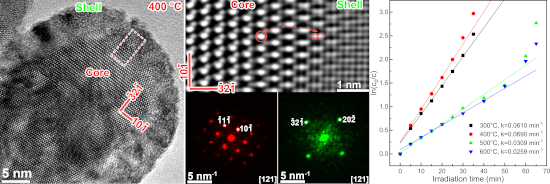
- exceeded four times that of P25 under visible light irradiation [8]. The degradation of methyl orange by brookite nanoflowers was much more efficient than that by anatase nanorods [9]. Moreover, the heterojunction of brookite TiO2 can enhance the photocatalytic activity (e.g., the rutile/brookite TiO2


Zinc oxide nanostructures for fluorescence and Raman signal enhancement: a review
Beilstein J. Nanotechnol. 2022, 13, 472–490, doi:10.3762/bjnano.13.40
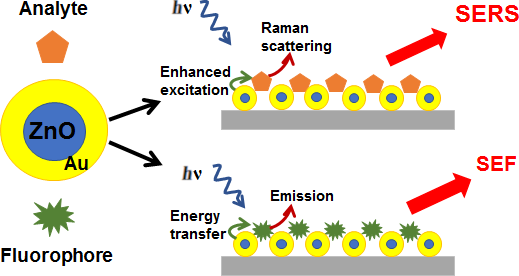
- their wide bandgap energy (3.3–3.7 eV), strong luminescence [4][5], antibacterial properties, and UV-protection properties. Additionally, ZnO nanomaterials can be designed into various morphologies, such as nanoparticles, nanoneedles, nanorods, nanocages, nanocombs, and nanoflowers [5][6][7][8]. Hybrid
- good reproducibility, and are usually effective for large scale production. The chemical precipitation technique has gained increased attention due to its simplicity and efficiency for obtaining nanosized ZnO structures with various morphologies, such as nanoparticles, nanorods, nanoneedles, and
- controllable morphology [28]. Various morphologies including nanoworms, nanowires, and nanorods with excellent crystallinity were also obtained using the solvothermal method [25]. According to Chieng et al., the particle sizes of the synthesized ZnO nanoparticles are in correlation with the glycol chain length




A non-enzymatic electrochemical hydrogen peroxide sensor based on copper oxide nanostructures
Beilstein J. Nanotechnol. 2022, 13, 424–436, doi:10.3762/bjnano.13.35
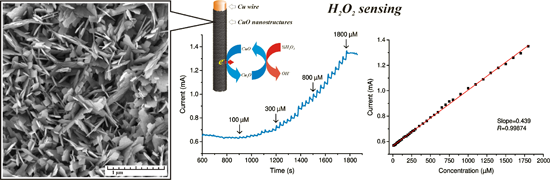
- candidate is copper oxide (CuO) [56][67][68][69][70][71]. It has selectivity for the determination of H2O2, high catalytic activity, and a variety of morphologies (e.g., nanoneedles, nanoplates, and nanorods). Various techniques have been used in the preparation of nanostructured epitaxial CuO coatings




Engineered titania nanomaterials in advanced clinical applications
Beilstein J. Nanotechnol. 2022, 13, 201–218, doi:10.3762/bjnano.13.15
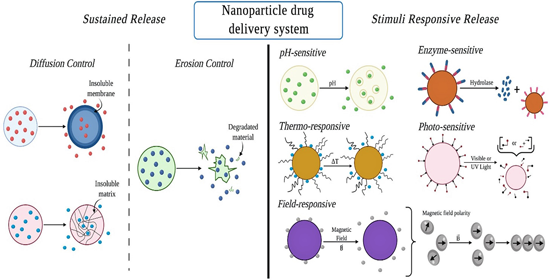
- (nanotubes, nanorods, nanowhiskers, nanoflower, nanotubes, nanobelts, or nanocrystals), and topographical features such as surface area, size (1–100 nm), and uncoordinated surface sites [26]. The photocatalytic nature of titania is greatly explored in antimicrobial studies as well as in photodynamic cancer


A comprehensive review on electrospun nanohybrid membranes for wastewater treatment
Beilstein J. Nanotechnol. 2022, 13, 137–159, doi:10.3762/bjnano.13.10




Tin dioxide nanomaterial-based photocatalysts for nitrogen oxide oxidation: a review
Beilstein J. Nanotechnol. 2022, 13, 96–113, doi:10.3762/bjnano.13.7
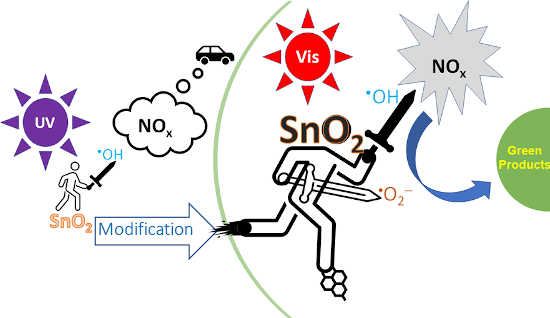
- density showed improved photocatalytic performances. Besides, the OV density contributes to the rise of the valence band maximum and a decrease of the bandgap energy of SnO2 materials. Morphology There are many shapes of SnO2, for example, nanoparticles, nanocubes, nanorods, nanosheets, nanospheres
- materials, preferably using two redox sites; (3) synthesizing other morphologies of SnO2 such as nanorods, nanotubes, or 3D structures to increase the specific surface area of the catalyst; (4) upscaling the syntheses and using other synthesis approaches such as sol–gel or chemical vapor deposition to form


Morphology-driven gas sensing by fabricated fractals: A review
Beilstein J. Nanotechnol. 2021, 12, 1187–1208, doi:10.3762/bjnano.12.88
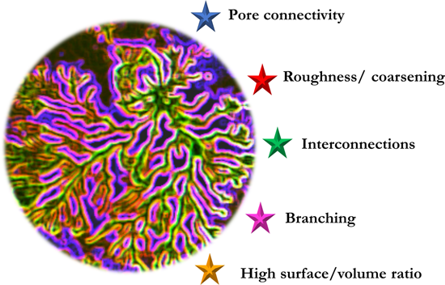
- ) [10][11][12][13][14][15][16], nanorods [17][18][19][20], nanosheets [21][22][23], nanobelts [24][25], and nano/micro-spheres/cubes/polyhedrons [26][27][28][29] with enhanced sensitivity as a gas sensor. A rich collection of research articles and review papers on distinct morphological nanostructured
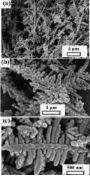
- were composed of many well aligned nanorods. The variations in potential barrier height at the contacts of the nanorods gave excellent gas sensing results towards hydrogen sulfide (H2S). The sensitivity response of the ZnO dendrite sensor at room temperature and the variation in sensitivity at
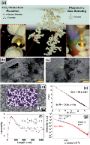
- substrate, respectively. Figure 22d illustrates the SEM image of Au–Bi2O3 fractal employed for box-counting. Figure 22e–g shows the estimation of the fractal dimensions of the fabricated cluster. Pang et al. synthesized a dendrite-like Co3O4 nanostructure composed of numerous nanorods (15–20 nm diameter and