Search results
Search for "nuclear magnetic resonance (NMR)" in Full Text gives 35 result(s) in Beilstein Journal of Nanotechnology.
Controlled supramolecular structure of guanosine monophosphate in the interlayer space of layered double hydroxide
Beilstein J. Nanotechnol. 2016, 7, 1928–1935, doi:10.3762/bjnano.7.184
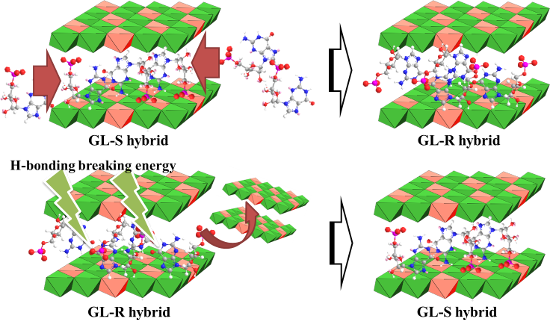
- nuclear magnetic resonance (NMR) utilizing a G4 quartet supramolecular assembly as the reference (Supporting Information File 1, Figure S2). The G4 quartet showed a single set of signals due to their symmetric structure. In GL-R, the signals for the quartet slightly shifted as well as the evolution of new


Characterisation of thin films of graphene–surfactant composites produced through a novel semi-automated method
Beilstein J. Nanotechnol. 2016, 7, 209–219, doi:10.3762/bjnano.7.19
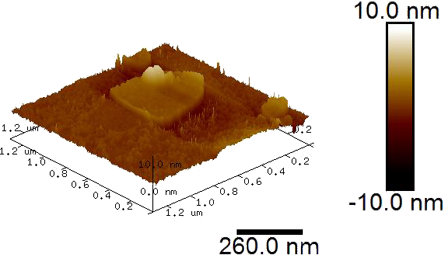
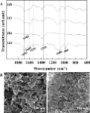
- running topspin analysis software. This analysis works according to the nuclear Overhauser effect (NOE). The NOE, which is present in nuclear magnetic resonance (NMR) spectroscopy, can be used to determine the amount of contact between the surfactant and the graphene sheet. This is achieved by observing




Fabrication and characterization of novel multilayered structures by stereocomplexion of poly(D-lactic acid)/poly(L-lactic acid) and self-assembly of polyelectrolytes
Beilstein J. Nanotechnol. 2016, 7, 81–90, doi:10.3762/bjnano.7.10
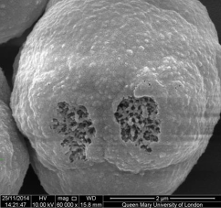
- between the (PDLA/PLLA)n stereocomplex and the cores with and without the polymeric (PSS/PAH)n/PLL multilayer precursor (PEM). Nuclear magnetic resonance (NMR) and gel permeation chromatography (GPC) were used to characterize the chemical composition and molecular weight of poly(lactic acid) polymers
- planar supports, and then transferred onto spherical sacrificial templates, in order to build hollow microcapsules. Nuclear magnetic resonance (NMR) and gas permeation chromatography (GPC) were used to characterize the chemical composition and molecular weight of synthetic PLA polymers. Ellipsometry and


Sonochemical co-deposition of antibacterial nanoparticles and dyes on textiles
Beilstein J. Nanotechnol. 2016, 7, 1–8, doi:10.3762/bjnano.7.1
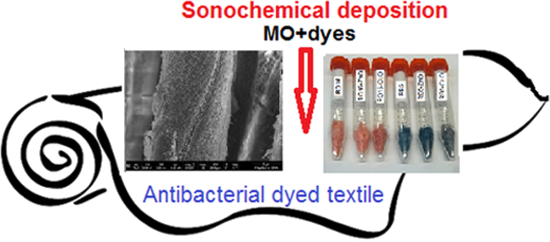
- characterized by UV spectroscopy (CARY 100 Scan UV spectrometer covering a wavelength range from 300 to 800 nm). An attempt to prove the existence of the dyes on the cotton was carried out by solid state nuclear magnetic resonance (NMR). The experiments were performed on a Bruker Advance III 500 narrow-bore




pH-Triggered release from surface-modified poly(lactic-co-glycolic acid) nanoparticles
Beilstein J. Nanotechnol. 2015, 6, 2504–2512, doi:10.3762/bjnano.6.260
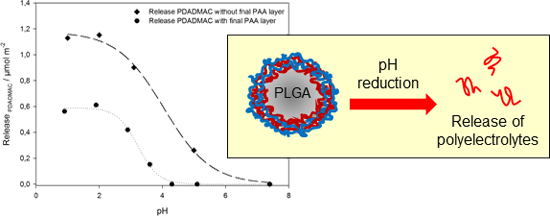
- of the initial dispersion was derived from the weight of the solids content. Nuclear magnetic resonance (NMR) spectroscopy: 1H NMR experiments were performed using a 400 MHz Avance spectrometer (Bruker, Rheinstetten, Germany). All measurements were carried out at room temperature (295 K) and all


A single-source precursor route to anisotropic halogen-doped zinc oxide particles as a promising candidate for new transparent conducting oxide materials
Beilstein J. Nanotechnol. 2015, 6, 2161–2172, doi:10.3762/bjnano.6.222
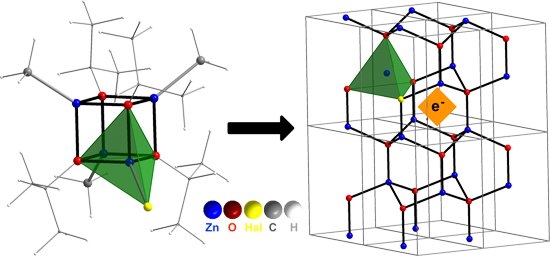
- -Bu]4 was reacted with I2 in toluene at T = −78 °C (see Section Experimental). One sees an immediate decoloration of the solution, indicating the consumption of iodine. Nuclear magnetic resonance (NMR) and in particular 1H NMR is well suited for the analysis of the obtained product distribution



Charge carrier mobility and electronic properties of Al(Op)3: impact of excimer formation
Beilstein J. Nanotechnol. 2015, 6, 1107–1115, doi:10.3762/bjnano.6.112
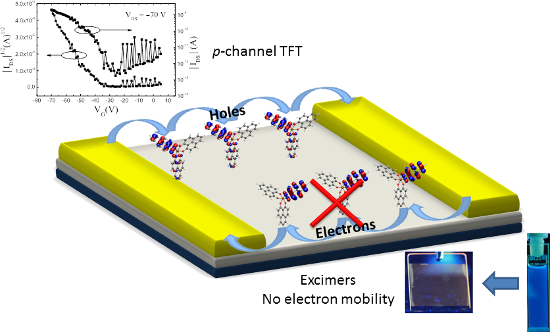
- experimental data. Results Al(Op)3 was synthesized as previously described [23]. To confirm the purity of the complex, proton and carbon nuclear magnetic resonance (NMR) spectroscopy and mass spectrometry (MS) were carried out and compared with the data reported in previous work [16]. Initially, in order to


Multiscale modeling of lithium ion batteries: thermal aspects
Beilstein J. Nanotechnol. 2015, 6, 987–1007, doi:10.3762/bjnano.6.102
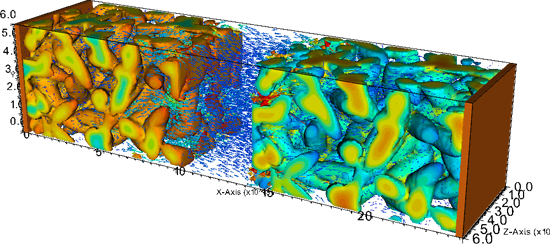
- the self-diffusion coefficient, which would be different from the diffusion coefficient of the anions, but the unique collective inter-diffusion coefficient. It cannot be determined directly by using, for example, nuclear magnetic resonance (NMR) measurements. However, there are simple approximations


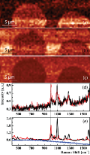
Tip-enhanced Raman spectroscopic imaging of patterned thiol monolayers
Beilstein J. Nanotechnol. 2011, 2, 509–515, doi:10.3762/bjnano.2.55
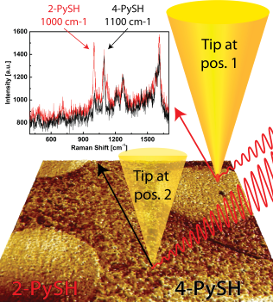
- magnetic resonance (NMR), infrared (IR) spectroscopy and Raman spectroscopy (RS) lack the necessary spatial resolution, while others such as scanning tunneling microscopy (STM) or scanning electron microscopy (SEM) do not provide enough chemical information. Furthermore, the limited quantity of analyte
- biological membranes or of artificially structured surfaces, used in molecular electronics, determines their properties as well as their function. However, characterization is difficult due to the small size and the low number of the molecules that comprise these structures. Most techniques such as nuclear




Magnetic nanoparticles for biomedical NMR-based diagnostics
Beilstein J. Nanotechnol. 2010, 1, 142–154, doi:10.3762/bjnano.1.17
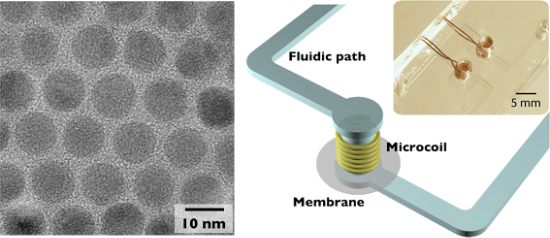
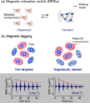
- targets. Another technology that has achieved considerable success is diagnostic magnetic resonance (DMR). Based on nuclear magnetic resonance (NMR) as the detection mechanism, DMR exploits MNPs as proximity sensors, which modulate the spin–spin relaxation time of water molecules adjacent to the
- systems Nuclear magnetic resonance (NMR) can be detected with instruments such as clinical MRI scanners (routinely used for deep tissue whole body imaging), and NMR spectroscopy (used to study proteins and small molecules). Both of these techniques have been used to measure T2 relaxation time for DMR