


Search results
Search for "open loop" in Full Text gives 27 result(s) in Beilstein Journal of Nanotechnology.
Bimodal atomic force microscopy driving the higher eigenmode in frequency-modulation mode: Implementation, advantages, disadvantages and comparison to the open-loop case
Beilstein J. Nanotechnol. 2013, 4, 198–207, doi:10.3762/bjnano.4.20
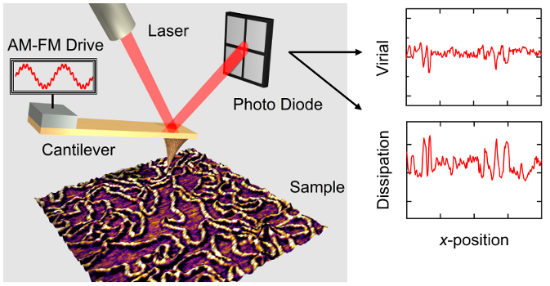
- the amplitude-modulation (AM) scheme while the second eigenmode was driven with a much smaller amplitude in open loop (OL, that is, only the first mode amplitude signal was used to control the tip–sample distance feedback loop. The second eigenmode drive signal had a constant amplitude and frequency
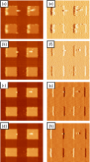
- , namely AM-OL, AM-FM (CE), and AM-FM (CA), which differ in the type of control scheme used to drive the higher eigenmode (open loop, constant-excitation frequency-modulation, and constant-amplitude frequency-modulation, respectively). The corresponding higher eigenmode channels exhibit clear differences


Drive-amplitude-modulation atomic force microscopy: From vacuum to liquids
Beilstein J. Nanotechnol. 2012, 3, 336–344, doi:10.3762/bjnano.3.38
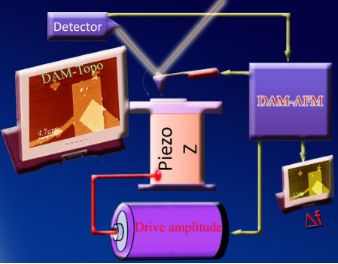
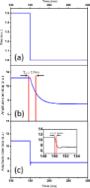
- of the cantilever with the amplitude and the frequency feedback loops enabled. Notice that the shape of the perturbation is a step function for both cases. However, for the open-loop case the perturbation is a sudden change in the amplitude of the driving force, whereas for the closed-loop
- configuration the perturbation is a sudden change in the amplitude setpoint. As shown in the charts, the response time in the second configuration is dramatically reduced with respect to the open-loop configuration. The second consideration, closely related to the previous one, is the energy balance. Assuming a
- step perturbation under high Q. (a) Perturbation applied to the free cantilever. (b) Amplitude response for a free cantilever in the open-loop configuration. (c) Amplitude response for a free cantilever in the close-loop configuration. The inset shows a zoom in the step region, showing a characteristic


Other Beilstein-Institut Open Science Activities



