


Search results
Search for "perovskites" in Full Text gives 30 result(s) in Beilstein Journal of Nanotechnology.
Direct AFM-based nanoscale mapping and tomography of open-circuit voltages for photovoltaics
Beilstein J. Nanotechnol. 2018, 9, 1802–1808, doi:10.3762/bjnano.9.171
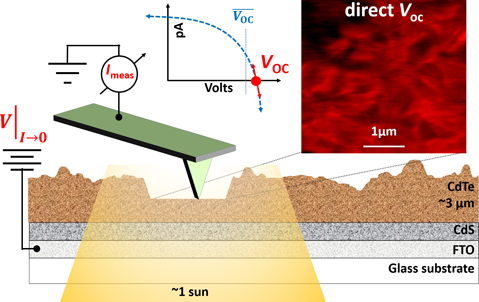
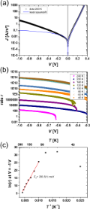
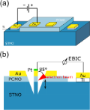
- challenge for generally fragile materials systems such as molecular perovskites [7]. Traditional point-by-point measurements are far slower still. Consequently, for AFM-based mapping of solar cell performance parameters that are traditionally derived from I–V measurements, such as VOC, the spatial and
- measured properties, for example with work function differences of molecular perovskites observed at specific facets [24] or grain boundary interfaces [2]. Topography commonly couples with conductive or photoconductive AFM contrast as well. Routines to test for such associations are therefore increasingly


Multimodal noncontact atomic force microscopy and Kelvin probe force microscopy investigations of organolead tribromide perovskite single crystals
Beilstein J. Nanotechnol. 2018, 9, 1695–1704, doi:10.3762/bjnano.9.161
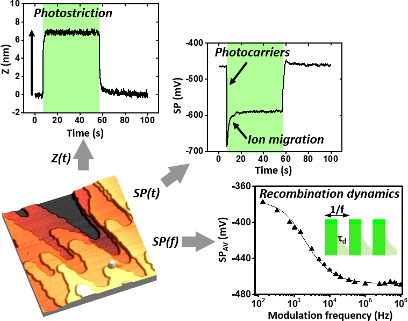
- photocarrier lifetime is quantified by performing KPFM measurements under frequency-modulated illumination. Our multimodal approach provides a unique way to investigate the interplay between the charges and ionic species, the photocarrier-lattice coupling and the photocarrier dynamics in hybrid perovskites
- . Keywords: carrier lifetime; ion migration; Kelvin probe force microscopy (KPFM); noncontact atomic force microscopy (nc-AFM); organic–inorganic hybrid perovskites; photostriction; single crystals; surface photovoltage (SPV); time-resolved surface photovoltage; Introduction Organic–inorganic hybrid
- perovskites (RMX3, where R = methylammonium or formamidinium, M = Pb or Sn, and X = halogen) have become a new platform for the development of next-generation light harvesting and optoelectronic devices in the past years [1]. Indeed, they exhibit an exceptional combination of optoelectronic properties


Synthesis and characterization of noble metal–titania core–shell nanostructures with tunable shell thickness
Beilstein J. Nanotechnol. 2017, 8, 2083–2093, doi:10.3762/bjnano.8.208
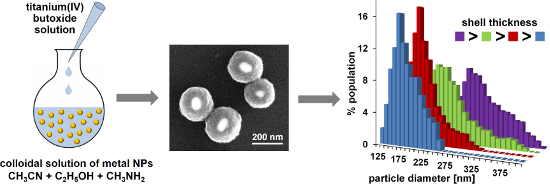
- titania to be overcome: the limitation of photocatalytic capability to UV light (λ < 400 nm). In addition, they may serve as a precursor for plasmon-sensitized colloidal perovskites, which are materials of great interest for solar cell applications [20]. The limiting factor in the broader use of Ag@TiO2
- nanoparticles with diameter of less than 20 nm and to obtain thinner shells. In addition, studies will be dedicated to converting the titania shell of the synthesized CSNs to either crystalline titania (anatase, rutile or their mix) or perovskites and to testing the performance of such systems in various


The effect of dry shear aligning of nanotube thin films on the photovoltaic performance of carbon nanotube–silicon solar cells
Beilstein J. Nanotechnol. 2016, 7, 1486–1491, doi:10.3762/bjnano.7.141
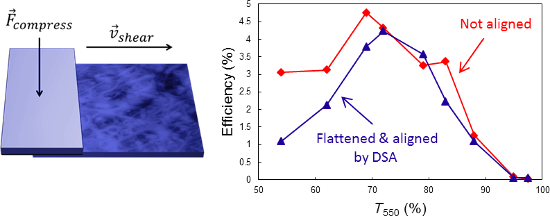
- explored from both a fundamental theory point of view [1][2], as well as experimentally in a host of different device architectures, including as additives in dye solar cells [3][4], organic photovoltaics [5][6], and perovskites [7][8] and as the active light absorbing component in conjunction with


Current–voltage characteristics of manganite–titanite perovskite junctions
Beilstein J. Nanotechnol. 2015, 6, 1467–1484, doi:10.3762/bjnano.6.152
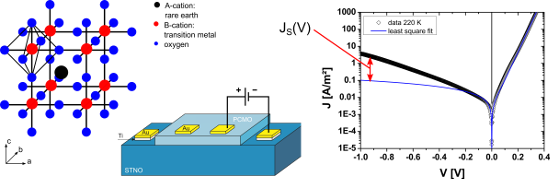
- electron–polaron hole–polaron pair generation and separation at the interface. Keywords: current–voltage characteristics; perovskites; photovoltaics; polarons; Introduction At present, photovoltaic devices are mainly based on high purity elemental or compound inorganic semiconducting materials with large
- semiconductors such as conjugated polymers [8] as well as some perovskite oxides [9][10][11]. Perovskites have the general formula ABX3, where the A cation in a cuboctahedral site coordinates with 12 anions, and the B cation in an octahedral site coordinates with 6 anions. New perovskite materials under
- evaluation for photovoltaic systems reveal vastly different properties ranging from narrow band gap manganite oxides perovskites with hopping transport to broad band gap lead halide perovskites [9][12][13][14]. For the lead halide perovskites the constituents are: A = CH3NH3+, B = Pb, and X = I, Br, Cl





Other Beilstein-Institut Open Science Activities



