


Search results
Search for "photoreduction" in Full Text gives 31 result(s) in Beilstein Journal of Nanotechnology.
Direct formation of gold nanorods on surfaces using polymer-immobilised gold seeds
Beilstein J. Nanotechnol. 2016, 7, 809–816, doi:10.3762/bjnano.7.72
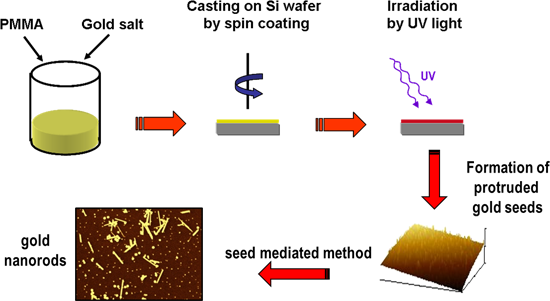
- direct growth on surfaces that were pre-coated with polymer-immobilised gold seeds. A Au–PMMA nanocomposite formed by UV photoreduction has been used as the gold seed. The influence of polymer Mw and gold concentration on the formation of GNRs has been investigated and discussed. The polymer
- formed by UV photoreduction. PMMA has amazing properties such as transparency, flexibility and light weight. Moreover, it is able to immobilise the nanoparticles avoiding their agglomeration and thus maintaining the novel size-dependent properties of nanomaterials. PMMA is widely used in lithography and
- numerous experiments and efforts to investigate the formation of gold nanoparticles in a polymer matrix and also to produce well-defined geometries of gold nanoparticles by using photoreduction [30][31]. It has been shown that by using different concentrations of gold salt, one can control the shape as


Surfactant-controlled composition and crystal structure of manganese(II) sulfide nanocrystals prepared by solvothermal synthesis
Beilstein J. Nanotechnol. 2015, 6, 2319–2329, doi:10.3762/bjnano.6.238
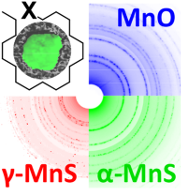
- ), ≈100 K (β-MnS), and 154 K (α-MnS) [6]. The interesting physical properties and the rich polymorphism prompted research on MnS nanocrystals (NCs) in view of applications as photoluminescent components [7], photoreduction catalysts [8], anode materials in lithium-ion batteries [9], and supercapacitor


Functionalized nanostructures for enhanced photocatalytic performance under solar light
Beilstein J. Nanotechnol. 2014, 5, 994–1004, doi:10.3762/bjnano.5.113
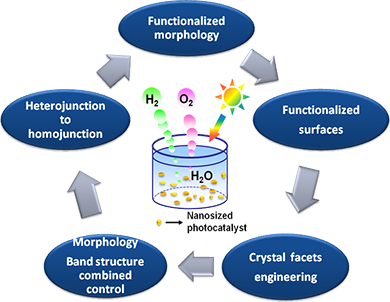
- as electron trapping sites and extract photogenerated electrons from Cd0.5Zn0.5S substrate, which finally leads to spatially separated photoreduction and oxidation reactions. NiS plays a similar role as a noble metal, which can provide active sites for proton reduction, and thus efficiently enhance


Enhancement of photocatalytic H2 evolution of eosin Y-sensitized reduced graphene oxide through a simple photoreaction
Beilstein J. Nanotechnol. 2014, 5, 801–811, doi:10.3762/bjnano.5.92
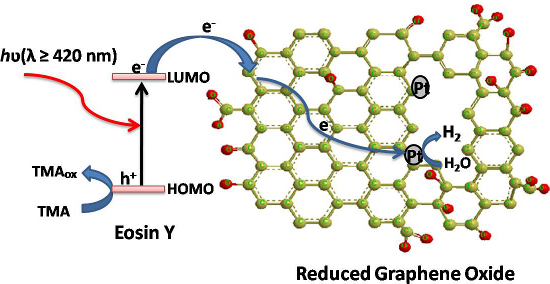
- ; graphene oxide; H2 evolution; photocatalysis; photoreduction; sp2 conjugated domains; Introduction Hydrogen is an efficient and green energy carrier. Photocatalytic water splitting into hydrogen by means of solar energy and semiconductor photocatalysts is a environmentally friendly way to produce storable
- -hybridization in the GO layer. As a result, the conductivity of GO decreases greatly compared with that of graphene. Amongst various methods for the reduction of GO to form RGO, photoreaction (photoreduction) is “green” without any toxic chemical reagents. Moreover, it is easy to control the degree of reduction
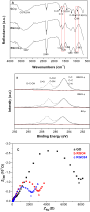
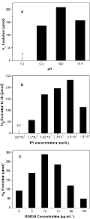
- processes can be described by the following reactions. The formed RGOx− can reduce PtCl62− at the zigzag edges of the RGOx. Figure 9C shows the Pt nanoparticles deposited on the surface of RGO24 by an in situ photoreduction of H2PtCl6 with EY sensitization. It clearly displays the uniform Pt aggregated





Enhanced photocatalytic activity of Ag–ZnO hybrid plasmonic nanostructures prepared by a facile wet chemical method
Beilstein J. Nanotechnol. 2014, 5, 639–650, doi:10.3762/bjnano.5.75
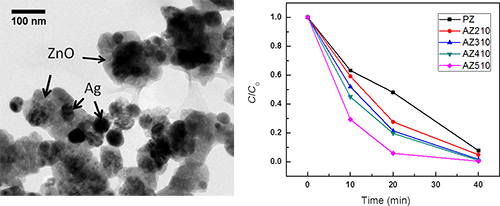
- microrods, by photoreduction of Ag ions onto the surface of the ZnO microrods prepared through a solvothermal-assisted method, which showed enhanced sun light active photocatalytic activity. In this paper, we report the synthesis of Ag–ZnO hybrid plasmonic nanostructures by a two-step facile wet chemical
- method involving the trisodium citrate assisted photoreduction of Ag ions onto the surface of ZnO nanostructures, prepared by a facile wet chemical method. The effects of citrate concentration and Ag nanoparticle loading on the photocatalytic activity of Ag–ZnO hybrid plasmonic nanostructures towards sun
- peaks in the diffraction patterns clearly indicates the formation of crystalline Ag nanoparticles by photoreduction onto ZnO nanostructures. No extra peaks related to any impurity or silver oxides were observed, which confirms that the as-synthesized products are pure wurtzite ZnO and Ag–ZnO hybrid


High activity of Ag-doped Cd0.1Zn0.9S photocatalyst prepared by the hydrothermal method for hydrogen production under visible-light irradiation
Beilstein J. Nanotechnol. 2014, 5, 587–595, doi:10.3762/bjnano.5.69
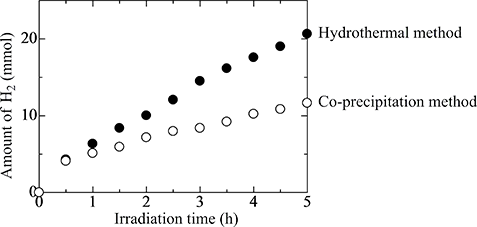
- surface might be increased via photoreduction during the reaction. As a result, the photocatalytic activity of the Ag(0.01)-doped Cd0.1Zn0.9S sample increased within the reaction time. The average hydrogen production rate from both runs was determined to be 3.91 mmol/h and the value was 1.7 times better


Other Beilstein-Institut Open Science Activities



