


Search results
Search for "polyethyleneimine" in Full Text gives 31 result(s) in Beilstein Journal of Nanotechnology.
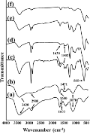
Synthesis, characterization and in vitro biocompatibility study of Au/TMC/Fe3O4 nanocomposites as a promising, nontoxic system for biomedical applications
Beilstein J. Nanotechnol. 2015, 6, 1677–1689, doi:10.3762/bjnano.6.170
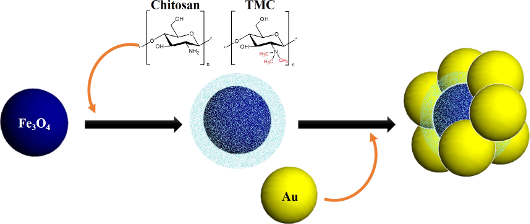
- interactions with cells and proteins [12]. Biodegradable polymers that are generally used for coating magnetic nanoparticles include poly(ethylene glycol) (PEG), poly(vinyl alcohol) (PVA), polyethyleneimine (PEI), poly(D,L-lactide), poly(lactic acid), poly(D,L-glycolide), poly(lactide-co-glycolide




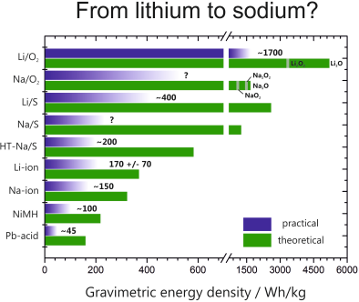
From lithium to sodium: cell chemistry of room temperature sodium–air and sodium–sulfur batteries
Beilstein J. Nanotechnol. 2015, 6, 1016–1055, doi:10.3762/bjnano.6.105


Caveolin-1 and CDC42 mediated endocytosis of silica-coated iron oxide nanoparticles in HeLa cells
Beilstein J. Nanotechnol. 2015, 6, 167–176, doi:10.3762/bjnano.6.16
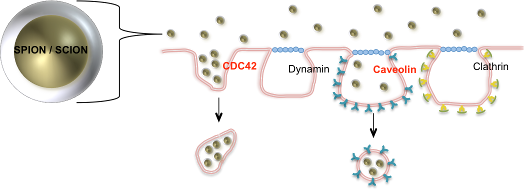
- of nanoparticles by HeLa cells is consistent with the literature. It was shown, that polyethyleneimine gold nanoparticles around 40 nm [33], gold nanoparticles of 4.5 nm [34] and conjugated polymer nanoparticles [36] are internalized through Caveolin dependent pathways. The same was observed for


Advances in NO2 sensing with individual single-walled carbon nanotube transistors
Beilstein J. Nanotechnol. 2014, 5, 2179–2191, doi:10.3762/bjnano.5.227
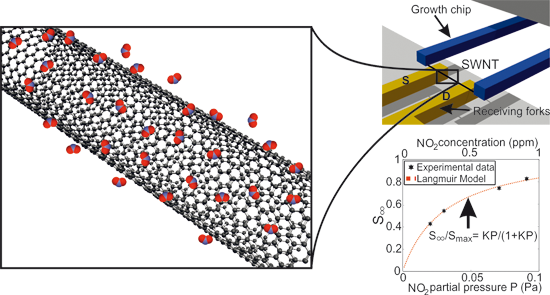
- SWNT FETs, for which the mechanisms may be different, is not available. On the other hand, polyethyleneimine (PEI) functionalization for NO2 sensing has been shown to dramatically enhance the response of SWNT sensors [14]. There, the authors argue that the main mechanism of sensitivity enhancement is
- -tube SWNT-based NO2 sensors. Sensors incorporating mats or forests of nanotubes are not considered. PEI: polyethyleneimine. It must be noted that the electrically refreshed gas sensors reported by Chang et al. [76] has been disputed by a subsequent article from Ervin et al. [77] who suggest that


Controlled synthesis and tunable properties of ultrathin silica nanotubes through spontaneous polycondensation on polyamine fibrils
Beilstein J. Nanotechnol. 2013, 4, 793–804, doi:10.3762/bjnano.4.90
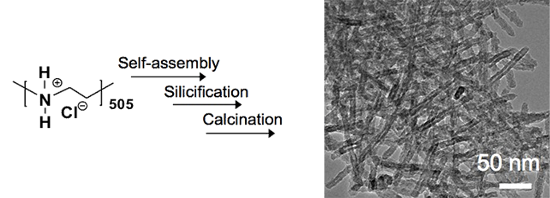
- crystalline fibrils that were conveniently produced from the neutralization of a solution of protonated linear polyethyleneimine (LPEI–H+) by alkali compounds. A simple mixing the fibrils with alkoxysilane in aqueous solution allowed for the rapid formation of silica to produce LPEI@silica hybrid nanotubes
- polymers and subsequent carbonization. Keywords: biomimetic silicification; polyethyleneimine; silica–carbon nanocomposite; silica nanotubes; template synthesis; Introduction Silica nanotubes with a controlled nanostructure (i.e., wall thickness and hollow space) and a tunable chemical composition are
- chemistry is highly desirable. We are interested in the programmable construction of biomimetic silica nanomaterials by exploiting the crystallization-driven self-assembly of a simple synthetic polyamine, namely linear polyethyleneimine (LPEI) [31][32][33]. In contrast to branched PEI, LPEI is composed only


Approaches to nanostructure control and functionalizations of polymer@silica hybrid nanograss generated by biomimetic silica mineralization on a self-assembled polyamine layer
Beilstein J. Nanotechnol. 2011, 2, 760–773, doi:10.3762/bjnano.2.84
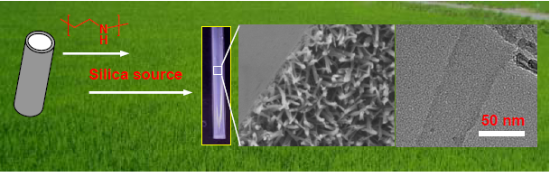
- polyamine@silica nanoribbon-based hybrid nanograss film, which was generated by performing a biomimetic silica mineralization reaction on a nanostructured linear polyethyleneimine (LPEI) layer preorganized on the inner wall of a glass tube. We found that the film thickness, size and density of the
- and facilely functionalized makes our nanograss potentially important for device-based application in microfluidic, microreactor and biomedical fields. Keywords: biomimetic silica mineralization; linear polyethyleneimine; nanofiber; nanograss; thin film; Introduction Silica-based, one-dimensional
- controlled synthesis of silica or hybrid thin films with tunable one-dimensional nanostructures still remains a challenge [20][21][22][23][24][25][26]. We are interested in using crystalline, self-assembling linear polyethyleneimine (LPEI) [27] as a mediator for silica deposition under ambient conditions. As


Other Beilstein-Institut Open Science Activities



