


Search results
Search for "semiconductor photocatalysts" in Full Text gives 27 result(s) in Beilstein Journal of Nanotechnology.
Preparation of NiS/ZnIn2S4 as a superior photocatalyst for hydrogen evolution under visible light irradiation
Beilstein J. Nanotechnol. 2013, 4, 949–955, doi:10.3762/bjnano.4.107
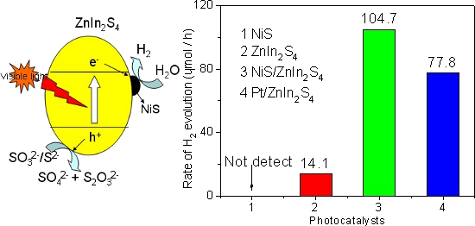
- electrodes for water splitting by Fujishima and Honda in 1972, great efforts have been devoted to the development of highly efficient semiconductor photocatalysts for hydrogen production [4]. So far, a variety of active photocatalysts for hydrogen production, including metal oxides [5][6][7][8], sulfides [9
- ] or RGO [23] into ZnIn2S4 nanostructures, the photocatalytic performance for hydrogen evolution over ZnIn2S4 have been enhanced to a certain degree. Studies on semiconductor-based photocatalysts revealed that the deposition of a suitable co-catalyst on the semiconductor photocatalysts can play
- water electrolysis [36]. Although Ni and NiO have already been used as co-catalysts for hydrogen evolution over oxide semiconductor photocatalysts, the application of NiS as co-catalyst for photocatalytic hydrogen evolution is less studied [37][38]. Only until recently, Xu et al. reported that NiS can


Structural, optical and photocatalytic properties of flower-like ZnO nanostructures prepared by a facile wet chemical method
Beilstein J. Nanotechnol. 2013, 4, 763–770, doi:10.3762/bjnano.4.87
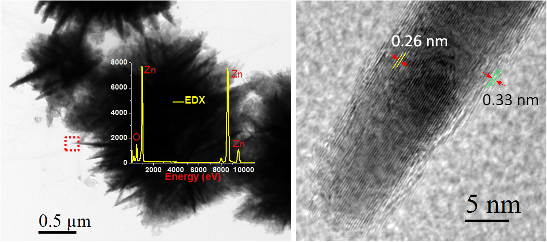
- these toxic chemicals. Photocatalytic degradation, in which the organic pollutants are degraded through photocatalytic oxidation and reduction reactions in the presence of a photocatalyst, is one of the most promising and clean processes used for water purification. Nanostructured semiconductor
- photocatalysts such as ZnO and TiO2 have attracted significant attention in recent years because of their wide-spread application in environmental remediation [1][2]. These photocatalysts have a high efficiency for the degradation of toxic organic pollutants that originate from the effluents of textile and


Other Beilstein-Institut Open Science Activities



