


Search results
Search for "solubilization" in Full Text gives 35 result(s) in Beilstein Journal of Nanotechnology.
Dispersion of single-wall carbon nanotubes with supramolecular Congo red – properties of the complexes and mechanism of the interaction
Beilstein J. Nanotechnol. 2017, 8, 636–648, doi:10.3762/bjnano.8.68
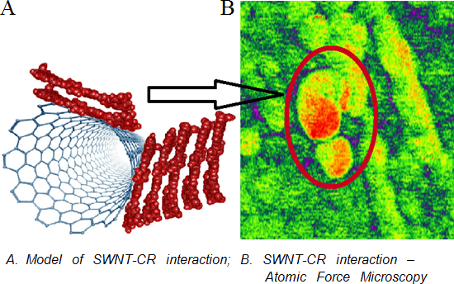
- engineering [10][11][12]. Pristine CNTs exist in form of bundles composed of hundreds of single tubes bound by van der Waals interactions. Most applications of carbon nanotubes require their dispersion (solubilization) which can be achieved by either covalent or noncovalent functionalization [8][13][14
- performed by sonication of pristine CNTs in an amphiphilic solution. Sonication leads both to the solubilization and shortening of carbon nanotubes. Shortening, resulting from long-term sonication, takes place at sites of structural defects present on nanotube surface. It is important to note that the


Nanoscale isoindigo-carriers: self-assembly and tunable properties
Beilstein J. Nanotechnol. 2017, 8, 313–324, doi:10.3762/bjnano.8.34
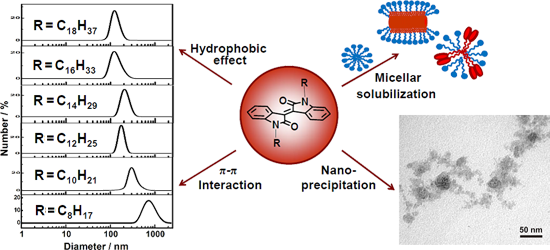
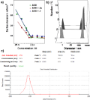
- hydropohobic solutes including drugs. Furthermore, the solubilization of organic hydrophobic dyes makes it possible to detect the formation of micelles in solution [67]. In Figure 4a, the dependence of the absorbance of hydrophobic dye (Sudan I) on the concentration of isoindigo derivatives 2g and 2h is shown
- ) and 0.1 mМ (for 2h). Thus, experimental data prove the formation of self-assembled structures of 2g and 2h with a hydrophobic field that can dissolve nonpolar probes. The critical association concentrations for 2g and 2h are 0.2 and 0.1 mМ, respectively. Calculated values of the solubilization
- capacity of 2g and 2h micellar aggregates are given in Table S4 (Supporting Information File 1). As can be seen, the solubilization capacity value grows with the increasing length of the alkyl chain. According to Table S4 (Supporting Information File 1), the solubilization ability of 2g and 2h is




Facile fabrication of luminescent organic dots by thermolysis of citric acid in urea melt, and their use for cell staining and polyelectrolyte microcapsule labelling
Beilstein J. Nanotechnol. 2016, 7, 1905–1917, doi:10.3762/bjnano.7.182
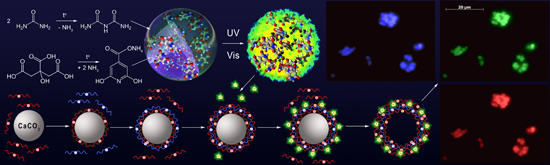
- ]. Solubilization of these clusters in water leads to micellar peptization and colloidal sol formation; peptization increases with temperature and dilution. The colloidal nature of the final O-dots solution can be demonstrated easily by the Tyndall cone arising at wavelengths where absorption is absent, for example




Heterometal nanoparticles from Ru-based molecular clusters covalently anchored onto functionalized carbon nanotubes and nanofibers
Beilstein J. Nanotechnol. 2015, 6, 1287–1297, doi:10.3762/bjnano.6.133
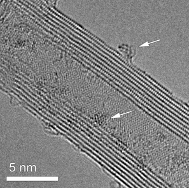
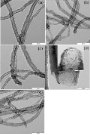
- phosphine-functionalized nanocarbons by stirring in a mixture of toluene and dichloromethane. Toluene is chosen to maximize interactions with the carbon support and dichloromethane to ensure solubilization of the metal species. The total metal loading is determined in each case by Ru, Co, Pt and/or Au ICP




The impact of the confinement of reactants on the metal distribution in bimetallic nanoparticles synthesized in reverse micelles
Beilstein J. Nanotechnol. 2014, 5, 1966–1979, doi:10.3762/bjnano.5.206
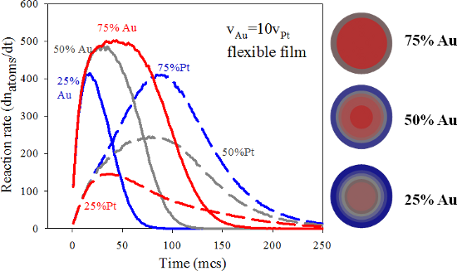
- into account the surface composition (Au or Pt). Another type of growth is Ostwald ripening, that is, the growth of larger particles at the expense of smaller ones by transport of material. It is assumed that the easier solubilization of the smallest particles causes their decrease in size. These atoms


Non-covalent and reversible functionalization of carbon nanotubes
Beilstein J. Nanotechnol. 2014, 5, 1675–1690, doi:10.3762/bjnano.5.178
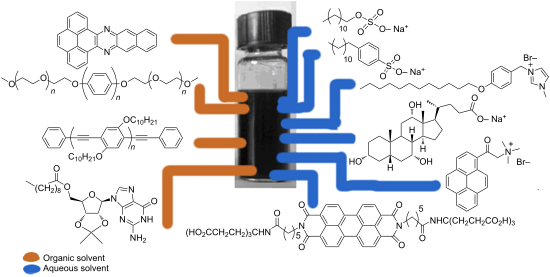
- applications in fields such as material science, drug delivery and diagnostic applications. Their versatile physicochemical features are nonetheless limited by their scarce solubilization in both aqueous and organic solvents. In order to overcome this drawback CNTs can be easily non-covalently functionalized
- functionalization of MWCNTs makes use of molecules that self-assemble around the nanotube forming supramolecular polymers. Llanes-Pallas et al. have shown that such a non-covalent solubilization can be realized by exploiting the formation of hydrogen bonds between the 2,6-di(acetylamino)pyridine and the imidic
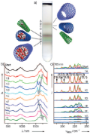
- favorably exploited for CNTs precipitation/dispersion cycles. Ortiz-Acevedo et al. obtained a diameter-selective solubilization of SWCNTs by using cyclic peptides containing thiol groups [101]. The oxidation induces polymerization of the peptides which wrap around the nanotube achieving a size-selective



In vitro interaction of colloidal nanoparticles with mammalian cells: What have we learned thus far?
Beilstein J. Nanotechnol. 2014, 5, 1477–1490, doi:10.3762/bjnano.5.161
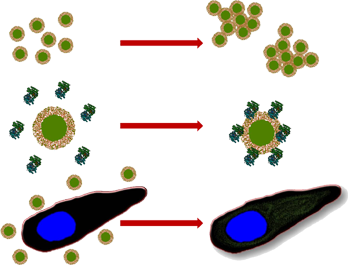
- prediction of NP interactions, for instance, in the human body or in ecotoxicology. Some NPs have been mistaken to elicit limited to no adverse effects upon zebrafish assays, as they had precipitated to the bottom, and thus, the fish had not been directly exposed to them. After correct solubilization


Morphological characterization of fullerene–androsterone conjugates
Beilstein J. Nanotechnol. 2014, 5, 374–379, doi:10.3762/bjnano.5.43
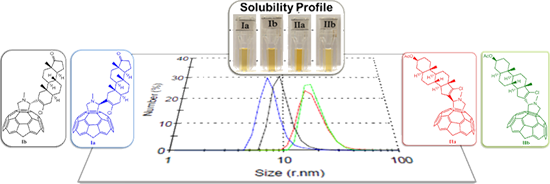
- ][7], nucleotides, sugars and steroids [8][9], have allowed the solubilization of these hybrid derivatives in aqueous media, thus enhancing certain biological activities. For the potential use of C60 derivatives as drug delivery systems, the size of the particles is important. In general, fast drug


Energy transfer in complexes of water-soluble quantum dots and chlorin e6 molecules in different environments
Beilstein J. Nanotechnol. 2013, 4, 895–902, doi:10.3762/bjnano.4.101
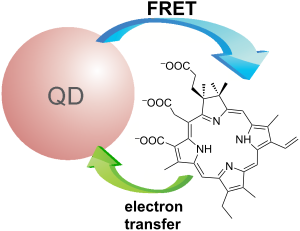
- quantum dots and Ce6 molecules two methods of QD solubilization were used. In the case of covalent binding the hydrophobic CdSe/ZnS/TOPO QDs with a core diameter of 3.5 nm were initially solubilized by L-cysteine. In the second step, the L-cysteine molecules were replaced with molecules of hydroxy


Magnetic-Fe/Fe3O4-nanoparticle-bound SN38 as carboxylesterase-cleavable prodrug for the delivery to tumors within monocytes/macrophages
Beilstein J. Nanotechnol. 2012, 3, 444–455, doi:10.3762/bjnano.3.51
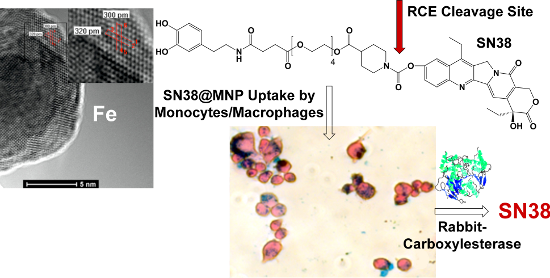
- carried out to determine the toxicity of NMP-SN38 on Mo/Ma. 3-(4,5-Dimethylthiazol-2-yl)-2,5-diphenyltetrazolium bromide (MTT) was dissolved in PBS at 5 mg/mL to prepare the MTT reagent solution. MTT solubilization buffer was prepared by dissolving 10% (w/v) sodium dodecylsulfate and 0.10 M HCl in water





