


Search results
Search for "storage modulus" in Full Text gives 29 result(s) in Beilstein Journal of Nanotechnology.
Frequency, amplitude, and phase measurements in contact resonance atomic force microscopies
Beilstein J. Nanotechnol. 2014, 5, 278–288, doi:10.3762/bjnano.5.30
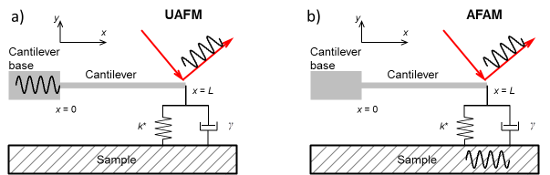
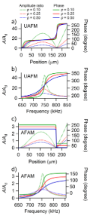
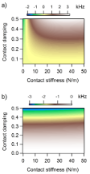
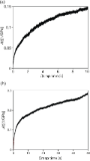
- acoustic microscopy (AFAM) configuration [3]), such that the tip oscillation amplitude and its phase with respect to the excitation can be measured and converted into a loss and storage modulus. In contact resonance AFM (CR-AFM) [3][4][5][6][7][8][9] a similar setup is used, supplying the sinusoidal


Dynamic nanoindentation by instrumented nanoindentation and force microscopy: a comparative review
Beilstein J. Nanotechnol. 2013, 4, 815–833, doi:10.3762/bjnano.4.93
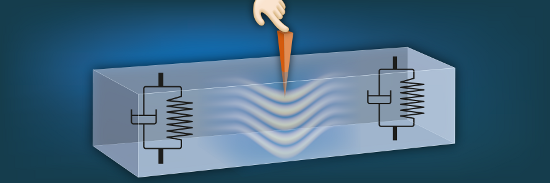
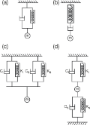
- principles in nanoindentation, and compares and contrasts these two techniques as they are used for characterization of viscoelastic processes at the nanoscale. Keywords: atomic force microscopy; loss modulus; nanoindentation; storage modulus; viscoelasticity; Review Introduction Understanding and
- strain could be modulated. In this case, stress and strain will exhibit a phase difference designated as angle δ and the modulus can be now expressed as complex modulus E*: Here, E′ is the storage modulus, which measures the energy stored during one oscillation cycle, and E″ is the loss modulus, which
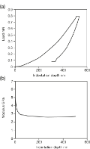
- temperature. Concomitantly, the storage modulus is reduced since molecular relaxation loosens the molecular bonds. Experimental aspects of the dynamic response measurement Some caveats should be applied in comparing experiments made under different conditions: The creep response depends on the tip shape, and




Multiple regimes of operation in bimodal AFM: understanding the energy of cantilever eigenmodes
Beilstein J. Nanotechnol. 2013, 4, 385–393, doi:10.3762/bjnano.4.45
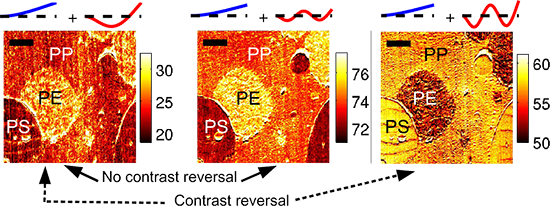
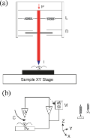
- different materials that are located side by side. The material on the left (red lines) has a Young’s modulus of 3 GPa and the one on the right (blue lines) has a modulus of 2 GPa. These values are close to the storage modulus from dynamic mechanical analysis (time–temperature superposition was used to


![[Graphic 3]](/bjnano/content/inline/2190-4286-4-45-i5.png?max-width=637&scale=1.18182) . In the top row (a, b) the first eigen...
. In the top row (a, b) the first eigen...



Conducting composite materials from the biopolymer kappa-carrageenan and carbon nanotubes
Beilstein J. Nanotechnol. 2012, 3, 415–427, doi:10.3762/bjnano.3.48
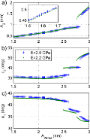
- measurements can be used to determine the sol–gel transition of polymer solutions. A larger loss modulus (G˝) than storage modulus (G΄) in the linear viscoelastic region is indicative of solution-like behaviour. Whereas, the reverse (G΄ > G˝) is indicative of gel-like behaviour [44]. The KC solutions with
- straight line in (c) indicates the rate of increase at the lower concentrations. (a–c) Storage (G΄, diamonds) and loss modulus (G˝, squares) of KC solutions at concentrations of 0.4%, 0.5%, and 0.6% w/v, respectively; (d and e) loss and storage modulus of KC versus solution concentration at 1.47% shear


Other Beilstein-Institut Open Science Activities



