


Search results
Search for "synthetic polymers" in Full Text gives 34 result(s) in Beilstein Journal of Nanotechnology.
Frontiers in pharmaceutical nanotechnology
Beilstein J. Nanotechnol. 2019, 10, 2538–2540, doi:10.3762/bjnano.10.244

- announced the approval of a first-of-its-kind RNA interference (RNAi)-based drug, Onpattro™, which uses solid lipid nanoparticles to protect the sensitive compound from early degradation. Again, lipid materials rather than synthetic polymers have been used for drug delivery applications. In pharmaceutical
Nanoarchitectonics meets cell surface engineering: shape recognition of human cells by halloysite-doped silica cell imprints
Beilstein J. Nanotechnol. 2019, 10, 1818–1825, doi:10.3762/bjnano.10.176
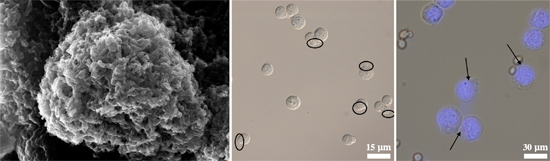
- can be doped with nanoscale inorganic particles) [8][9]; 2) direct anchoring of inorganic nanoparticles to cell surfaces [10][11]; 3) fabrication of “hard” inorganic shells mimicking natural eggshells [12]. Synthetic polymers can be grafted onto the surface of individual cells using atom-transfer


Liquid-crystalline nanoarchitectures for tissue engineering
Beilstein J. Nanotechnol. 2018, 9, 205–215, doi:10.3762/bjnano.9.22
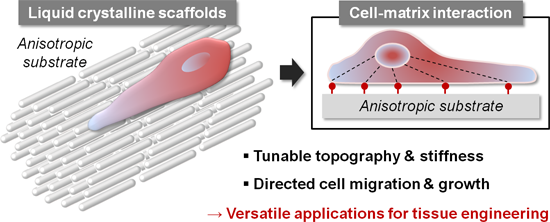
- nanoscale topographies [93][94]. LC elastomer scaffolds in nematic and smectic-A phases Liquid crystal elastomers (LCEs) are crosslinked 3D networks of rubber-like synthetic polymers exhibiting orientational and/or positional order [95]. Due to the tunable malleability and highly anisotropic shape change in


Cationic PEGylated polycaprolactone nanoparticles carrying post-operation docetaxel for glioma treatment
Beilstein J. Nanotechnol. 2017, 8, 1446–1456, doi:10.3762/bjnano.8.144
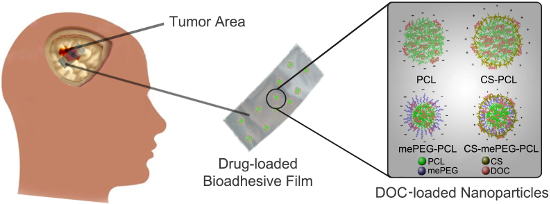
- reported to be nontoxic, biocompatible and biodegradable and is approved for therapeutic use in humans by the FDA. PCL can be copolymerized with other synthetic polymers such as polyethylene glycol (PEG) and polyethylene oxide (PEO) to obtain new polycaprolactone derivatives with various novel properties




Self-assembled anchor layers/polysaccharide coatings on titanium surfaces: a study of functionalization and stability
Beilstein J. Nanotechnol. 2015, 6, 617–631, doi:10.3762/bjnano.6.63
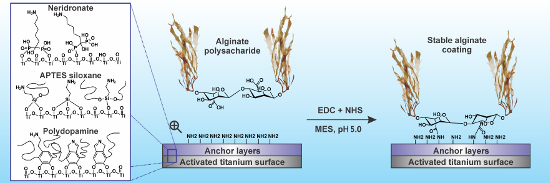
- titanium surfaces. Bio-related titanium surface modifications based on polysaccharides and synthetic polymers have been performed by physisorption and electrostatic interactions. In comparison with polylactide coatings, physisorbed alginate coatings are capable of exhibiting pronounced cell adhesion [17


Influence of stabilising agents and pH on the size of SnO2 nanoparticles
Beilstein J. Nanotechnol. 2014, 5, 2192–2201, doi:10.3762/bjnano.5.228
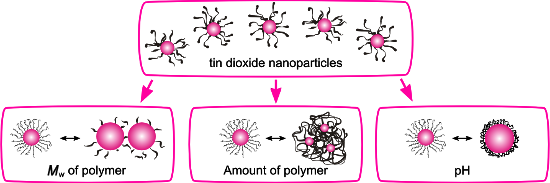
- stabilising agents significantly affect the size, shape and surface properties of nanomaterials synthesised in their presence [18]. In 1718, Helcher applied a natural polymer (starch) to stabilise gold nanoparticles [19]. Today, synthetic polymers are commonly used to stabilise different types of
- metal oxides occurring in polymeric micelles [20]. The second theory, although less popular, describes the stabilisation of polymers by molecules that results from the polymerisation of monomers which occur in the presence of nanoparticles. In this article, synthetic polymers were used as stabilisers


Biopolymer colloids for controlling and templating inorganic synthesis
Beilstein J. Nanotechnol. 2014, 5, 2129–2138, doi:10.3762/bjnano.5.222
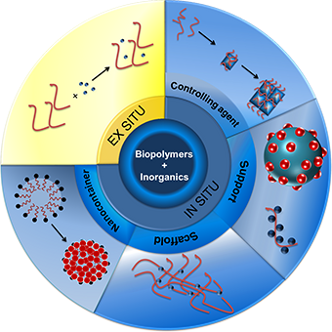
- synthetic polymers (see Section 4 in [60] for a review), but only a limited number of works are found for biopolymers. Li et al. [61] prepared cross-linked chitosan microspheres and immobilized bovine serum albumin covalently on their surface. On the resulting particles, silica was formed by a sol–gel
- of “hard templates” stated above, the approach has been very productive with synthetic polymers [2][60], but only explored in a limited way with biopolymers. The main reason for this is that the assembly of many biopolymers results in a rather continuous network and not necessarily in “discrete
- supports (e.g., metallization or mineralization of DNA) or by using particle systems. Hydrogel approaches can also be confined to the spaces of particles. Clearly, synthetic polymers are often a more economic and versatile alternative, but biopolymers can be especially interesting in those applications in


Controlled synthesis and tunable properties of ultrathin silica nanotubes through spontaneous polycondensation on polyamine fibrils
Beilstein J. Nanotechnol. 2013, 4, 793–804, doi:10.3762/bjnano.4.90
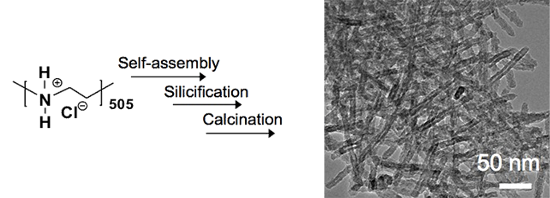
- ]. Moreover, polypeptides are unsuitable for the large-scale production of silica nanotubes. In contrast, LPEI is one of simplest synthetic polymers and its alkali-induced self-assembly can be easily performed in water at room temperature. According to the recipe to the silica nanotubes shown in Figure 1A–C


Approaches to nanostructure control and functionalizations of polymer@silica hybrid nanograss generated by biomimetic silica mineralization on a self-assembled polyamine layer
Beilstein J. Nanotechnol. 2011, 2, 760–773, doi:10.3762/bjnano.2.84
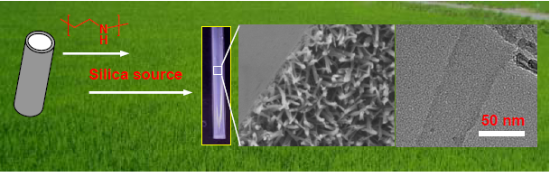
- one of the simplest synthetic polymers, LPEI is cost-effective and suitable for a wide range of applications. The silica mineralization reaction was assumed to occur site-selectively on the surface of crystalline LPEI aggregates, producing the LPEI@silica hybrid nanostructure or pure silica materials


Other Beilstein-Institut Open Science Activities



