


Search results
Search for "tissue regeneration" in Full Text gives 30 result(s) in Beilstein Journal of Nanotechnology.
Surface functionalization of 3D-printed plastics via initiated chemical vapor deposition
Beilstein J. Nanotechnol. 2017, 8, 1629–1636, doi:10.3762/bjnano.8.162
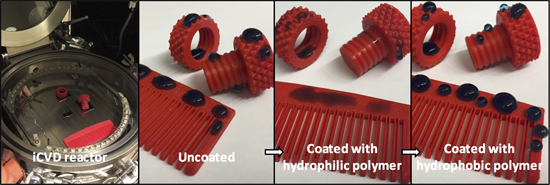
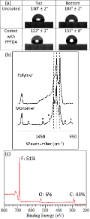
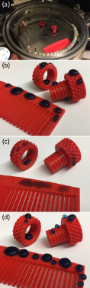
- hydrophobic surface properties and do not promote cellular differentiation [3][18]. Surface modification of printed scaffolds can allow for the tuning of surface functionalization to promote vascularization and tissue regeneration while maintaining control over the mechanical robustness of the bulk structure



Luminescent supramolecular hydrogels from a tripeptide and nitrogen-doped carbon nanodots
Beilstein J. Nanotechnol. 2017, 8, 1553–1562, doi:10.3762/bjnano.8.157
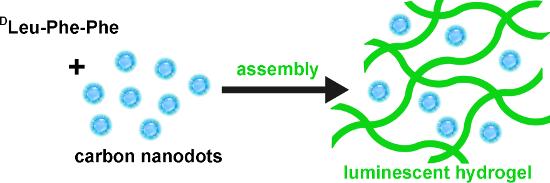
- long term, a supramolecular hydrogel composed of a peptide and luminescent nanodots could be valuable for tissue regeneration based on a bioactive scaffold that can be also visualized in vivo by fluorescence microscopy. Alternatively, other potential applications could be developed in the future for


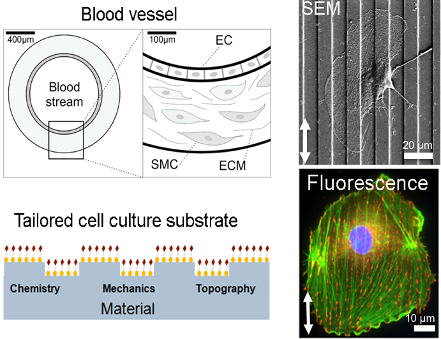
Nano- and microstructured materials for in vitro studies of the physiology of vascular cells
Beilstein J. Nanotechnol. 2016, 7, 1620–1641, doi:10.3762/bjnano.7.155



Fabrication of hybrid nanocomposite scaffolds by incorporating ligand-free hydroxyapatite nanoparticles into biodegradable polymer scaffolds and release studies
Beilstein J. Nanotechnol. 2015, 6, 2217–2223, doi:10.3762/bjnano.6.227
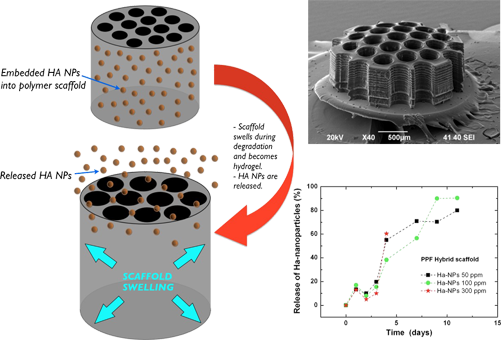
- similarity to the mineral constituent of human bones, are bioactive and can be fairly easily bioconjugated [1]. HA NPs can enhance cell proliferation in bone tissue regeneration [2]. Tissue engineering is an interdisciplinary field that combines the principles of life sciences and engineering to improve
- tissue growth and functions. Whenever the need arises for a certain type of scaffold to be produced, all these fields have to be utilized together to get an appropriate solution. HA is an essential ingredient of normal bone and teeth and is widely used for bone tissue regeneration. Given the high degree


Oxygen-plasma-modified biomimetic nanofibrous scaffolds for enhanced compatibility of cardiovascular implants
Beilstein J. Nanotechnol. 2015, 6, 254–262, doi:10.3762/bjnano.6.24
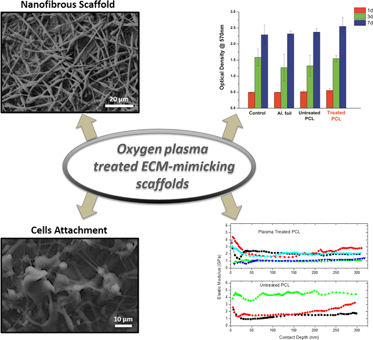
- complications of thrombosis and implant failure. Thus, we herein fabricated poly-ε-caprolactone (PCL) electrospun nanofibrous scaffolds, to serve as coatings for cardiovascular implants and guide tissue regeneration. Oxygen plasma treatment was applied in order to modify the surface chemistry of the scaffold
- properties along with the topographical nanoscale features of the scaffolds could be very useful in the design of novel biomimetic coatings, able to guide tissue regeneration especially in cardiovascular implant industry, where in situ vascular regeneration remains an unmet challenge. Experimental Scaffold


Other Beilstein-Institut Open Science Activities



