


Search results
Search for "Escherichia coli" in Full Text gives 62 result(s) in Beilstein Journal of Nanotechnology.
Reconstitution of the membrane protein OmpF into biomimetic block copolymer–phospholipid hybrid membranes
Beilstein J. Nanotechnol. 2016, 7, 881–892, doi:10.3762/bjnano.7.80
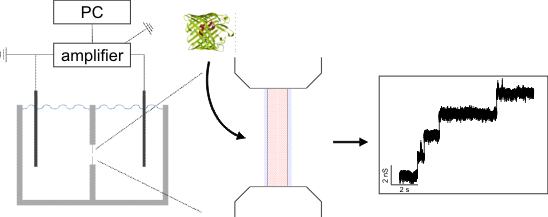
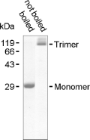
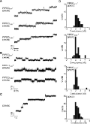
- -isoprene-block-ethylene oxide) block copolymers blended with 1,2-diphytanoyl-sn-glycero-3-phosphocholine. By reconstituting the outer membrane protein OmpF from Escherichia coli into these membranes, we demonstrate functionality of this protein in biomimetic lipopolymer membranes, independent of the
- been assessed yet [46][47]. In the present work, we studied the reconstitution of OmpF from Escherichia coli into biomimetic lipopolymer membranes, generated by self-assembly of amphiphilic poly(1,4-isoprene-block-ethylene oxide) block copolymers (PIPEO) and 1,2-diphytanoyl-sn-glycero-3-phosphocholine
- . Isolation of OmpF Native OmpF protein was purified from Escherichia coli strain BE BL21(DE3)omp6 [9], lacking both LamB and OmpC [6][10]. Briefly, cells from a one liter culture were resuspended in 50 mM Tris-HCl buffer (pH 7.5) containing 2 mM MgCl2 and DNAse and broken by passing through a French press



Antibacterial activity of silver nanoparticles obtained by pulsed laser ablation in pure water and in chloride solution
Beilstein J. Nanotechnol. 2016, 7, 465–473, doi:10.3762/bjnano.7.40
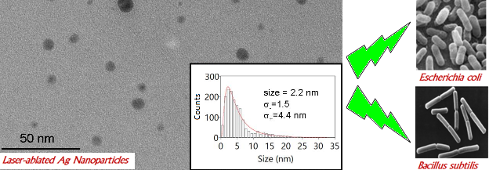
- Escherichia coli and Bacillus subtilis as references for Gram-negative and Gram-positive bacteria, respectively. In all cases, AgNPs with an average diameter less than 10 nm were obtained, which has been shown in previous works to be the most effective size for bactericidal activity. The measured zeta
- water or in aqueous solutions of LiCl using a 1064 nm ablation wavelength. Then, the obtained AgNPs were characterized and tested for antimicrobial activity against Escherichia coli and Bacillus subtilis as references for Gram-negative and Gram-positive bacteria, respectively. Results AgNP
- zeta-potential values are the standard deviation of the mean value, as obtained by the software supplied with the Malvern instrument. Bacterial strains and growth conditions The Escherichia coli strain XL1Blue (Stratagene, La Jolla, CA, USA) and the Bacillus subtilis strain 168 [42] were used to test


NanoE-Tox: New and in-depth database concerning ecotoxicity of nanomaterials
Beilstein J. Nanotechnol. 2015, 6, 1788–1804, doi:10.3762/bjnano.6.183
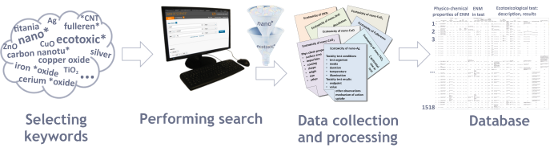
- selected ENMs is available for 116 different test species (Table S5). Most of the experiments have been performed with water flea Daphnia magna (337 entries), followed by bacterium Escherichia coli (120 entries), unicellular alga Pseudokirchneriella subcapitata (107 entries), fish Danio rerio (66 entries
- FeOx NPs to fish. Interestingly, toxicity tests with plants have been conducted with all 8 NPs. While relatively many studies have been performed with bacteria, the majority of them consider the effects towards potentially pathogenic bacterial strains, e.g., Escherichia coli, Klebsiella pneumoniae


Nanobioarchitectures based on chlorophyll photopigment, artificial lipid bilayers and carbon nanotubes
Beilstein J. Nanotechnol. 2014, 5, 2316–2325, doi:10.3762/bjnano.5.240
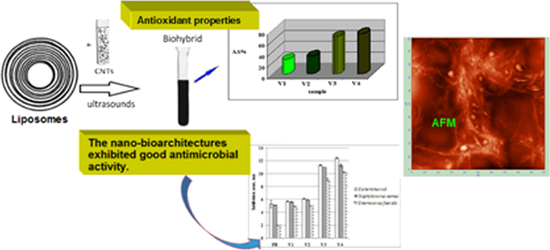
- radical scavenging ability (affording an antioxidant activity of 73.25%) and enhanced biocidal ability, offering inhibition zones of 12.4, 11.3 and 10.2 mm in diameter, against Escherichia coli, Staphylococcus aureus and Enterococcus faecalis, respectively. Keywords: antibacterial activity; antioxidant
- Sigma-Aldrich (Germany). The antimicrobial activity was tested against human pathogenic bacteria such as Staphylococcus aureus ATTC 25923, Escherichia coli ATCC 8738, and Enterococcus faecalis ATCC 29212. The bacterial strains were grown in Luria Bertani Agar (LBA) plates at 37 °C with the following
- -negative bacteria from the American Type Culture Collection (ATCC). In the present study three bacterial strains were used for the antibacterial assay: Staphylococcus aureus (ATCC 6538), Enterococcus faecalis (ATCC 29212) and Escherichia coli (ATCC 8738). The microorganisms used in this study were selected


Carbon nano-onions (multi-layer fullerenes): chemistry and applications
Beilstein J. Nanotechnol. 2014, 5, 1980–1998, doi:10.3762/bjnano.5.207
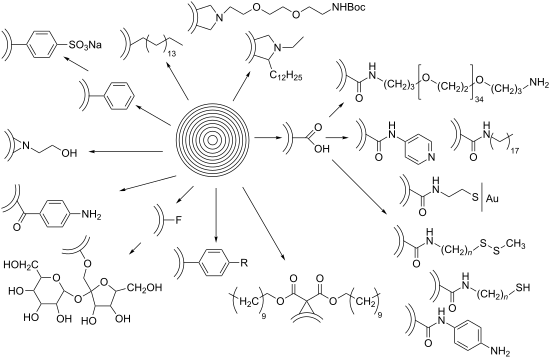
- , Escherichia coli and Caenorhabditis elegans [17][51]. In both studies, no toxic effects of the water-soluble CNOs on the investigated organisms were observed. We recently reported the weak inflammatory potential and low cytotoxicity in vitro and in vivo of CNOs and their ability to be up-taken by antigen


Carbon-based smart nanomaterials in biomedicine and neuroengineering
Beilstein J. Nanotechnol. 2014, 5, 1849–1863, doi:10.3762/bjnano.5.196
- anticancer drugs and preserving their activity under biological conditions [81][82][83][84]. The affinity of NDs for protein adsorption has been finally utilised to separate recombinant proteins from Escherichia coli [85], resulting not only in a radically faster process than the commonly used purification


Biocalcite, a multifunctional inorganic polymer: Building block for calcareous sponge spicules and bioseed for the synthesis of calcium phosphate-based bone
Beilstein J. Nanotechnol. 2014, 5, 610–621, doi:10.3762/bjnano.5.72
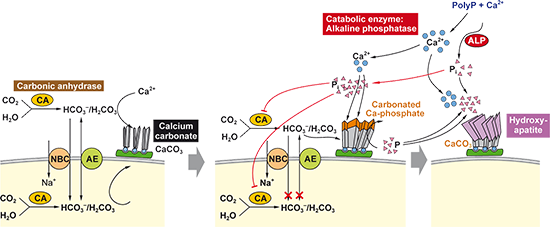
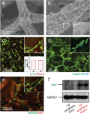
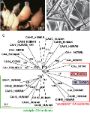
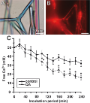
- , raised against the Sycon CA. The immunocomplexes were stained with Cy5-labelled anti-rabbit IgG. (C) Formation of CaCO3 in the ammonium carbonate diffusion assay in the presence of CA. For this series of experiments the recombinant human CA2 enzyme, expressed in Escherichia coli (C6624, Sigma), with a



Artificial sunlight and ultraviolet light induced photo-epoxidation of propylene over V-Ti/MCM-41 photocatalyst
Beilstein J. Nanotechnol. 2014, 5, 566–576, doi:10.3762/bjnano.5.67
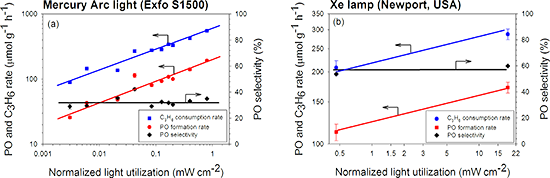
- photocatalytic reactions is a common phenomenon, which has been observed in, e.g., the photo-degradation of gaseous formaldehyde [2], dye [3][4][5] and polychlorinated dibenzo-p-dioxins [6], and the disinfection of Escherichia coli [7][8][9]. How the light energy can be effectively utilized in a heterogeneous


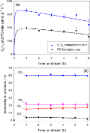


Photocatalytic antibacterial performance of TiO2 and Ag-doped TiO2 against S. aureus. P. aeruginosa and E. coli
Beilstein J. Nanotechnol. 2013, 4, 345–351, doi:10.3762/bjnano.4.40
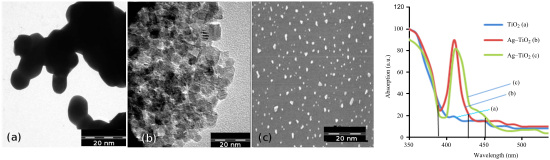
- aeruginosa, Escherichia coli) bacteria. As a result, the viability of all three microorganisms was reduced to zero at 60 mg/30 mL culture in the case of both (3% and 7% doping) concentrations of Ag-doped TiO2 nanoparticles. Annealed TiO2 showed zero viability at 80 mg/30 mL whereas doped Ag-TiO2 7% showed
- investigated against Gram-positive Staphylococcus aureus (S. aureus), and Gram-negative Pseudomonas aeruginosa (P. aeruginosa) and Escherichia coli (E. coli) bacteria under visible light. Results and Discussion XRD of TiO2 and Ag-doped TiO2 The samples were annealed at 450 °C to achieve crystallization in TiO2


Electrospinning preparation and electrical and biological properties of ferrocene/poly(vinylpyrrolidone) composite nanofibers
Beilstein J. Nanotechnol. 2013, 4, 189–197, doi:10.3762/bjnano.4.19

- PVP nanofibers. X-ray diffraction (XRD) results showed that the crystalline structure of Fc in the fibers was amorphous after the electrospinning process. A biological evaluation of the antimicrobial activity of Fc/PVP nanofibers was carried out by using Gram-negative Escherichia coli (E. coli) as


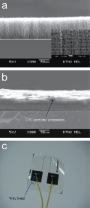
Paper modified with ZnO nanorods – antimicrobial studies
Beilstein J. Nanotechnol. 2012, 3, 684–691, doi:10.3762/bjnano.3.78
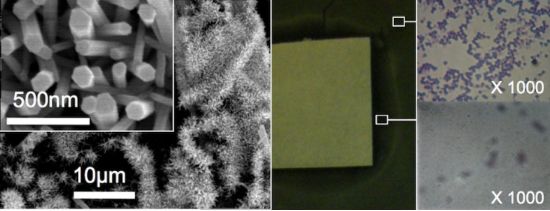
- three model microbes, Gram-positive bacteria Staphylococcus aureus, Gram-negative bacteria Escherichia coli and common airborne fungus Aspergillus niger. No viable bacterial colonies or fungal spores could be detected in the areas surrounding test samples of the antimicrobial paper. Gram-negative
- bacteria Escherichia coli were found to be inhibited in an area that is 239% and 163% the area of the paper sample under different room lighting conditions, i.e., halogen and fluorescent lamp illumination, respectively. For Gram-positive bacteria Staphylococcus aureus the zones of inhibition surrounding
- ) nanoparticles embedded into a paper matrix have been reported as exhibiting antibacterial properties [4]. Wallpaper prepared by using zinc oxide nanoparticle (~20 nm) coatings has been reported to render antibacterial surfaces that inhibit growth of bacteria such as Escherichia coli (E. coli) [5]. An increase


FTIR nanobiosensors for Escherichia coli detection
Beilstein J. Nanotechnol. 2012, 3, 485–492, doi:10.3762/bjnano.3.55
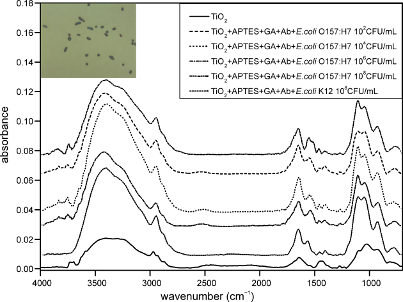
- due to enterohaemorrhagic E. coli (Escherichia coli) have a low incidence but can have severe and sometimes fatal health consequences, and thus represent some of the most serious diseases due to the contamination of water and food. New, fast and simple devices that monitor these pathogens are
- Foodborne illness is primarily caused by pathogenic microorganisms among which Campylobacter, Salmonella, Listeria monocytogenes, and Escherichia coli O157: H7 are responsible for the majority of foodborne outbreaks [1][2], and most of the recalls of food products have implicated these pathogens [3]. In





