


Search results
Search for "Kelvin probe force microscopy (KPFM)" in Full Text gives 54 result(s) in Beilstein Journal of Nanotechnology.
Distinguishing magnetic and electrostatic interactions by a Kelvin probe force microscopy–magnetic force microscopy combination
Beilstein J. Nanotechnol. 2011, 2, 552–560, doi:10.3762/bjnano.2.59
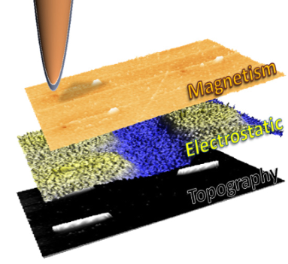
- magnetic field during the MFM operation [14][15][16]; (ii) performing a combination of Kelvin probe force microscopy (KPFM) [17][18] and MFM to compensate the electrostatic contribution to the frequency shift signal. In the first method the evolution of the MFM signal with the magnetic field is a signature
- ., they exhibit large surface potential differences causing heterogeneous electrostatic interaction between the tip and the sample that could be interpreted as a magnetic interaction. To distinguish clearly the origin of the tip–sample forces we propose to use a combination of Kelvin probe force
- microscopy (KPFM) and MFM. The KPFM technique allows us to compensate in real time the electrostatic forces between the tip and the sample by minimizing the electrostatic contribution to the frequency shift signal. This is a great challenge in samples with low magnetic moment. In this work we studied an


The role of the cantilever in Kelvin probe force microscopy measurements
Beilstein J. Nanotechnol. 2011, 2, 252–260, doi:10.3762/bjnano.2.29
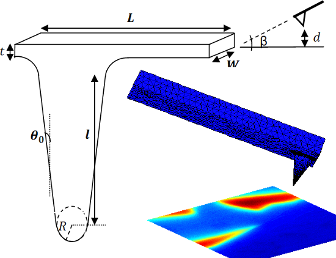
- cantilever in quantitative Kelvin probe force microscopy (KPFM) is rigorously analyzed. We use the boundary element method to calculate the point spread function of the measuring probe: Tip and cantilever. The calculations show that the cantilever has a very strong effect on the absolute value of the
- calculated and found to be relatively small. Keywords: boundary elements method; cantilever; convolution; Kelvin probe force microscopy; point spread function; Introduction The effect of the measuring probe in electrostatic force based microscopies, such as Kelvin probe force microscopy (KPFM) [1], is very


Defects in oxide surfaces studied by atomic force and scanning tunneling microscopy
Beilstein J. Nanotechnol. 2011, 2, 1–14, doi:10.3762/bjnano.2.1
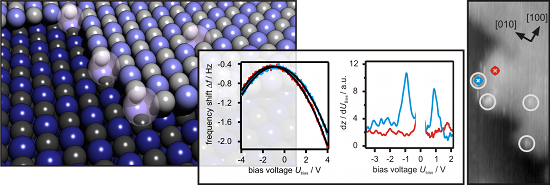
- surface termination by NC-AFM with atomic resolution, point defects in magnesium oxide on Ag(001) and line defects in aluminum oxide on NiAl(110), respectively, were thoroughly studied. The contact potential was determined by Kelvin probe force microscopy (KPFM) and the electronic structure by scanning
- defects in oxide surfaces was studied by non-contact atomic force microscopy (NC-AFM) and scanning tunneling microscopy (STM). Furthermore, the contact potential was determined by Kelvin probe force microscopy (KPFM). This technique has a high spatial resolution, thus avoiding averaging over various


Scanning probe microscopy and related methods
Beilstein J. Nanotechnol. 2010, 1, 155–157, doi:10.3762/bjnano.1.18

- molecules on surfaces. AFM has evolved considerably in the last few years, where new operation modes, such as non-contact force microscopy (nc-AFM), Kelvin probe force microscopy (KPFM) or friction force microscopy (FFM), were developed. One main focus is the high resolution capabilities of nc-AFM, which

Other Beilstein-Institut Open Science Activities



