Search results
Search for "NMR spectroscopy" in Full Text gives 60 result(s) in Beilstein Journal of Nanotechnology.
Microwave assisted synthesis and characterisation of a zinc oxide/tobacco mosaic virus hybrid material. An active hybrid semiconductor in a field-effect transistor device
Beilstein J. Nanotechnol. 2015, 6, 785–791, doi:10.3762/bjnano.6.81
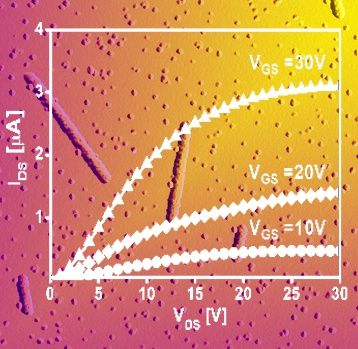
- was employed to synthesize stable zinc oxide (ZnO) nanoparticles, employing a molecular precursor. Insightful studies of the decomposition of the precursor were done using NMR spectroscopy and material characterization of the hybrid material derived from the decomposition was achieved using dynamic
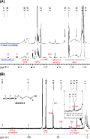
- 13C NMR spectroscopy. Without the addition of the base, the precursor complex did not undergo any decomposition after the completion of the microwave reaction under typical reaction conditions. However, in the presence of the base, the precursor does undergo decomposition with appearance of a
- materials with functional properties that can be implemented into future device applications. Schematic representation of the microwave decomposition pathway of the zinc oximato precursor in the presence of TEAOH as a base based on NMR spectroscopy. Note that the water ligands are omitted in the starting


Chemoselective silicification of synthetic peptides and polyamines
Beilstein J. Nanotechnol. 2015, 6, 103–110, doi:10.3762/bjnano.6.10
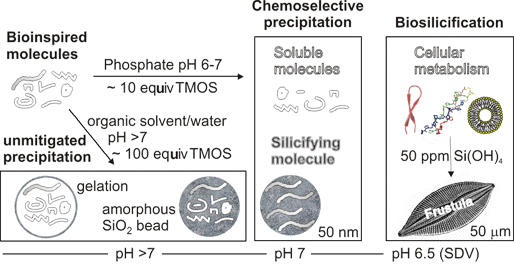
- present experiments which quantify the additivity, and potential cooperativity of long chain polyamines (LCPAs) and cationic peptides in the silicification process. Keywords: biomineralisation; biosilicification; NMR spectroscopy; polyamines; silaffin; Introduction Modifications of the Stöber method [1


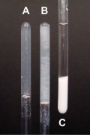


Electrostatic interplay: The interaction triangle of polyamines, silicic acid, and phosphate studied through turbidity measurements, silicomolybdic acid test, and 29Si NMR spectroscopy
Beilstein J. Nanotechnol. 2014, 5, 2026–2035, doi:10.3762/bjnano.5.211
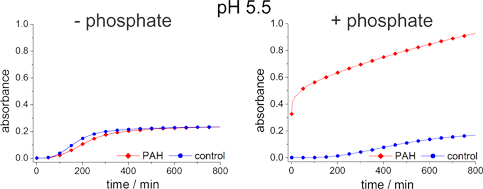
- studied in order to visualize the possible influence of hydrophobic interactions. For 29Si NMR spectroscopy aqueous solutions of isotope-labelled sodium [29Si] metasilicate as precursor compound were used. Different silica precursors, such as toxic TMOS (tetramethyl orthosilicate) or TEOS (tetraethyl
- oligomers/silica nanoparticles below the pKa of PAH. The resulting immobilization of higher silicic acid oligomers could indeed be observed by 29Si NMR spectroscopy previously [23]. The soluble silica (mono- and disilicic acid) is almost completely polycondensed into insoluble species (higher silica


Carbon nano-onions (multi-layer fullerenes): chemistry and applications
Beilstein J. Nanotechnol. 2014, 5, 1980–1998, doi:10.3762/bjnano.5.207
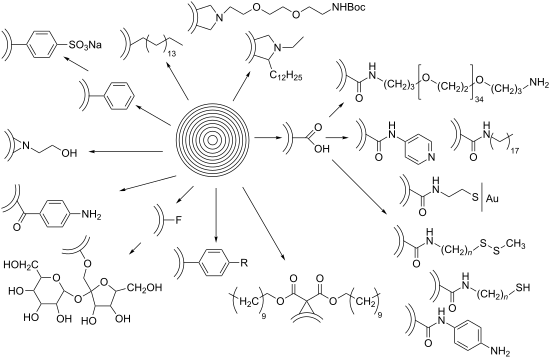
- product was well soluble in common organic solvents such as ethanol, chloroform and dichloromethane. Evidence for a successful CNO functionalization was derived from 1H NMR spectroscopy, MALDI mass spectrometry and elemental analysis. TEM suggested that the individual CNOs had diameters between 60 and 300
- , the authors estimated that approximately one pyridine functionality per 120 CNO surface carbon atoms was present. The pyridine groups were then decorated with Zn-tetraphenylporphyrin (ZnTPP) what was confirmed by NMR spectroscopy and electrochemistry. No further spectroscopic studies were carried out
- well as Raman spectroscopy were used to verify the successful alkylation of the CNOs. It was reported that the CNO-C16 exhibits an outstanding solubility in a multitude of organic solvents, even in high concentrations of up to 0.1 mg·mL−1. This high solubility enabled the use of 1H NMR spectroscopy


Visible light photooxidative performance of a high-nuclearity molecular bismuth vanadium oxide cluster
Beilstein J. Nanotechnol. 2014, 5, 711–716, doi:10.3762/bjnano.5.83

- proposed as a transient species with short lifetime using 51V NMR spectroscopy [46]. In the present case, the anion is electrostatically stabilized by four bismuth(III) ions which coordinate to binding pockets formed on the cluster surface, see Scheme 1. Initial photocatalytic studies using the


Controlled synthesis and tunable properties of ultrathin silica nanotubes through spontaneous polycondensation on polyamine fibrils
Beilstein J. Nanotechnol. 2013, 4, 793–804, doi:10.3762/bjnano.4.90
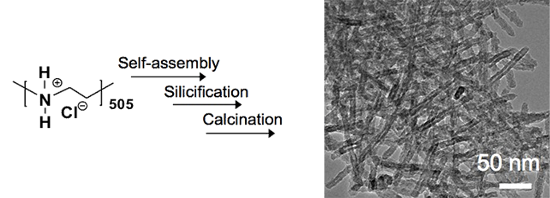
- -MAS NMR spectroscopy, and the spectra were recorded on a JEOL-400 MHz NMR spectrometer. Raman spectra were recorded with a Renishaw Raman imaging microscope. Radiation of 514 nm from an Ar-ion laser was used as the excitation source. The photoluminescence (phosphorescence) spectra of silica


New hybrid materials based on poly(ethyleneoxide)-grafted polysilazane by hydrosilylation and their anti-fouling activities
Beilstein J. Nanotechnol. 2013, 4, 671–677, doi:10.3762/bjnano.4.75
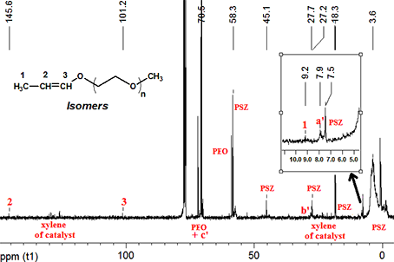
- kinetics and yields of this reaction have been surveyed by 1H and 13C NMR spectroscopy. The PEO grafting-density onto PSZ by hydrosilylation increases with a reduction of the S–H/allyl ratio and a decrease of the PEO chain-length. The PEO-graft-PSZ (PSZ-PEO) hybrid coatings, which can be used to prevent
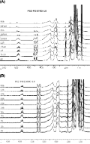
- 13C NMR spectroscopy. Figure 2 shows the 1H NMR and 13C NMR spectra of the mixture of the reactants and of the grafting products. In Figure 1 and in Scheme 2, it is found that the structure of the grafted group ≡Si–CH2–CH2–CH2–O– of PSZ-PEO is very close to that of the group ≡Si–CH2–CH2–CH2–N– of the





Preparation of electrochemically active silicon nanotubes in highly ordered arrays
Beilstein J. Nanotechnol. 2013, 4, 655–664, doi:10.3762/bjnano.4.73
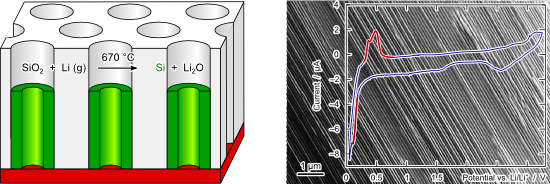
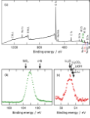
- appearance turns to a lustrous black (Figure 5a). The conversion can be monitored by magic angle spinning nuclear magnetic resonance (MAS NMR) spectroscopy. In the 29Si MAS NMR spectrum of an ALD sample (step (d) of Figure 2), a resonance is observed at −108.4 ppm (Figure 5b), which can be assigned to 'Q





Zeolites as nanoporous, gas-sensitive materials for in situ monitoring of DeNOx-SCR
Beilstein J. Nanotechnol. 2012, 3, 667–673, doi:10.3762/bjnano.3.76
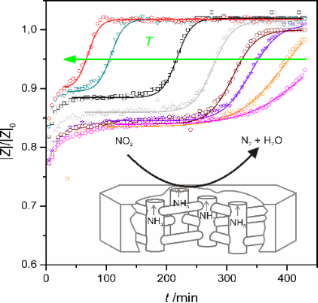
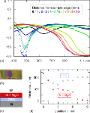
- can be measured by different measuring techniques, such as infrared (IR) spectroscopy [2], NMR spectroscopy [3], thermal analysis [4][5][6] and indicator method [7], as well as the amine titration method [8] and temperature-programmed desorption of ammonia (NH3-TPD) [9][10][11]. H-form zeolites are


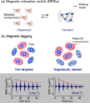
Magnetic nanoparticles for biomedical NMR-based diagnostics
Beilstein J. Nanotechnol. 2010, 1, 142–154, doi:10.3762/bjnano.1.17
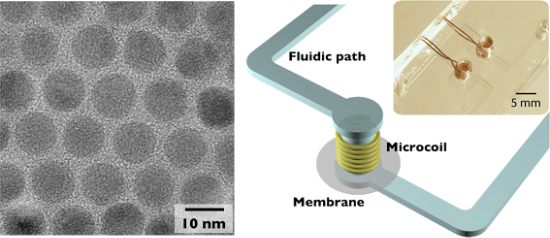
- systems Nuclear magnetic resonance (NMR) can be detected with instruments such as clinical MRI scanners (routinely used for deep tissue whole body imaging), and NMR spectroscopy (used to study proteins and small molecules). Both of these techniques have been used to measure T2 relaxation time for DMR