Search results
Search for "Ostwald ripening" in Full Text gives 61 result(s) in Beilstein Journal of Nanotechnology.
Oriented attachment explains cobalt ferrite nanoparticle growth in bioinspired syntheses
Beilstein J. Nanotechnol. 2014, 5, 210–218, doi:10.3762/bjnano.5.23
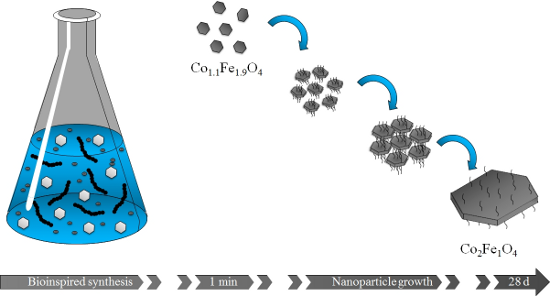
- particle diameter. At the same time the larger maximum shifts to an increased diameter Dlarge = 40 nm. Tailing can now be observed in the size distribution as well, indicating that Ostwald ripening occurs in the later stages of particle growth. The diminishing amount of smaller nanoparticles and the
- kinetic model for oriented attachment (OA) described by Zhang et al. [24] with Ostwald ripening (OR) dominating the later stage of nanoparticle growth. The change in diameter with time can be modelled by the proposed model [24] with d0 as the initial particle size and k1 = 3.4 × 10⁻⁵ s−1 as an oriented
- attachment kinetic reaction constant between two particles, dOR as the particle diameter at which Ostwald ripening starts, d as the particle diameter with time, k2 = 6.11 Å3 s−1 as the rate constant and t as the time. The vanishing smaller maximum in the size distribution (see Figure 2) is a further


Design criteria for stable Pt/C fuel cell catalysts
Beilstein J. Nanotechnol. 2014, 5, 44–67, doi:10.3762/bjnano.5.5
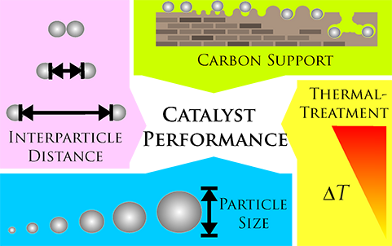
- platinum (Gibbs–Thomson effect) [14][15]. If the dissolved platinum is redeposited on larger platinum particles, significant particle growth can occur and the according degradation mechanism is called Ostwald ripening (3D Ostwald ripening, if the dissolved platinum species travel through the electrolyte
- , and 2D Ostwald ripening – as known from high temperature TEM studies in the absence of an electrolyte – if platinum atoms are believed to diffuse along the carbon support) [44][45][47][48]. Another possible explanation for the growth of platinum particles in the catalyst layer is coalescence [17][49
- phenomena such as Ostwald ripening or platinum deposition in the ionomer. Much of the up-to-date knowledge on degradation mechanisms of standard fuel cell catalysts has been derived from post-mortem analyses of membrane electrode assemblies (MEAs) after fuel cell operation. Electron-microscopic techniques




Functionalization of vertically aligned carbon nanotubes
Beilstein J. Nanotechnol. 2013, 4, 129–152, doi:10.3762/bjnano.4.14
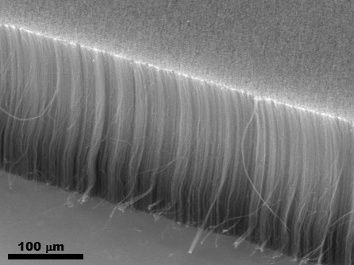
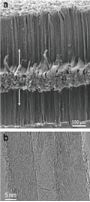
- prevented, extending the catalyst lifetime [50]. Another positive effect of the use of the oxidant is the inhibition of Ostwald ripening if injected during the annealing treatment of the catalyst film; the Ostwald ripening causes the formation of large particles thus reducing the yield of the CNT synthesis








STM study on the self-assembly of oligothiophene-based organic semiconductors
Beilstein J. Nanotechnol. 2011, 2, 802–808, doi:10.3762/bjnano.2.88
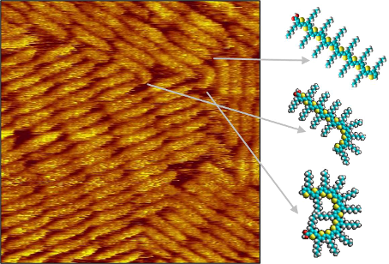
- shorter oligomers. This phenomenon can be explained by a decrease in diffusivity as the size of the oligomers increase. However, the adsorption–desorption dynamics at the surface and the observed Ostwald ripening [21][22] lead to an almost perfect monolayer with time. The arrangement of the molecules


Generation and agglomeration behaviour of size-selected sub-nm iron clusters as catalysts for the growth of carbon nanotubes
Beilstein J. Nanotechnol. 2011, 2, 734–739, doi:10.3762/bjnano.2.80
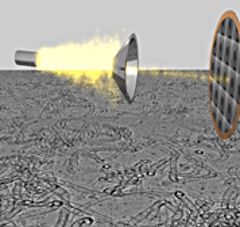
- parameters, led to an agglomeration of the small sub-nm iron clusters to form iron nanoparticles and hence allowing their subsequent detection under the microscope (Figure 2). This cluster growth process occurs by Ostwald ripening, which takes place as a fast process in a matter of minutes at this
- temperature [14]. Our findings are in accordance with the stability of size-selected Au clusters pinned on graphite for which strong cluster agglomeration above 600 °C was shown [11], indicating that a combination of diffusion controlled agglomeration and Ostwald ripening of Fe clusters becomes significant at


Formation of SiC nanoparticles in an atmospheric microwave plasma
Beilstein J. Nanotechnol. 2011, 2, 665–673, doi:10.3762/bjnano.2.71
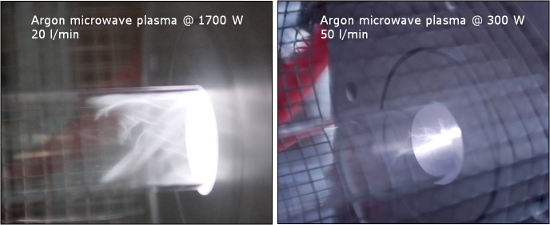
- sizes ranging from 7 nm to about 20 nm according to BET and XRD measurements are produced. The dependency of the particle size on the process parameters is evaluated statistically and explained with growth-rate equations derived from the theory of Ostwald ripening. The results show that the particle
- equation describes the growth rate of larger particles, which is known as Ostwald ripening, resulting in the well-known log-normal distribution of the particle sizes. Taking into account, that D = ƒ(1 = ptotal, Tx), with 1 ≤ x ≤ 2, one can give the following proportionalities for the growth rate of a



Ceria/silicon carbide core–shell materials prepared by miniemulsion technique
Beilstein J. Nanotechnol. 2011, 2, 638–644, doi:10.3762/bjnano.2.67
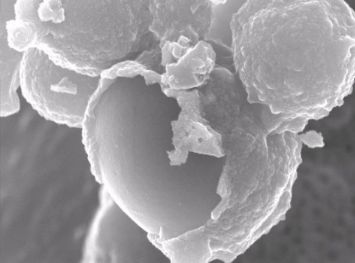
- -water) miniemulsion, with the monomer as the dispersed oil phase. The nanodroplets are generated by shearing this system with ultrasound. A highly hydrophobic osmotic pressure agent (costabilizer) is added to the oil phase, effectively suppressing diffusional degradation (Ostwald ripening) of the


Inorganic–organic hybrid materials through post-synthesis modification: Impact of the treatment with azides on the mesopore structure
Beilstein J. Nanotechnol. 2011, 2, 486–498, doi:10.3762/bjnano.2.52
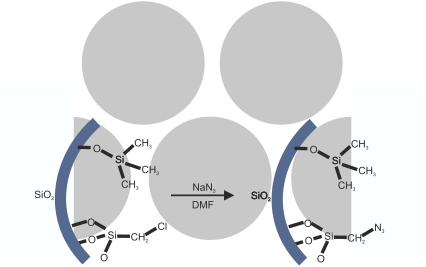
- 100 °C in an autoclave yields mesoporous silica gels with larger pore sizes and pore volumes compared to gels aged in ethanol at room temperature due to promoted dissolution and reprecipitation processes [20]. Processes such as syneresis, Ostwald ripening, etc., are facilitated and accelerated with


Platinum nanoparticles from size adjusted functional colloidal particles generated by a seeded emulsion polymerization process
Beilstein J. Nanotechnol. 2011, 2, 459–472, doi:10.3762/bjnano.2.50
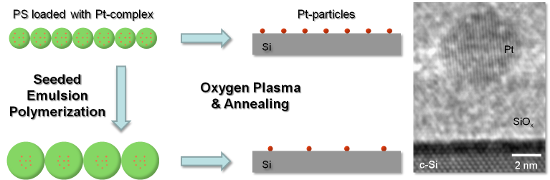
- nanoparticles [17][18][19][20]. Here, the monomer droplets are preformed by ultrasonication and critically stabilized against coagulation by the addition of surfactants. Ostwald ripening, the mechanism that leads to formation of bigger particles at the expense of smaller ones due to the higher Laplace pressure



Flash laser annealing for controlling size and shape of magnetic alloy nanoparticles
Beilstein J. Nanotechnol. 2010, 1, 55–59, doi:10.3762/bjnano.1.7
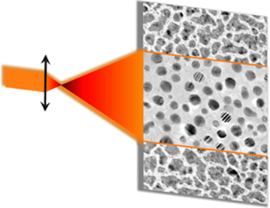
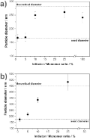
- are then more effective on the biggest particles leading to the reduction of the particle size and polydispersity (Table 1). This process can be described, as an “inverse” Ostwald ripening [28], since energetic factors cause small NPs to grow, drawing materials from the bigger clusters, which shrink


Preparation and characterization of supported magnetic nanoparticles prepared by reverse micelles
Beilstein J. Nanotechnol. 2010, 1, 24–47, doi:10.3762/bjnano.1.5
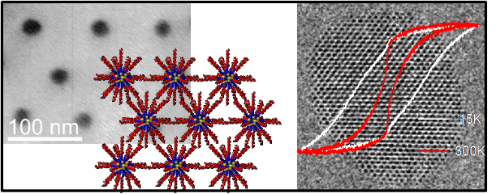
- supported particles could be annealed up to 700 °C without losing their positional order, i.e., no Ostwald ripening was observed. A last remark addresses the effect of the hydrogen plasma treatment on NPs with a propensity for hydride formation such as in case of Co. Though the consequences of CoHx