Search results
Search for "PVDF" in Full Text gives 60 result(s) in Beilstein Journal of Nanotechnology.
Carbon nanotube-wrapped Fe2O3 anode with improved performance for lithium-ion batteries
Beilstein J. Nanotechnol. 2017, 8, 649–656, doi:10.3762/bjnano.8.69
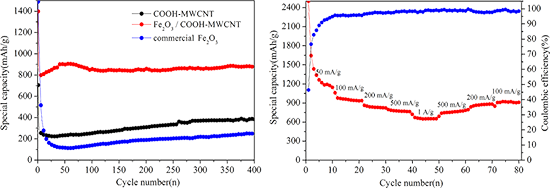
- %), conductive carbon black (Super P, 20 wt %) and polyvinylidene fluoride (PVDF, 10 wt %) were mixed in N-methyl-2-pyrrolidone to form a uniform slurry that was and stirred for 6 h. The slurry was spread on to the surface of a copper foil using a medical blade. The casted film was heated at 110 °C for 12 h in a


From lithium to sodium: cell chemistry of room temperature sodium–air and sodium–sulfur batteries
Beilstein J. Nanotechnol. 2015, 6, 1016–1055, doi:10.3762/bjnano.6.105
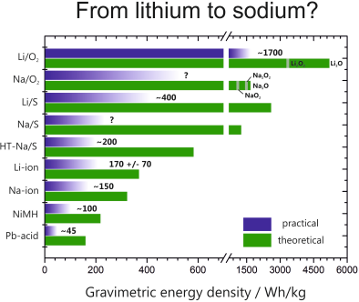
- electrode. Black et al. exposed battery components to potassium superoxide dissolved in aprotic liquids and found that polyvinylidene fluoride (PVDF), a common binder material, decomposes while lithium fluoride (LiF) is formed [81]. They suggest that LiO2, a strong base that is formed as an intermediate in
- a Li/O2 cell, extracts protons from the PVDF polymer. From the thermodynamic point of view, carbon is also reactive towards, for example, Li2O2 or oxygen at high oxidative potentials, too. For this purpose McCloskey et al. employed a 13C carbon electrode and monitored CO2 species via DEMS evolved


Hybrid spin-crossover nanostructures
Beilstein J. Nanotechnol. 2014, 5, 2230–2239, doi:10.3762/bjnano.5.232
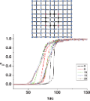
- deposited on the gold and the graphite substrates where the ferroelectric PVDF–TrFE film was poled “down”. However, if the interfacial dipoles of the PVDF–TrFE film are poled “up” instead, the characteristic inverse photoemission (IPES) signature of the SCO complex in the HS form persists down to 100 K
- layer of [Fe(H2B(pz)2(bipy)] deposited on PVDF–TrFE poled “up” (red) and “down” (blue). Each spectrum corresponds to the characteristic signature of the complex in the HS and LS form, respectively. Adapted with permission from [35], copyright 2014 The Royal Society of Chemistry. Thermal SCO curves for



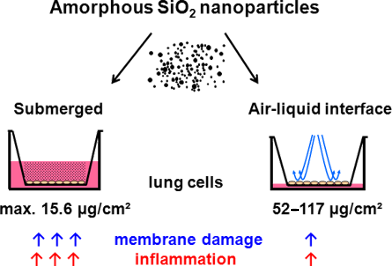
Silica nanoparticles are less toxic to human lung cells when deposited at the air–liquid interface compared to conventional submerged exposure
Beilstein J. Nanotechnol. 2014, 5, 1590–1602, doi:10.3762/bjnano.5.171
- (OptEIA kits, Heidelberg, Germany). 4-(2-Hydroxyethyl)piperazine-1-ethanesulfonic acid (HEPES) and the chemicals for sodium dodecylsulfate polyacrylamide gel electrophoresis (SDS-PAGE) were from Carl Roth (Karlsruhe, Germany). For the Western blots Immobilon-P PVDF membranes (Millipore, Eschborn, Germany
- for 15 s and then stored at −20 °C. Equal amounts of the lysates were loaded onto 10% SDS-polyacrylamide gels and after electrophoresis, the proteins were transferred onto Immobilon-P PVDF membranes. The membranes were blocked with 5% (w/v) non-fat dry milk in 1% Tween20 in Tris-buffered saline (TBS


Magnesium batteries: Current state of the art, issues and future perspectives
Beilstein J. Nanotechnol. 2014, 5, 1291–1311, doi:10.3762/bjnano.5.143
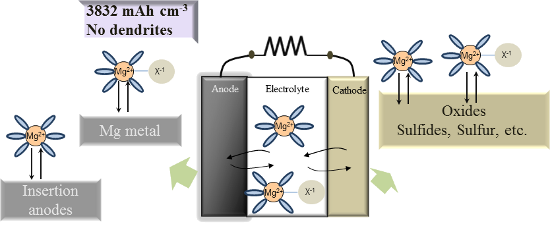
- electrolyte in polymeric matrices such as poly(vinylene difluoride) PVDF and poly(ethylene oxide) PEO, was reported by Chusid et al. [36]. The group impregnated magnesium organohalo-aluminate salts, such as Mg(AlCl2EtBu)2 dissolved in tetrahydrofuran and tetraglyme, in both PEO and PVDF matrices. These
- complex solutions were found to be inert towards the polymers used and reversible magnesium deposition/stripping from these gel electrolytes was shown. The best electrochemical performance reported was for the Mg(AlCl2EtBu)2/tetraglyme/PVDF gel as high specific conductivity (3.7 mS cm−1 at 25 °C) was


Synthesis and electrochemical performance of Li2Co1−xMxPO4F (M = Fe, Mn) cathode materials
Beilstein J. Nanotechnol. 2013, 4, 860–867, doi:10.3762/bjnano.4.97
- consisted of Al2O3/C/PVdF in a ratio of 80/10/10, in order to imitate the effect of the carbon- and binding electrode components at high potentials. Because the loading mass and the effective surface area of the active material on the electrodes that were used for electrolyte testing were similar in all
- -configuration cells with Li-metal foil acting both as the reference and counter electrodes, borosilicate glass was used as a separator. The positive electrodes were prepared by thoroughly mixing the active material (80 wt %) with carbon Timcal Super C (10 wt %) and PVdF (10 wt %) dissolved in a minimal amount
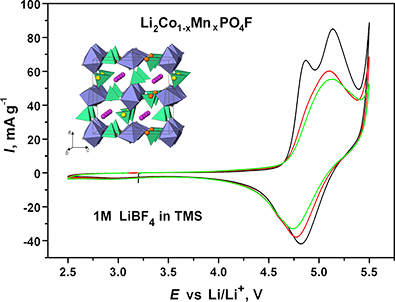
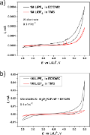
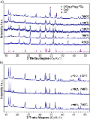
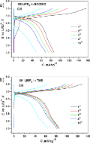
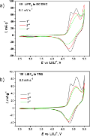
- 3D-Li2MPO4F, positions of Li atoms are denoted. Cyclovoltammetry curves (first cycle) of 1 M LiPF6 in EC/DMC (black) and 1 M LiBF4 in TMS (red) at scan rate of 0.1 mV·s−1. (a) Aluminum electrode, (b) idle electrode consisting of Al2O3/C/PVdF in an 80/10/10 ratio. Powder XRD patterns of Li2CoPO4F/C (a



Influence of particle size and fluorination ratio of CFx precursor compounds on the electrochemical performance of C–FeF2 nanocomposites for reversible lithium storage
Beilstein J. Nanotechnol. 2013, 4, 705–713, doi:10.3762/bjnano.4.80
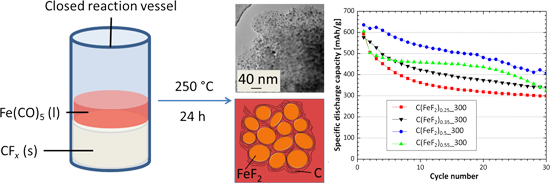
- and polyvinylidene fluoride (PVDF) in the mass ratio 90:10. A slurry containing the above mixture was prepared by using N-methyl-2-pyrrolidinone. It was spread on a stainless steel (SS) foil (area: 1.13 cm2) and dried on hot plate at 160 °C for 12 h. Typically, each electrode contained 3–4 mg of


Electrochemical and electron microscopic characterization of Super-P based cathodes for Li–O2 batteries
Beilstein J. Nanotechnol. 2013, 4, 665–670, doi:10.3762/bjnano.4.74
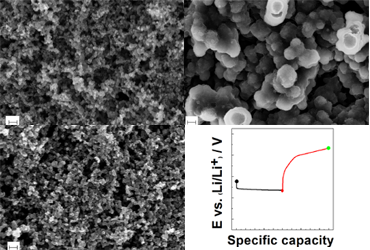
- cells were prepared by airbrushing a suspension of Super-P (Timcal) and polyvinylidene fluoride (PvdF) in N-methyl-2-pyrrolidone (mass ratio Super-P/PvdF 8:2) on a gas diffusion layer (Toray paper). The obtained electrodes of 12 mm in diameter were first dried at 100 °C in order to allow the evaporation


AFM as an analysis tool for high-capacity sulfur cathodes for Li–S batteries
Beilstein J. Nanotechnol. 2013, 4, 611–624, doi:10.3762/bjnano.4.68
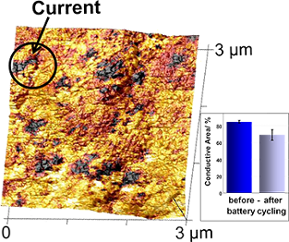
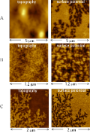
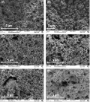
- samples prepared by either suspension-spraying or doctor-blade coating with different binders. Morphological studies of the cathodes before and after the electrochemical tests were performed by using AFM and scanning electron microscopy (SEM). The cathodes that contained polyvinylidene fluoride (PVDF) and
- ]. Polyvinylidene fluoride (PVDF) and carboxymethyl cellulose (CMC) binders were used to test the influence of the binders on the battery performance. The suspension-spraying technique is advantageous because it can be used in mass production processes. In a first step the focus was on the preparation of a porous
- the battery, whose cathode was coated by hand (doctor-blade coated, referred to as DBC-PVDF), has a high initial discharge capacity (872 mAh·g−1), the capacity decreases significantly upon cycling. After 50 cycles, the remaining capacity is only 242 mAh·g−1. This behaviour is quite typical for the Li



Single-pass Kelvin force microscopy and dC/dZ measurements in the intermittent contact: applications to polymer materials
Beilstein J. Nanotechnol. 2011, 2, 15–27, doi:10.3762/bjnano.2.2
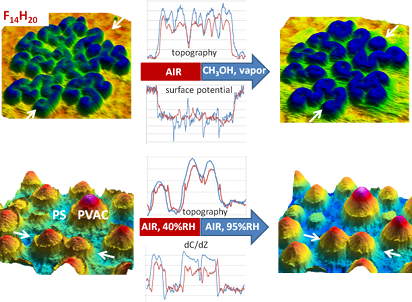
- ) (PVAC) were prepared from their solutions in toluene. A thin film of a blend of PMMA with poly(vinyledenefluoride) (PVDF) blend was spin cast from its solution in 1-methyl-2-pyrrolidinone. The polymers with molecular weights in the 100–150 K range, solvents and ITO glass substrates were purchased from
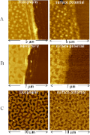
- thin film of a PMMA and PVDF blend. The relation between the polymer morphology and material performance is the key question for polymer technology that reinforces the importance of compositional imaging. The film was prepared by spin-casting of PMMA and PVDF solutions, and the blend was formed during
- evaporation of the solvent and crystallization of PVDF. Therefore, dendritic structures observed on film surface represent crystalline PVDF. The dark surface potential contrast of the structures is consistent with the presence of a molecular dipole (~2.1 V) in this polymer and the preferential orientation of